As privacy coins continue to evolve, one challenge has remained largely hidden from everyday users: exchange integration.
Many people assume privacy coins struggle with adoption because of regulations or market demand. While those factors play a role, there’s another issue that often goes unnoticed—technical complexity.
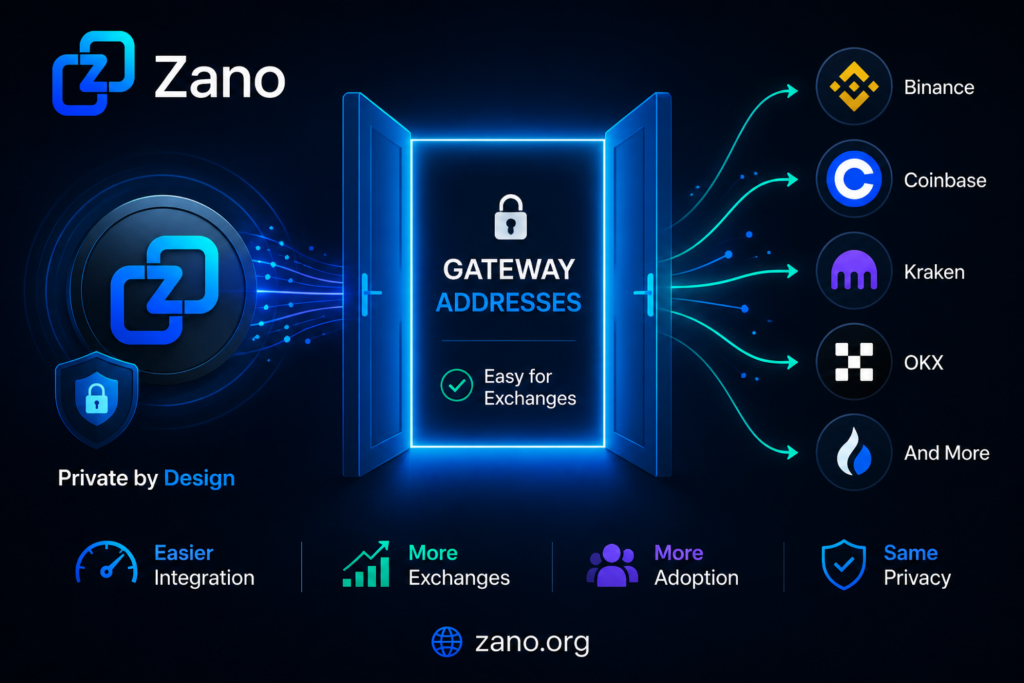
Zano’s upcoming Gateway Addresses, arriving with Hard Fork 6, aim to solve one of the biggest engineering challenges that has made integration more difficult for exchanges and other blockchain services.
Table of Contents
- The Hidden Barrier to Adoption
- Why Zano Was Harder to Integrate
- What Are Gateway Addresses?
- Why Exchanges Will Like Them
- Privacy Still Comes First
- What This Could Mean for Zano
- Learn More
- Sources
1. The Hidden Barrier to Adoption
When people think about privacy coins, they often focus on anonymity.
But for exchanges, wallets, bridges, and payment platforms, the biggest concern is much simpler:
Can we integrate this blockchain easily?
Most crypto infrastructure today was originally designed around blockchains like Ethereum, where wallet balances are simple to read and update.
Privacy-focused blockchains like Zano use a different architecture, making integration more challenging for developers.
2. Why Zano Was Harder to Integrate
Unlike Ethereum, Zano doesn’t store your funds as one simple account balance.
Instead, your balance is made up of multiple transaction outputs created over time.
Imagine the difference between:
- A bank account — you simply check the balance.
- A jar filled with coins — you count every coin to know how much you have.
Both tell you the same answer, but one takes much more work.
For exchanges processing thousands of deposits every day, that additional work meant writing custom software specifically for Zano.
For many companies, the extra engineering effort simply wasn’t worth it.
3. What Are Gateway Addresses?
Gateway Addresses are a new type of address being introduced with Zano Hard Fork 6.
They give exchanges and blockchain services a much simpler way to interact with the Zano network.
Instead of dealing with complex balance calculations, Gateway Addresses provide:
- A familiar account-style balance
- Easy deposit tracking
- Standard customer deposit references
- Simpler integration for exchanges and wallets
For developers who have already worked with Ethereum or similar blockchains, the process will feel much more familiar.
4. Why Exchanges Will Like Them
Gateway Addresses remove much of the custom engineering previously required to support Zano.
This means exchanges can:
- Reduce development time
- Lower integration costs
- Track customer deposits more easily
- Maintain standard operational workflows
By removing these technical barriers, adding Zano support becomes significantly easier than before.
5. Privacy Still Comes First
One important point is that Gateway Addresses do not reduce user privacy.
The Gateway Address itself is transparent, allowing exchanges to audit deposits and manage funds efficiently.
However, users continue to benefit from Zano’s built-in privacy technology during normal transactions.
In other words:
- Services get the transparency they need.
- Users keep the privacy they expect.
This balance is one of the key goals behind the feature.
6. What This Could Mean for Zano
Making integrations easier doesn’t guarantee new exchange listings—but it removes one of the biggest technical reasons why some platforms may have delayed supporting Zano.
Over time, Gateway Addresses could help:
- More centralized exchanges integrate Zano
- Additional wallets add support
- More bridges connect Zano with other blockchain ecosystems
- Developers build new applications more easily
Rather than changing what makes Zano unique, Gateway Addresses make its privacy technology more accessible to the businesses and developers building crypto infrastructure.
If adoption grows, this upgrade could become one of the most important additions introduced in Hard Fork 6.
7. Learn More
Gateway Addresses are expected to launch as part of Zano Hard Fork 6 and are designed to make the network easier for exchanges, wallets, bridges, and other blockchain services to integrate—while preserving the privacy that defines Zano.
To learn more about Zano and upcoming network upgrades, visit:
Disclaimer: ZanoNews.com is an independent news and information website. This article is for informational purposes only and does not constitute financial or investment advice.
4 thoughts on “How Gateway Addresses Could Bring Zano to More Exchanges”
Comments are closed.