
The Zano team recently shared an important message about fungibility—a key feature that every form of money should have.
Simply put, every coin should be worth the same and be accepted equally, regardless of who owned it before. Zano believes that privacy is essential to making this possible.
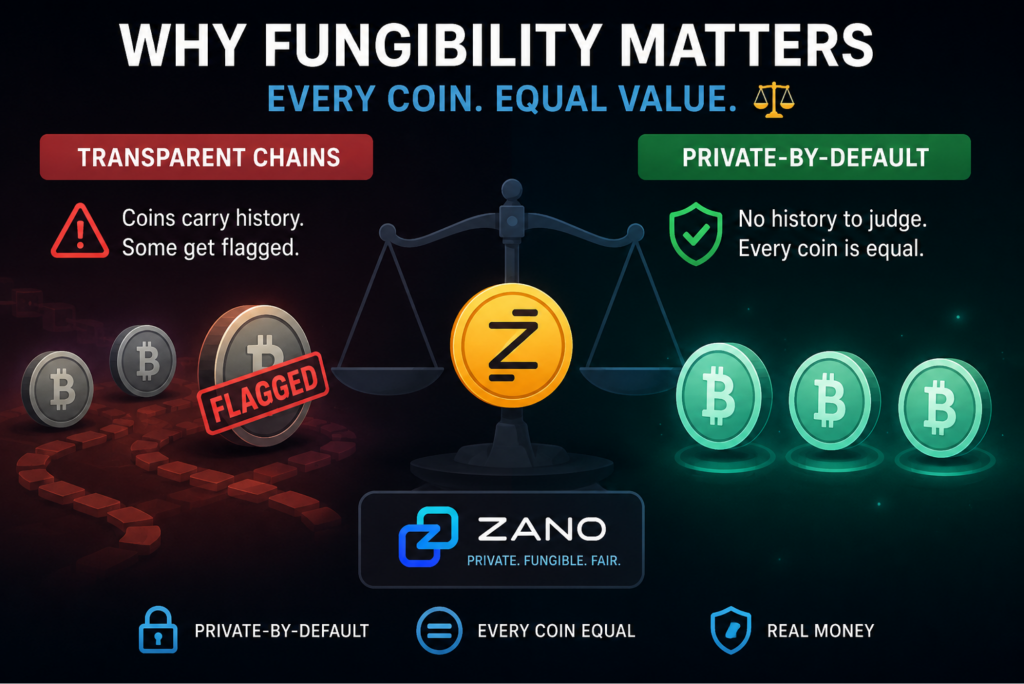
Table of Contents
1. What Is Fungibility?
Fungibility means that every unit of money is equal.
For example, if someone gives you 1 BTC, it should have the same value and be accepted just like any other 1 BTC. The history of that coin shouldn’t affect whether you can use it.
This is one of the fundamental qualities of money.
2. The Problem with Transparent Blockchains
On transparent blockchains, every transaction is publicly recorded.
This means a coin carries its transaction history wherever it goes. If it was previously linked to suspicious activity, some exchanges or services may flag or reject it—even if the current owner had nothing to do with that history.
As a result, not every coin is always treated equally.
3. How Privacy Helps
Privacy-by-default changes this.
By keeping transaction details private, coins cannot easily be judged by their past history. Instead, every unit remains interchangeable, helping preserve the principle of fungibility.
This allows digital money to function more like physical cash, where one unit is treated the same as another.
4. Why It Matters
Fungibility is one of the foundations of a fair financial system. When every coin is treated equally, users don’t have to worry about the history of the funds they receive. For Zano, privacy is more than just protecting personal information—it’s about ensuring digital money remains fair, equal, and usable for everyone.
To learn more, visit:
Disclaimer: ZanoNews.com is an independent news and information website. This article is for informational purposes only and should not be considered financial, investment, or legal advice.