
On July 15, 2025, the Zano team explained how the network’s token supply is designed to change as adoption grows. Unlike many cryptocurrencies that continually increase their supply, Zano combines a fixed block reward with transaction fee burns that can eventually offset new coin issuance.
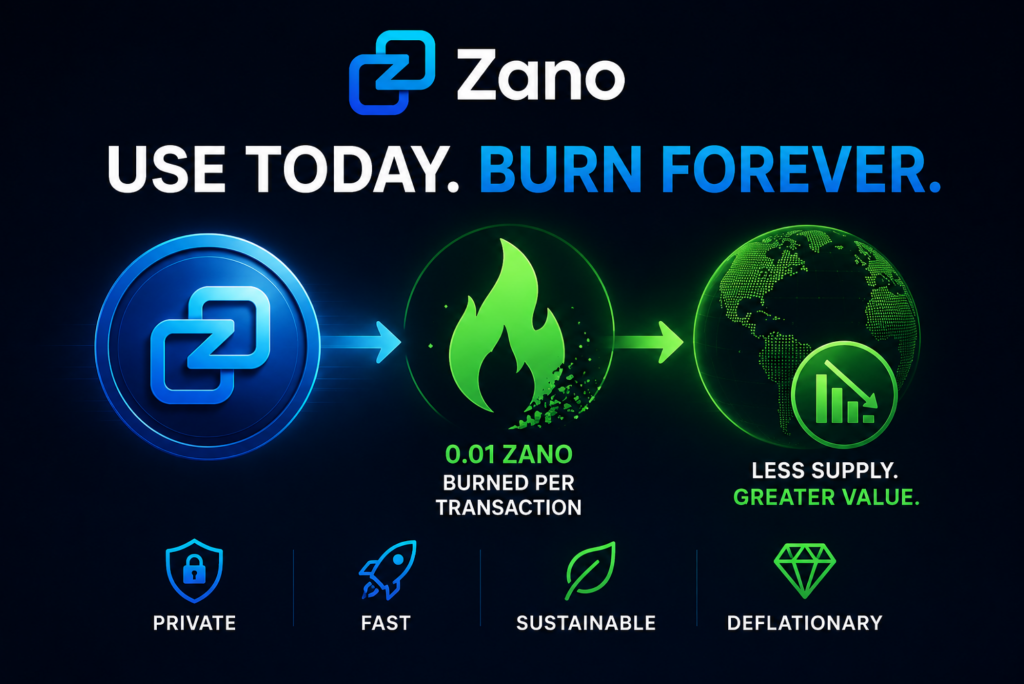
Table of Contents
- Introduction
- How Zano Creates New Coins
- How Zano Burns Coins
- When Does Inflation Reach Zero?
- What Happens if Network Usage Increases?
- Why This Matters
- Learn More About Zano
- Source
1. Introduction
Many cryptocurrencies increase their circulating supply over time through mining or staking rewards. This process is known as inflation because more coins enter circulation.
Zano takes a different approach. While new ZANO coins are created through block rewards, every transaction also permanently removes a small amount of ZANO from circulation. As network usage grows, the number of coins burned increases, helping reduce inflation over time.
2. How Zano Creates New Coins
New ZANO enters circulation through block rewards.
The network is designed to produce:
| Network Activity | Amount |
|---|---|
| Block reward | 1 ZANO |
| Block time | 1 minute |
| New ZANO created each day | Approximately 1,440 ZANO |
This emission remains consistent, providing predictable issuance for the network.
3. How Zano Burns Coins
Every transaction on the Zano network permanently burns part of the transaction fee.
Specifically:
- Each transaction burns 0.01 ZANO.
- Burned coins are permanently removed from circulation.
- The more transactions processed by the network, the more ZANO is burned.
Unlike the block reward, which remains relatively constant, the number of coins burned depends entirely on network activity.
4. When Does Inflation Reach Zero?
According to the Zano team, the network reaches net zero inflation when the amount of ZANO burned equals the amount of new ZANO created.
This happens at approximately:
| Daily Transactions | Network Effect |
|---|---|
| Around 144,000 | Burned coins equal newly created coins |
| Above 144,000 | More ZANO is burned than created |
At this point, transaction fee burns completely offset the daily block rewards.
5. What Happens if Network Usage Increases?
If daily transaction volume continues to grow beyond approximately 144,000 transactions, the network begins removing more ZANO from circulation than it creates.
This is known as a deflationary supply, where the total supply gradually decreases over time.
Rather than relying on scheduled token burns, Zano’s supply becomes increasingly influenced by real network usage. As more people use the blockchain, more transaction fees are burned.
6. Why This Matters
Zano’s tokenomics are designed so that network activity directly affects the coin’s supply.
Instead of having inflation that continually increases circulating supply, transaction fee burns help reduce inflation as adoption grows. If network usage becomes high enough, the blockchain can transition from inflationary to deflationary.
This approach links the long-term supply of ZANO to actual blockchain activity rather than fixed issuance alone.
7. Learn More About Zano
If you’re new to the Zano ecosystem, visit the official website to learn more about its privacy-focused blockchain, ecosystem, and latest developments:
8. Source
Official Zano Announcement on X
Disclaimer: ZanoNews.com is an independent news and information website. This article is for informational purposes only and should not be considered financial, investment, or legal advice.