
Crypto assets like Bitcoin and Ethereum are useful, but their transactions are normally visible on public blockchains. Confidential Layer offers a way to bring these assets into Zano and give them the privacy features of the Zano blockchain.
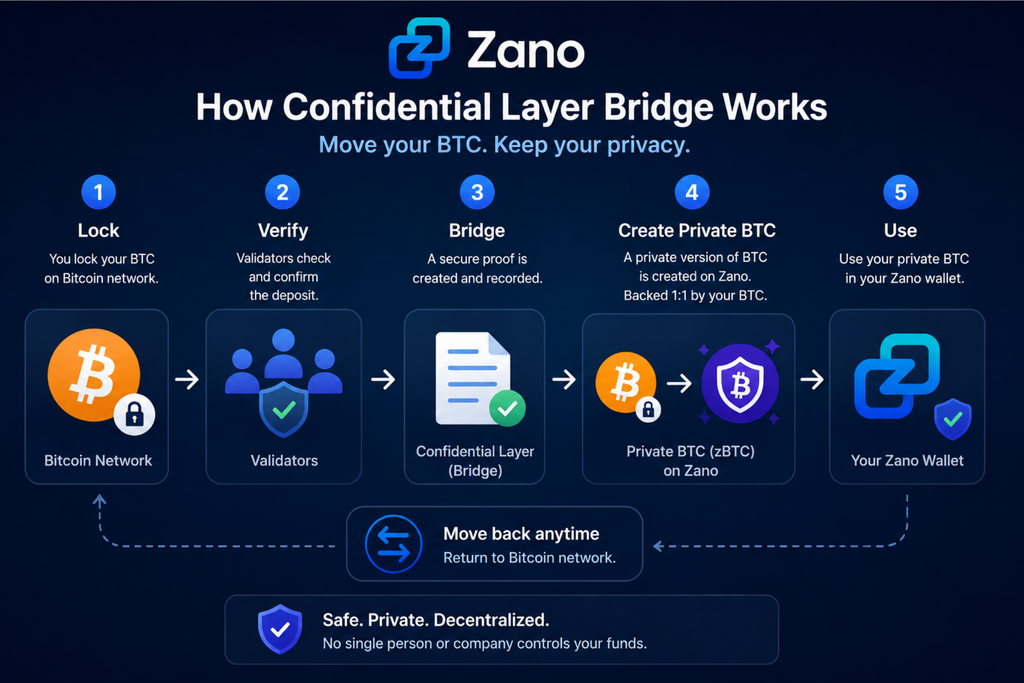
But how does it actually work? 👇
Table of Contents
- What Is Confidential Layer?
- How Does the Bridge Work?
- How Are the Funds Kept Safe?
- What Do You Receive on Zano?
- Why Does This Matter?
1. What Is Confidential Layer?
Confidential Layer is a decentralized, non-custodial bridge that connects public blockchains such as Bitcoin and Ethereum with privacy-focused blockchains like Zano.
In simple terms, it lets you take an asset such as BTC or ETH from its original blockchain and create a private version of that asset on Zano.
For example:
BTC → Confidential Layer → BTCx on Zano
The original asset remains locked on its native blockchain, while the Zano version is backed 1:1 by that locked asset.
2. How Does the Bridge Work?
Let’s use Bitcoin (BTC) as a simple example.
First, the user locks BTC on the Bitcoin network. The bridge’s validators detect the deposit and create a cryptographic proof, known as a witness, confirming that the deposit happened.
That information is then recorded on the Bridgeless blockchain, which powers Confidential Layer.
Once the deposit is verified, the system can authorize the creation of the private version of Bitcoin on Zano.
The process can be simplified to:
1. Lock BTC → 2. Verify the deposit → 3. Create the private version → 4. Send it to your Zano wallet
The result is BTCx, a private version of Bitcoin that can be used within the Zano ecosystem.
3. How Are the Funds Kept Safe?
Confidential Layer does not rely on one company or person holding everyone’s funds.
Instead, it uses a network of validators and threshold signatures. In simple terms, the signing power is divided between multiple participants.
A minimum number of validators must work together to approve a withdrawal. No single validator has the complete private key needed to control the locked funds. Zano states that the bridge requires 66% of validators to sign transactions.
This distributed approach means there is no single central authority holding the assets.
4. What Do You Receive on Zano?
Once the deposit has been verified, the bridge creates a wrapped version of the original asset on Zano.
For example:
These assets are backed 1:1 by the original assets locked on their native blockchains. On Zano, they can benefit from Zano’s privacy features, including hidden transaction amounts and addresses.
You can then use the private version on Zano and, when needed, move it back and receive the original asset.
5. Why Does This Matter?
Normally, using Bitcoin or Ethereum means accepting that your transaction history can be publicly visible.
Confidential Layer offers another option: keep exposure to the original asset while using it in a more private environment.
You don’t have to exchange your Bitcoin for ZANO just to get privacy. You can bridge the Bitcoin itself and receive BTCx on Zano.
That creates a simple combination:
Your asset + Zano’s privacy + the ability to move back when needed.
Confidential Layer is therefore designed to connect the open crypto world with Zano’s private ecosystem, giving users more choice over how they use their digital assets.
Sources:
Disclaimer: ZanoNews.com is an independent news and information website. This article is for informational purposes only and does not constitute financial or investment advice.
2 thoughts on “How Does the Confidential Layer Bridge Work?”
Comments are closed.