
From Bitcoin’s Original Vision to Zano’s Private Digital Economy 🔐

Bitcoin started with a simple idea: people should be able to send money directly to each other without needing a bank in the middle.

But Bitcoin transactions are publicly recorded, meaning wallet addresses, amounts and transaction history can be analysed. Zano takes a different approach by making privacy part of the network from the beginning.
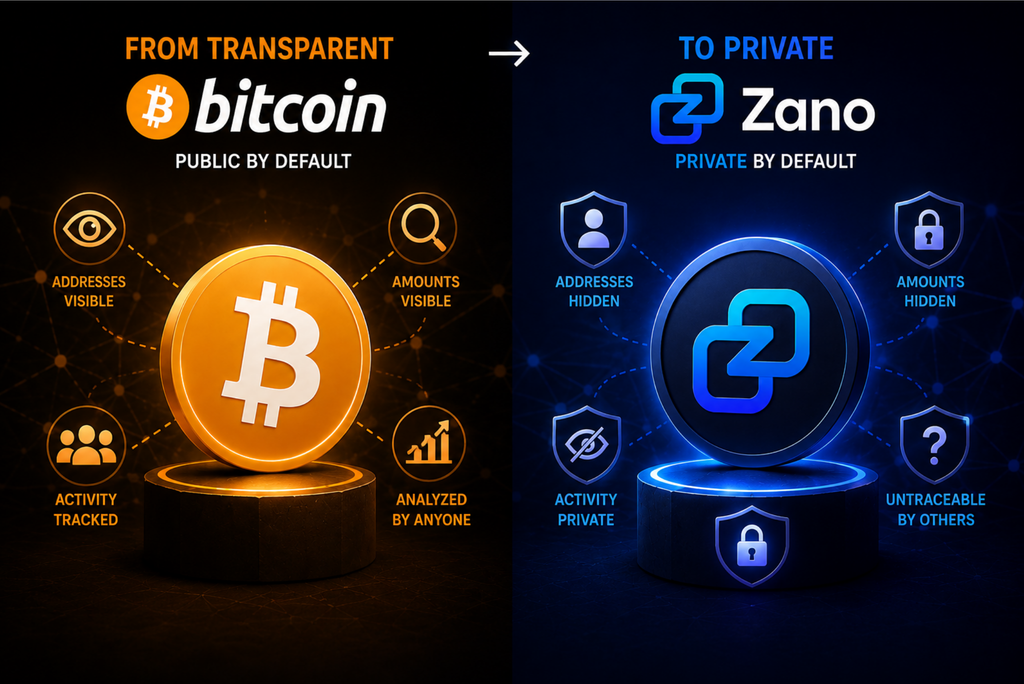
🎥 From Bitcoin’s Original Vision to Zano’s Private Digital Economy 👇

Table of Contents

  1. Bitcoin’s Original Idea
  2. What Changed Over Time?
  3. Why Privacy Matters
  4. What Makes Zano Different?
  5. More Than Just Private Payments
  6. From Bitcoin to Private Digital Assets
  7. Why This Matters

1. Bitcoin’s Original Idea

When Bitcoin was introduced in 2008, its goal was to create peer to peer electronic cash.

In simple terms, that means one person could send digital money directly to another person without relying on a bank or other middleman.

That idea changed how people thought about money and financial control.

2. What Changed Over Time?

Bitcoin has grown far beyond its early use as digital cash.

Today, many people see Bitcoin primarily as a long term investment or digital store of value.

Bitcoin itself still works as a peer to peer network, but its public blockchain creates an important difference from traditional cash:

Bitcoin transactions can be viewed and analysed by anyone.

Wallet addresses, transaction amounts and the movement of funds are recorded publicly.

For users who value financial privacy, this can be a serious concern.

3. Why Privacy Matters

Imagine if every time you paid for something, anyone could look up:

  • How much you spent
  • Where your money came from
  • Where you sent it
  • How much money remained in your wallet

That is essentially the problem with transparent blockchains.

Your real name may not appear next to a wallet address, but activity can potentially be analysed and connected to people over time.

Zano was designed with a different approach.

4. What Makes Zano Different?

On Zano, privacy is enabled by default.

The network is designed to hide important transaction information, including:

  • The sender
  • The receiver
  • The amount
  • The type of asset being transferred

Instead of making users find and activate privacy tools themselves, Zano builds privacy directly into the blockchain.

This means privacy is part of the normal experience rather than an optional extra.

5. More Than Just Private Payments

Zano is not focused only on sending its native $ZANO coin.

The network also supports Confidential Assets, which are private digital tokens that can represent different types of value.

For example, Zano supports private versions of assets such as Bitcoin and other cryptocurrencies through its broader ecosystem.

This means the idea is bigger than simply creating a private cryptocurrency.

The goal is to build a private digital economy where different types of digital assets can be used while keeping transaction information confidential.

6. From Bitcoin to Private Digital Assets

One example is BTCx, a Bitcoin backed asset on Zano.

The basic idea is:

BTC → Zano → BTCx

Bitcoin can be brought into the Zano ecosystem and represented as BTCx, allowing users to benefit from Zano’s privacy features while maintaining exposure to Bitcoin.

We have explained this in more detail here:

👉 From Bitcoin to BTCx: A More Private Way to Use Bitcoin

This approach could give people another choice: keep exposure to familiar digital assets while using them in a more private environment.

7. Why This Matters

Bitcoin showed that digital money could work without a traditional bank sitting in the middle.

Zano is taking that idea in another direction by asking another important question:

Can digital money also give people greater control over their financial privacy?

For Zano, privacy is not an optional feature added later. It is part of the foundation of the network.

And with Confidential Assets, the idea goes beyond private payments toward a broader private digital economy.

Sources

Disclaimer: ZanoNews.com is an independent news and information website. This article is for informational purposes only and does not constitute financial or investment advice.
From Bitcoin to BTCx: A More Private Way to Use Bitcoin 🔐

Bitcoin was created with a simple idea: people should be able to send money directly to each other without a bank in the middle.

But Bitcoin transactions are public. Anyone can look at the blockchain and follow the history of a Bitcoin from one wallet to another.

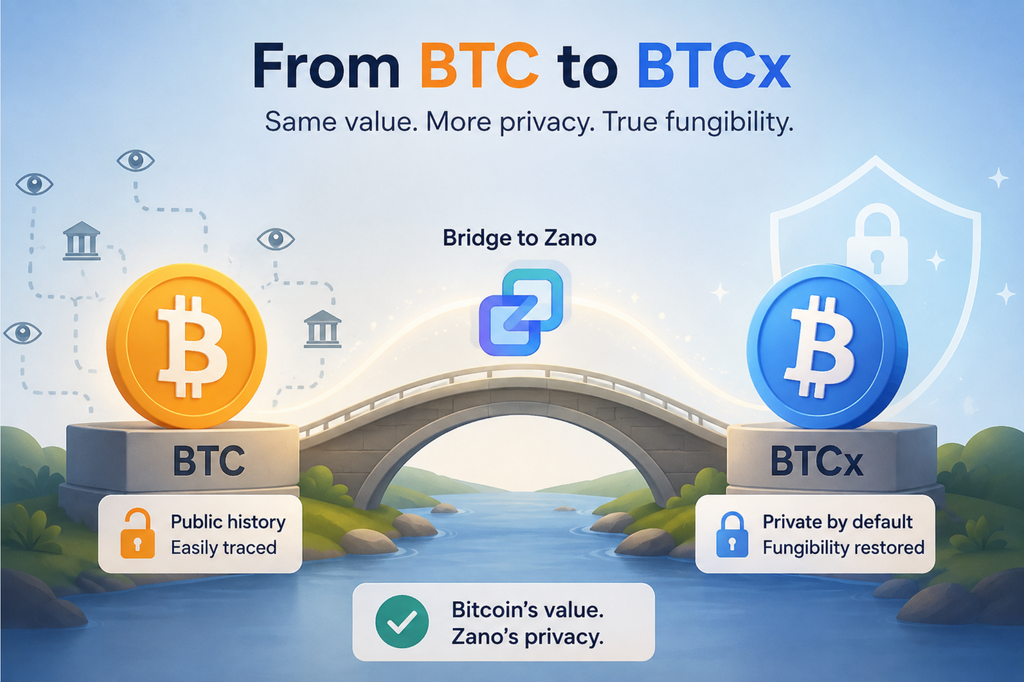
Zano is taking a different approach. By bridging Bitcoin (BTC) to Zano, users can receive BTCx, a Bitcoin-backed asset designed to provide greater privacy and restore fungibility.

Table of Contents

  1. What Does Fungibility Mean?
  2. Why Bitcoin’s History Matters
  3. What Is Confidential Layer?
  4. How BTCx Works
  5. What Makes BTCx Different?
  6. Why This Could Matter

1. What Does Fungibility Mean?

Fungibility simply means that one unit is equal and interchangeable with another unit of the same thing.

For example, if you have a €20 note and someone gives you another €20 note, you normally do not care which specific note you receive.

Money should ideally work the same way.

With Bitcoin, however, every transaction is recorded on a public blockchain. This means the history of individual coins can be tracked.

Zano argues that privacy is important for true fungibility because coins should not be treated differently based on where they have previously been.

2. Why Bitcoin’s History Matters

Bitcoin’s public history makes transactions easy to track.

Blockchain analysis can be used to follow where coins have moved and identify their previous activity. This can create a situation where someone may look at a Bitcoin differently because of its transaction history.

The Bitcoin itself has not changed. Only its history is visible.

This is where fungibility becomes important. If every Bitcoin can be traced and potentially judged by its past, then not every Bitcoin may be treated exactly the same.

3. What Is Confidential Layer?

Confidential Layer is a decentralized bridge that connects assets such as Bitcoin and Ethereum with Zano’s private blockchain. It allows users to bring their existing crypto assets into Zano and use them with Zano’s privacy features.

In simple terms, you can think of it as a bridge between two blockchains.

For Bitcoin, the process looks like this:

BTC → Confidential Layer → BTCx on Zano

The original BTC is locked on the Bitcoin network, while a corresponding wrapped version, BTCx, is created on Zano and backed 1:1 by the original asset.

👉 Bridge your BTC to Zano

Want to understand how the bridge works? 👉 Read our beginner-friendly guide to Confidential Layer

4. How BTCx Works

Zano offers a way to move Bitcoin into its private ecosystem.

The basic process is:

BTC → Bridge to Zano → BTCx

BTCx is a Bitcoin-backed asset on Zano. Once Bitcoin is represented as BTCx on Zano, it can use Zano’s privacy features.

This means users can move from the public Bitcoin network into a system where transaction information is designed to remain private.

Want to see how BTCx works? 👉 Read our beginner-friendly guide to BTCx

4. What Makes BTCx Different?

The main difference is privacy.

On Bitcoin, transaction information is publicly visible. On Zano, confidential transactions can hide important details such as the amount being transferred and the addresses involved.

This gives BTCx a different experience from regular BTC.

Instead of every BTCx being publicly linked to its previous movements, Zano’s privacy system is designed to make individual BTCx units difficult to distinguish from one another.

In simple terms:

BTC has a visible history. BTCx is designed to keep that history private.

5. Why This Could Matter

Bitcoin made it possible to send money without relying on a bank.

The next question is whether people should also be able to use digital money without exposing their entire transaction history to the public.

That is the problem Zano is trying to address with BTCx.

By bringing Bitcoin into Zano’s private environment, users can keep exposure to Bitcoin while gaining access to a more private way of moving and using a Bitcoin-backed asset.

For people who value financial privacy, this could make BTCx an interesting bridge between Bitcoin’s liquidity and Zano’s privacy technology.

Sources:

Disclaimer: ZanoNews.com is an independent news and information website. This article is for informational purposes only and does not constitute financial or investment advice.

How Does the Confidential Layer Bridge Work?

Crypto assets like Bitcoin and Ethereum are useful, but their transactions are normally visible on public blockchains. Confidential Layer offers a way to bring these assets into Zano and give them the privacy features of the Zano blockchain.

But how does it actually work? 👇

Table of Contents

  1. What Is Confidential Layer?
  2. How Does the Bridge Work?
  3. How Are the Funds Kept Safe?
  4. What Do You Receive on Zano?
  5. Why Does This Matter?

1. What Is Confidential Layer?

Confidential Layer is a decentralized, non-custodial bridge that connects public blockchains such as Bitcoin and Ethereum with privacy-focused blockchains like Zano.

In simple terms, it lets you take an asset such as BTC or ETH from its original blockchain and create a private version of that asset on Zano.

For example:

BTC → Confidential Layer → BTCx on Zano

The original asset remains locked on its native blockchain, while the Zano version is backed 1:1 by that locked asset.

2. How Does the Bridge Work?

Let’s use Bitcoin (BTC) as a simple example.

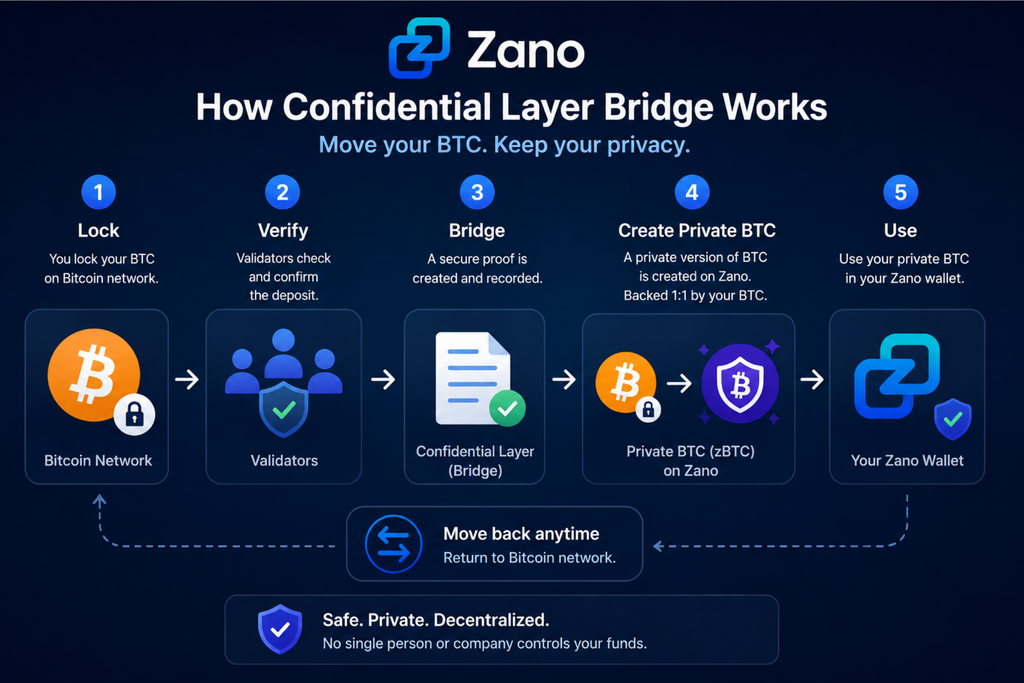
First, the user locks BTC on the Bitcoin network. The bridge’s validators detect the deposit and create a cryptographic proof, known as a witness, confirming that the deposit happened.

That information is then recorded on the Bridgeless blockchain, which powers Confidential Layer.

Once the deposit is verified, the system can authorize the creation of the private version of Bitcoin on Zano.

The process can be simplified to:

1. Lock BTC → 2. Verify the deposit → 3. Create the private version → 4. Send it to your Zano wallet

The result is BTCx, a private version of Bitcoin that can be used within the Zano ecosystem.

3. How Are the Funds Kept Safe?

Confidential Layer does not rely on one company or person holding everyone’s funds.

Instead, it uses a network of validators and threshold signatures. In simple terms, the signing power is divided between multiple participants.

A minimum number of validators must work together to approve a withdrawal. No single validator has the complete private key needed to control the locked funds. Zano states that the bridge requires 66% of validators to sign transactions.

This distributed approach means there is no single central authority holding the assets.

4. What Do You Receive on Zano?

Once the deposit has been verified, the bridge creates a wrapped version of the original asset on Zano.

For example:

Ethereum → ETHx
Bitcoin → BTCx

These assets are backed 1:1 by the original assets locked on their native blockchains. On Zano, they can benefit from Zano’s privacy features, including hidden transaction amounts and addresses.

You can then use the private version on Zano and, when needed, move it back and receive the original asset.

5. Why Does This Matter?

Normally, using Bitcoin or Ethereum means accepting that your transaction history can be publicly visible.

Confidential Layer offers another option: keep exposure to the original asset while using it in a more private environment.

You don’t have to exchange your Bitcoin for ZANO just to get privacy. You can bridge the Bitcoin itself and receive BTCx on Zano.

That creates a simple combination:

Your asset + Zano’s privacy + the ability to move back when needed.

Confidential Layer is therefore designed to connect the open crypto world with Zano’s private ecosystem, giving users more choice over how they use their digital assets.

Sources:

Disclaimer: ZanoNews.com is an independent news and information website. This article is for informational purposes only and does not constitute financial or investment advice.