
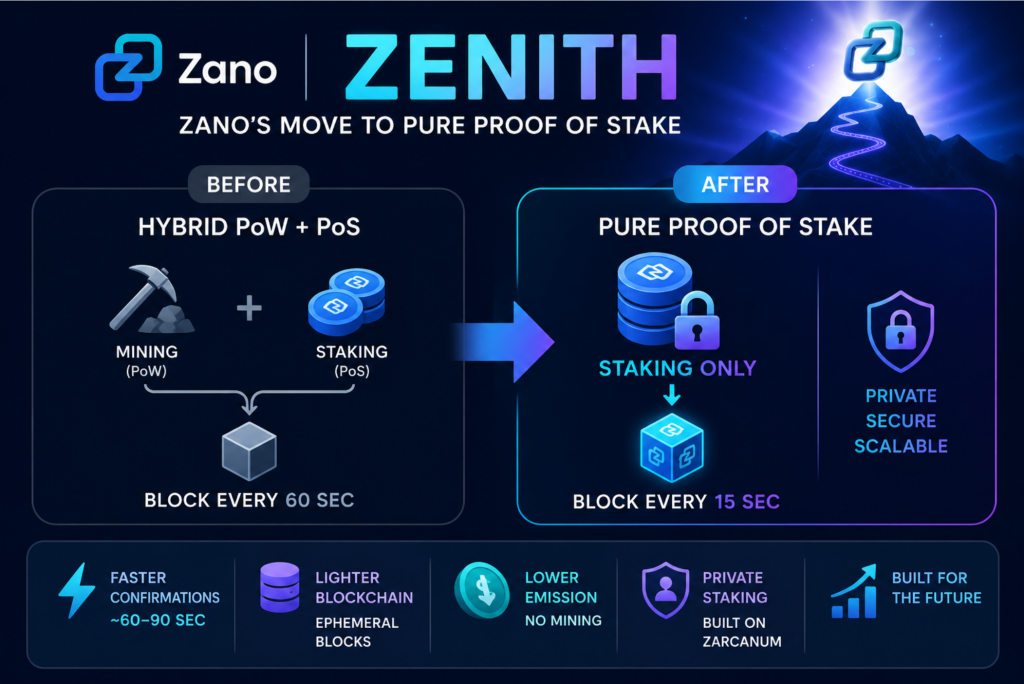
For years, Zano has focused on building a blockchain that puts privacy first. Now, the project has announced one of its biggest upgrades yet: Zenith, a new consensus system that will move Zano from its current hybrid model to a Pure Proof of Stake (PoS) network.
The goal isn’t just to modernize the blockchain. Zenith is designed to improve security, speed up transactions, reduce unnecessary blockchain growth, and strengthen Zano’s long-term sustainability—all while preserving the privacy features that make Zano unique.
Here’s a simple breakdown of what Zenith means for users.
Table of Contents
- What Is Zenith?
- Why Is Zano Changing?
- What Is Pure Proof of Stake?
- Faster Transactions and Confirmations
- Smaller Blockchain, Faster Sync
- Lower Coin Emission
- What This Means for Zano Users
- Source
1. What Is Zenith?
Zenith is Zano’s next-generation consensus protocol.
Today, Zano uses a Hybrid Proof of Work (PoW) and Proof of Stake (PoS) system. With Zenith, the network will transition to Pure Proof of Stake, meaning blocks will be created entirely by staking instead of combining mining and staking.
Unlike many Proof of Stake blockchains, Zenith is built on Zarcanum, allowing users to stake while keeping their balances and staking activity private.
2. Why Is Zano Changing?
The Zano team originally tried to improve its hybrid consensus system.
However, after years of research, every major improvement continued running into limitations caused by the Proof of Work component.
Rather than continuing to patch the existing design, the team worked with blockchain research company Common Prefix to develop a new privacy-preserving Proof of Stake protocol from the ground up.
The result was Zenith.
3. What Is Pure Proof of Stake?
Proof of Stake secures a blockchain using coins that users stake instead of computers that perform mining.
In simple terms:
- Current Zano: Mining + Staking
- Zenith: Staking only
One important difference is that Zano’s implementation keeps staking private.
Most Proof of Stake networks publicly show validator balances and staking activity. Zenith is designed so users can help secure the network without revealing their holdings.
4. Faster Transactions and Confirmations
One of the biggest improvements for everyday users will be speed.
The proposed Zenith targets include:
| Current Zano | Zenith |
|---|---|
| Block every 60 seconds | Block every 15 seconds |
| Around 10 confirmations | Around 4–6 confirmations |
| Several minutes to confirm | Around 60–90 seconds |
That means payments, wallet transfers and decentralized applications should all feel much faster once Zenith is live.
5. Smaller Blockchain, Faster Sync
Normally, creating four times as many blocks would make a blockchain much larger.
Zenith introduces something called Ephemeral Blocks.
Instead of storing every old block forever, the network keeps only the important cryptographic information once older blocks are finalized.
This allows Zano to:
- Keep fast block times
- Reduce storage requirements
- Improve synchronization for new nodes
- Offer optional archival storage for anyone who wants the complete history
In short, users get faster confirmations without permanently increasing blockchain size.
6. Lower Coin Emission
Moving away from Proof of Work also changes how new coins enter circulation.
Today, miners receive approximately:
- 720 ZANO per day
- 21,600 ZANO per month
- 262,800 ZANO per year
Because miners must pay electricity, hardware and operating costs, many sell part of their rewards.
Once Zenith launches, Proof of Work mining will end. The Zano team is still finalizing exactly how future rewards will be distributed, but the network’s security will rely entirely on staking instead of mining.
7. What This Means for Zano Users
Zenith represents one of the biggest upgrades in Zano’s history.
If everything performs as expected after testing and implementation, users can look forward to:
- Faster transaction confirmations
- Private Proof of Stake
- Improved security
- Lower long-term storage requirements
- Better performance for wallets, merchants and applications
- A blockchain designed for long-term growth
The upgrade is still under development and will undergo extensive testing before activation, but it marks an important milestone in Zano’s evolution toward a faster, more scalable and privacy-focused blockchain.
8. Source
Disclaimer: ZanoNews.com is an independent news and information website. This article is for informational purposes only and does not constitute financial or investment advice.
2 thoughts on “Zenith: Zano’s Move to Pure Proof of Stake Explained”
Comments are closed.