Zano Hard Fork 6: A New Era for Wallets & Exchanges 🌍

The Zano team has announced another exciting update about its upcoming Hard Fork 6 (HF6), and it could become one of the project’s most important upgrades yet.

Instead of only improving performance, Hard Fork 6 aims to make Zano much easier for wallets, exchanges, payment providers, and decentralized applications (dApps) to integrate.

A new feature called Gateway Addresses is designed to simplify the process by removing one of the biggest technical barriers developers have faced when integrating Zano. This could help bring Zano to more wallets, exchanges, payment providers, and blockchain applications while preserving the privacy that makes the network unique.

In this article, we’ll explain in simple terms what Hard Fork 6, Gateway Addresses, and a UTXO-based privacy chain are—and why this upgrade matters.
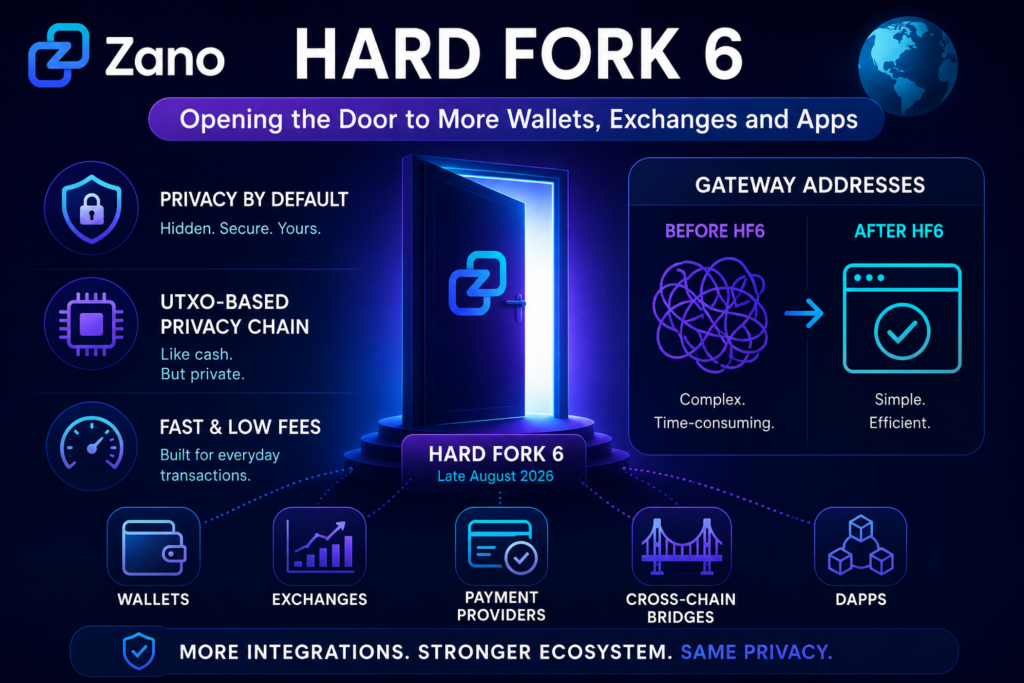
Table of Contents

  1. What Is Zano?
  2. What Is a UTXO-Based Privacy Chain?
  3. Why Has Integrating Zano Been Difficult?
  4. What Is Hard Fork 6?
  5. What Is a Gateway Address?
  6. Why This Upgrade Matters
  7. What It Means for Zano Users
  8. What This Upgrade Could Mean

1. What Is Zano?

Zano is a privacy-focused Layer 1 blockchain built for secure and confidential digital transactions.

Unlike many public blockchains where anyone can see wallet balances and transaction history, Zano keeps your financial activity private.

Some of its main features include:

  • Private transactions by default.
  • Hidden wallet balances.
  • Confidential Assets (privacy-preserving tokens built on Zano).
  • Low transaction fees.
  • Fast transaction processing.
  • A hybrid Proof-of-Work (PoW) and Proof-of-Stake (PoS) consensus model.

Its mission is simple: give users complete financial privacy while remaining secure and decentralized.

2. What Is a UTXO-Based Privacy Chain?

Zano uses a UTXO (Unspent Transaction Output) model, just like Bitcoin.

Think of it like paying with cash.

If you buy something costing €20 using a €50 note, you receive €30 in change.

Your wallet works in a similar way by using small pieces of cryptocurrency called UTXOs instead of one visible account balance.

What makes Zano different is that it also hides:

  • The sender.
  • The receiver.
  • The transaction amount.
  • Wallet balances.

This gives users much stronger financial privacy than most public blockchains.

3. Why Has Integrating Zano Been Difficult?

Because Zano protects user privacy, it has traditionally been harder for developers to integrate.

Instead of simply reading one wallet balance, developers often had to:

  • Scan the blockchain.
  • Track private transaction outputs.
  • Recalculate balances.
  • Keep wallets synchronized.

This extra work could take weeks, making Zano more difficult to integrate than many other cryptocurrencies.

4. What Is Hard Fork 6?

A hard fork is a major blockchain upgrade that introduces new features and rules.

Hard Fork 6 is expected to activate in late August 2026.

Its goal isn’t to reduce privacy—it is to make building on Zano much easier while keeping the same privacy protections users already enjoy.

5. What Is a Gateway Address?

The biggest feature in Hard Fork 6 is Gateway Addresses.

These are special addresses created for:

  • Cryptocurrency exchanges.
  • Wallet providers.
  • Payment services.
  • Cross-chain bridges.
  • Decentralized applications.

Before Hard Fork 6

Developers had to:

  • Scan the blockchain.
  • Track thousands of private outputs.
  • Continuously rebuild balances.

After Hard Fork 6

Developers simply:

  1. Register a Gateway Address.
  2. Read one account balance.
  3. Process deposits and withdrawals much more efficiently.

This could reduce integration time from weeks to a much simpler process.

Regular Zano users won’t notice any difference in how they use their wallets, and their privacy remains protected.

6. Why This Upgrade Matters

Making Zano easier to integrate could encourage more companies to support it.

Potential benefits include:

  • More exchange listings.
  • More wallet support.
  • Lower development costs.
  • Easier maintenance.
  • More blockchain applications built on Zano.

The easier a blockchain is to integrate, the more likely businesses are to adopt it.

7. What It Means for Zano Users

Although this upgrade mainly targets developers, everyday users could also benefit.

As integration becomes easier, Zano could see:

  • More wallets supporting ZANO.
  • More exchanges listing the coin.
  • Better payment options.
  • Increased liquidity.
  • More developers building useful applications.

Ultimately, a stronger ecosystem benefits everyone.

8. What This Upgrade Could Mean

Hard Fork 6 is more than just another software upgrade.

By introducing Gateway Addresses, Zano is making it easier for businesses and developers to support one of the crypto industry’s most privacy-focused blockchains while preserving the privacy that makes the network unique.

If more wallets, exchanges, and applications adopt Zano after Hard Fork 6, it could become one of the most important milestones in the project’s growth.

For the Zano community, it’s another step toward making privacy-focused cryptocurrency more accessible while staying true to the principles that have always set Zano apart.

Why these changes?

“one of the most important milestones” is a little stronger and flows better than “a major milestone”, while still being careful not to overstate the outcome.

“while preserving the privacy that makes the network unique” reads more naturally than “without compromising on privacy” and emphasizes Zano’s key strength.

Learn More:

Disclaimer: ZanoNews.com is an independent news and information website. This article is for informational purposes only and should not be considered financial, investment, or legal advice.
The Biggest Change in Zano’s History Is Coming 🧭

If you’ve been following Zano for a while, you probably know the project has never been afraid to do things differently.

From private transactions and Confidential Assets to Confidential Smart Contracts, the team has focused on building technology that puts privacy first.

Now, they’re working on what could become the biggest change the network has ever seen.

It’s called Zenith.

Instead of making small improvements to the existing network, Zenith is designed to completely change how Zano secures its blockchain. If everything goes as planned, Zano will move from its current hybrid Proof of Work (PoW) and Proof of Stake (PoS) system to a fully private Proof-of-Stake network.

Before we go any further, there’s one important thing to know:

Nothing is changing today.

Mining continues as normal, staking continues as normal, and the current Zano network isn’t going anywhere yet. Zenith is still being developed and is currently planned for 2027, following testing, security reviews, and community approval.

So, what is Zenith, and why is everyone talking about it?

Table of Contents

1. What Is Zenith?
2. Why Is Zano Changing?
3. Will the Network Be Faster?
4. What About Privacy?
5. What Are Ephemeral Blocks?
6. What Happens to Mining?
7. When Will Zenith Launch?
8. Why This Matters

1. What Is Zenith?

Every blockchain needs a way to decide who creates the next block and confirms transactions.

That’s called consensus.

Right now, Zano uses two different systems at the same time.

The first is Proof of Work, where miners use computing power to help secure the network.

The second is Proof of Stake, where people lock up (or “stake”) their ZANO to help secure the blockchain.

This hybrid approach has worked well for years.

But according to the Zano team, running two different systems together also makes the network more complicated to improve over time.

That’s where Zenith comes in.

Instead of continuing to build on the existing design, the developers created a completely new consensus system that’s simpler while still keeping privacy at the heart of the network.

According to the project, Zenith is the result of more than 12 years of blockchain research, including work with blockchain security researchers at Common Prefix.

2. Why Is Zano Changing?

This is probably the biggest question people have.

If the current network works, why change it?

Interestingly, the developers say they didn’t originally plan to remove mining.

Their first idea was simply to improve the current hybrid system.

But after years of research, they realised that supporting both mining and staking together made the network harder to develop.

Instead of making the existing system even more complicated, they decided to build something simpler.

According to the team, Zenith should make the network:

  • Easier to improve.
  • Easier to maintain.
  • More efficient.
  • Better prepared for future upgrades.

Most importantly, they believe they can do all of this without giving up the privacy that makes Zano different.

3. Will the Network Be Faster?

Yes—that’s one of the biggest goals.

Today, Zano creates a new block about every 60 seconds.

With Zenith, the target is around 15 seconds.

That doesn’t necessarily mean your transaction will be confirmed in 15 seconds, but it should reduce waiting times considerably.

The team also plans to reduce the recommended number of confirmations from 10 blocks to around 4 to 6 blocks.

For everyday users, that simply means sending ZANO could feel much quicker than it does today.

4. What About Privacy?

Privacy isn’t going away.

In fact, it’s still one of the main goals behind Zenith.

On many Proof-of-Stake blockchains, it’s possible to see how much someone has staked or identify the wallets producing blocks.

Zenith is designed differently.

Using Zano’s Zarcanum privacy technology, the network aims to keep staking activity private by hiding stake amounts and making it much harder to link block production to individual users.

In other words, the team wants to improve the technology without sacrificing privacy.

5. What Are Ephemeral Blocks?

This is probably the most technical part of Zenith, but the idea is actually quite simple.

If the blockchain creates blocks four times faster, it also creates much more data.

Over time, that could make the blockchain much larger.

To help solve this, Zenith introduces something called ephemeral blocks.

Think of them as a smarter way of storing older blockchain data.

Instead of keeping every old block forever in exactly the same form, the network can safely reduce how much information needs to be stored while still keeping everything secure and verifiable.

The goal is to keep the blockchain growing more efficiently as the network becomes faster.

6. What Happens to Mining?

Nothing changes right now.

Miners continue securing the network exactly as they do today.

However, if Zenith is activated in the future, Proof-of-Work mining will come to an end, and Zano will become a fully Proof-of-Stake blockchain.

Today, miners receive approximately:

  • 720 ZANO every day
  • 21,600 ZANO every month
  • 262,800 ZANO every year

Under Zenith, those mining rewards would no longer exist in their current form.

The proposal also includes two other changes:

  • Fewer new ZANO entering circulation over time.
  • Transaction fees being burned instead of redistributed.

According to the Zano team, these changes are designed to create a more sustainable long-term economic model for the network.

7. When Will Zenith Launch?

Zenith is still under development.

The team is currently targeting 2027, but no official launch date has been announced.

Before the upgrade can happen, Zenith will go through more development, testing, security reviews, and community evaluation.

Until then, Zano continues operating exactly as it does today.

8. Why This Matters

Every blockchain releases upgrades from time to time.

Zenith is different.

Instead of adding another feature, it’s changing the way the entire network works.

If everything goes according to plan, Zano will move to a simpler, fully private Proof-of-Stake network that’s designed to be faster, easier to improve, and better prepared for the future.

For current users, nothing changes today.

But if Zenith is successfully delivered, it could mark the beginning of the next chapter in Zano’s history.

To learn more, visit:

Disclaimer: ZanoNews.com is an independent news and information website. This article is for informational purposes only and should not be considered financial, investment, or legal advice.
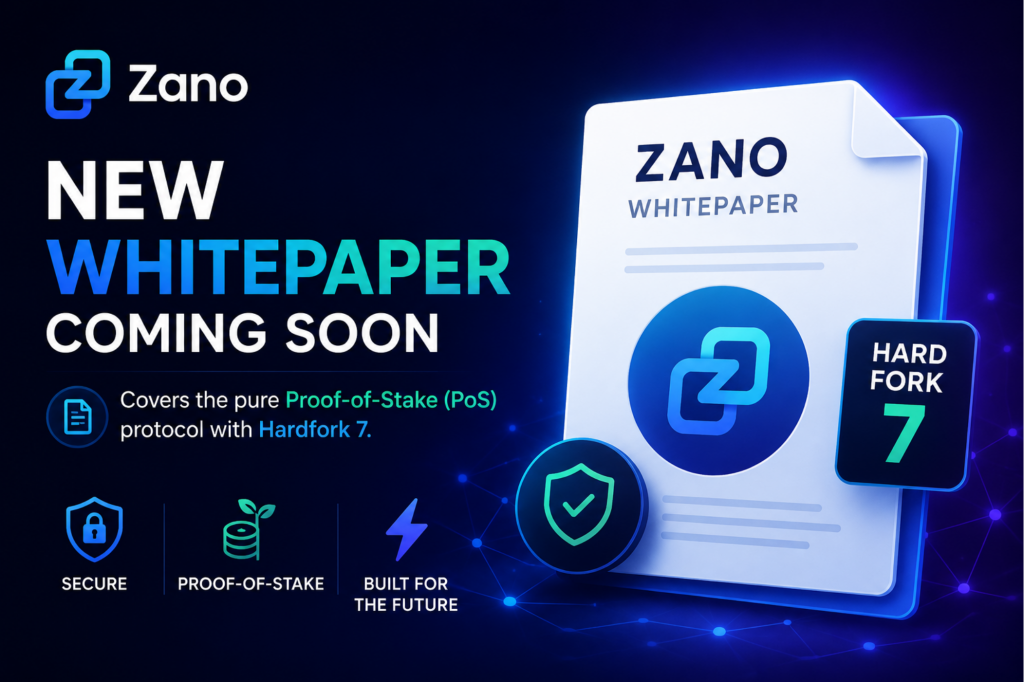
New Zano Whitepaper Coming Soon 📄

Zano has announced that a new whitepaper is on the way, covering the pure Proof-of-Stake (PoS) protocol that will be introduced with Hardfork 7.

A whitepaper is a technical document that explains how a blockchain or technology works, including its design, security, and underlying architecture. It serves as a key reference for developers, researchers, and community members who want a deeper understanding of the project.

While the new whitepaper has not yet been released, it is expected to provide more details about Zano’s transition to a pure Proof-of-Stake consensus model and what it means for the network.

The Zano team announced:

“New whitepaper incoming! It covers the pure Proof-of-Stake protocol shipping with Hardfork 7. Releasing soon. 🔒”

Once the whitepaper is published, we’ll provide a simple breakdown of the key changes and what they mean for the Zano ecosystem.

To learn more, visit:

Disclaimer: ZanoNews.com is an independent news and information website. This article is for informational purposes only and should not be considered financial, investment, or legal advice.
Zano Weekly Development Update 💻

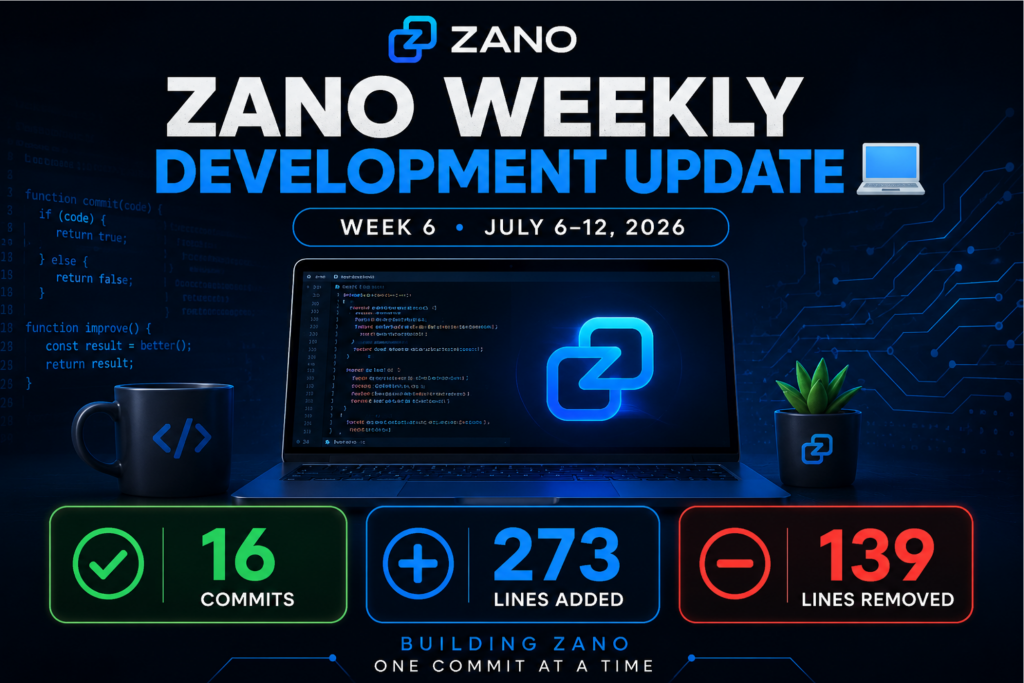
The latest weekly development update from the We Are Zano community shows that work on the Zano ecosystem is continuing steadily. During the week of July 6–12, 2026, developers made several improvements to the codebase, highlighting the team’s ongoing commitment to building and maintaining the network.

Table of Contents

  1. Weekly Development Highlights
  2. What Is a Commit?
  3. Why Regular Development Matters
  4. Why It Matters

1. Weekly Development Highlights

According to the latest update, Zano developers completed:

  • 16 commits
  • 273 lines of code added
  • 139 lines of code removed

These updates reflect continuous work to improve and maintain the Zano blockchain.

2. What Is a Commit?

A commit is a saved change to a project’s source code. Developers make commits when they fix bugs, improve performance, add new features, or clean up existing code.

Adding and removing code is a normal part of software development. In many cases, removing code means replacing older code with a cleaner or more efficient version.

3. Why Regular Development Matters

Consistent development is a positive sign for any blockchain project. It shows that the team is actively maintaining the network, improving performance, and preparing for future updates.

Regular progress also gives the community confidence that the project continues to move forward.

4. Why It Matters

Development happens behind the scenes, but it plays a major role in the long-term success of any cryptocurrency project. Weekly updates like these provide a simple way for the community to track Zano’s ongoing progress and see that development remains active.

To learn more, visit:

Disclaimer: ZanoNews.com is an independent news and information website. This article is for informational purposes only and should not be considered financial, investment, or legal advice.
Zano June Update: HF6 Confirmed 📢

The Zano team has released its June Monthly Project Update, highlighting progress across network development, ecosystem expansion, and community growth. Here’s a quick look at the biggest announcements.

Table of Contents

  1. HF6 Activation Confirmed
  2. Gateway Addresses Lead the Upgrade
  3. PrivacyGateway Card Adds ZANO Top-Ups
  4. New ZANO Integrations
  5. Community Platform Changes
  6. Growing Global Community
  7. June at a Glance

1. HF6 Activation Confirmed

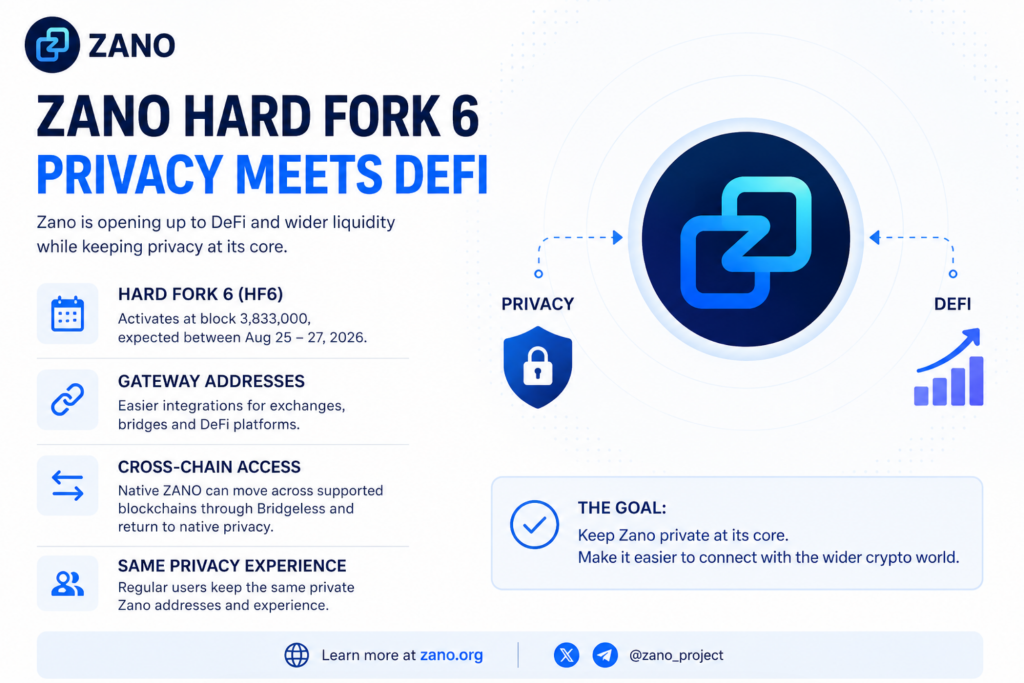
Hard Fork 6 (HF6) has officially been finalized and is scheduled to activate at block 3,833,000, expected between August 25–27.

This gives node operators and community members time to prepare for the upcoming network upgrade.

2. Gateway Addresses Lead the Upgrade

The headline feature of HF6 will be Gateway Addresses, while privacy remains enabled by default, staying true to Zano’s privacy-first approach.

3. PrivacyGateway Card Adds ZANO Top-Ups

The PrivacyGateway Card now supports direct ZANO top-ups, making it even easier for users to fund their cards using the native cryptocurrency.

4. New ZANO Integrations

Zano continues expanding its ecosystem with new integrations, including:

  • CardsRelay
  • sshwap
  • fswap

These additions provide users with more ways to use and access ZANO.

5. Community Platform Changes

The Zano team also announced that Discord will be retired in favor of a new alias-authenticated Zano Forum, providing a more secure and integrated community experience.

6. Growing Global Community

Community adoption continues to grow, with the Zano Private Economy Conference in Nigeria attracting more than 700 attendees, demonstrating increasing interest in privacy-focused blockchain technology.

7. June at a Glance

June was another strong month for Zano. With HF6 locked in, new integrations, improved payment features, and a growing global community, the project continues building momentum ahead of its next major network upgrade.

To learn more, visit:

Disclaimer: ZanoNews.com is an independent news and information website. This article is for informational purp

Zano Hard Fork 6 Gets a Date as Privacy Chain Opens to DeFi

Zano’s upcoming Hard Fork 6 (HF6) is gaining wider attention after TheStreet reported on the major network upgrade.

HF6 aims to help Zano connect with DeFi and wider crypto liquidity while keeping privacy at the heart of the network.

Table of Contents

  1. What Is Zano Hard Fork 6?
  2. Why Gateway Addresses Matter
  3. Zano Opens the Door to DeFi
  4. What Happens Next?
  5. Sources

1. What Is Zano Hard Fork 6?

Hard Fork 6 will activate at block 3,833,000, expected between August 25 and 27, 2026.

Users running Zano full-node desktop wallets should update before the fork.

2. Why Gateway Addresses Matter

One of the biggest HF6 changes is Gateway Addresses.

They are designed to make it easier for exchanges, bridges and DeFi platforms to connect with Zano, while regular users can continue using Zano’s private addresses.

Simply put: easier integrations without changing Zano’s privacy-first experience.

3. Zano Opens the Door to DeFi

HF6 also prepares native ZANO for cross-chain access through Bridgeless.

This could allow ZANO to connect with public blockchain liquidity and DeFi services, while users can bridge back to the Zano network when native privacy is needed.

Update: Zano’s Hard Fork 6 is also gaining wider crypto media attention, with Bitcoin.com News highlighting the upgrade’s potential to open ZANO to DeFi liquidity and a broader exchange footprint.

4. What Happens Next?

The idea behind HF6 is simple:

Keep Zano private at its core. Make it easier to connect with the wider crypto world.

With the activation block approaching, Hard Fork 6 could be an important step in Zano’s push toward wider utility.

5. Sources

Disclaimer: ZanoNews.com is an independent news and information website. This article is for informational purposes only and does not constitute financial or investment advice.

Zano’s Bridgeless Update: Privacy on Zano, Liquidity Across Chains

Privacy and liquidity do not always work well together in crypto.

Privacy-focused blockchains can protect users, but limited access to major DeFi platforms, exchanges and public blockchain liquidity can make their assets harder to use.

Zano’s Bridgeless update is designed to tackle this problem with a simple idea:

Keep privacy where it matters. Let liquidity move where it is useful.

A recent post from House of Chimera on X highlighted how native $ZANO
can remain on Zano’s privacy-focused blockchain while wrapped ZANO, or wZANO, moves across supported public networks.

Table of Contents

  1. What Is the Zano Bridgeless Update?
  2. How Does ZANO Move Across Chains?
  3. What Is wZANO?
  4. Why Liquidity Matters for Zano
  5. What Happens to Privacy?
  6. Why This Could Open More Doors for ZANO
  7. Privacy When You Need It. Liquidity When You Want It.
  8. Sources

1. What Is the Zano Bridgeless Update?

Zano is built around financial privacy.

But the wider crypto world runs across many different blockchains and DeFi ecosystems.

The Bridgeless integration aims to connect these two worlds.

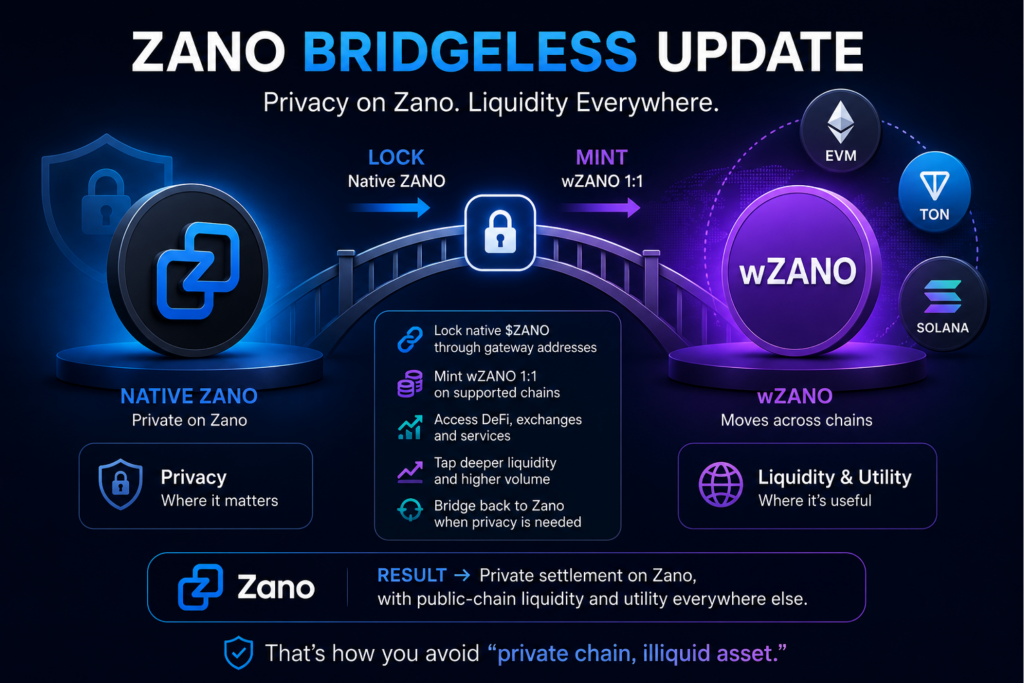
Native $ZANO can be locked on the Zano blockchain through Gateway Addresses. An equal amount of wZANO can then be created on supported public networks such as EVM chains, TON and Solana.

The idea is simple:

$ZANO stays native to its privacy network. wZANO travels.

2. How Does ZANO Move Across Chains?

The process works in a few steps.

Native $ZANO is first locked in a Gateway Address on the Zano blockchain.

The protocol then mints the same amount of wZANO on the supported destination chain.

For example, if ZANO is bridged out, the corresponding wZANO is backed 1:1 by native $ZANO.

When a user bridges back, the wZANO is burned and the native $ZANO is unlocked. Zano says the system uses Threshold Signatures so no single validator holds the complete key needed to control a transfer.

3. What Is wZANO?

wZANO is a wrapped version of ZANO designed to work on other blockchains.

Think of it as a version of ZANO that can enter public blockchain ecosystems.

This could allow wZANO to interact with DeFi services, liquidity pools and other blockchain applications that native $ZANO cannot directly access on the Zano network.

The important difference is:

Native $ZANO is private on Zano.

wZANO is visible when used on transparent public blockchains.

4. Why Liquidity Matters for Zano

Liquidity simply means how easily an asset can be bought, sold or traded.

More liquidity can mean easier trading and access to a wider range of crypto services.

By moving wZANO across supported public networks, ZANO could gain access to deeper liquidity and higher trading activity.

The House of Chimera described the result as private settlement on Zano combined with public-chain liquidity and utility elsewhere.

This could help Zano avoid a common problem:

A private blockchain with an asset that is difficult to access or trade.

5. What Happens to Privacy?

This is important to understand.

Zano’s privacy does not automatically move with wZANO to public blockchains.

When wZANO is used on transparent networks such as EVM chains, TON or Solana, balances and transactions can be publicly visible.

If privacy is needed, users can bridge back to native $ZANO, where Zano’s privacy protections apply again.

In simple terms:

Bridge out for liquidity and wider utility.

Bridge back for Zano’s native privacy.

6. Why This Could Open More Doors for ZANO

Zano says the infrastructure could give ZANO new access to DeFi liquidity pools and potentially make the asset easier to integrate with larger exchanges and services.

As a wrapped asset on public chains, wZANO can potentially interact with lending protocols, liquidity pools and other DeFi applications.

This does not guarantee exchange listings or adoption.

But it removes some of the technical barriers that have limited how native privacy assets interact with the wider crypto ecosystem.

7. Privacy When You Need It. Liquidity When You Want It.

The most interesting part of the Bridgeless update may be its simplicity.

Zano does not need to turn its private blockchain into a public one.

Instead, native $ZANO can remain within Zano’s privacy ecosystem while wZANO connects with public blockchain liquidity.

Privacy on Zano.

Liquidity across chains.

Maybe the future of privacy crypto is not choosing one or the other.

Maybe it is giving users the choice.

8. Sources

  1. House of Chimera — Original X Post
  2. Zano Blog — ZANO Goes Cross-Chain: Native Zano Is Coming to Bridgeless
  3. Bridgeless Zano Integration Documentation
  4. Zano Offficial Website

Disclaimer: ZanoNews.com is an independent news and information website. This article is for informational purposes only and does not constitute financial or investment advice.

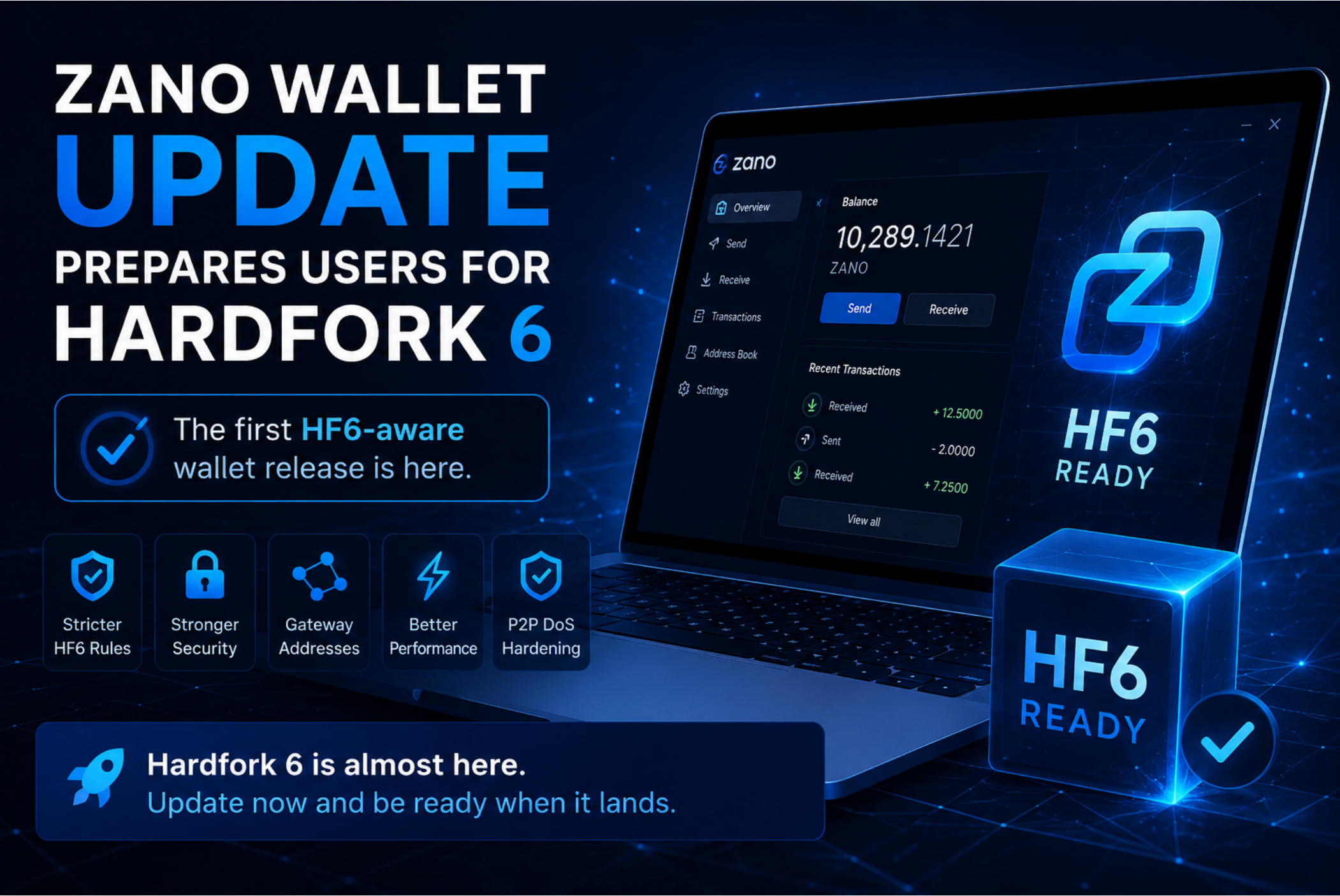
Zano Wallet Update Prepares Users for Hardfork 6 🔥

Zano has released a new wallet update designed to prepare users for the upcoming Hardfork 6 (HF6).

This is the first wallet version built to support HF6 features. Updating now means users can be ready when the network upgrade goes live.

Table of Contents

  1. What Is Included in the Update?
  2. Why Update Before Hardfork 6?
  3. Key Security Improvements
  4. How to Download the Wallet
  5. Sources

1. What Is Included in the Update?

The new wallet update includes several features and technical improvements:

  • Gateway Addresses support
  • Stricter HF6 consensus rules
  • Intrinsic payment IDs for individual outputs
  • Stronger wallet-file encryption
  • Simulation mode for mining-pool block validation
  • P2P security improvements, including SOCKS5 proxy support
  • More secure RPC tools for data encryption and decryption

2. Why Update Before Hardfork 6?

A hardfork is a major network upgrade that introduces new rules or features.

By updating early, users can make sure their wallet is compatible with the upcoming changes and avoid needing to update at the last minute.

3. Key Security Improvements

The update focuses strongly on security.

It improves wallet-file encryption, adds tighter network protections against denial-of-service attacks, and strengthens tools used for encrypting and decrypting data.

For users, the main takeaway is simple: update from an official source and keep your wallet recovery phrase private and secure.

4. How to Download the Wallet

The official Zano wallet page provides download options for desktop, mobile and browser-based wallets.

Always download wallet software from official sources only. Before installing, check that you are on the official Zano website and verify the download details where available.

5. Sources

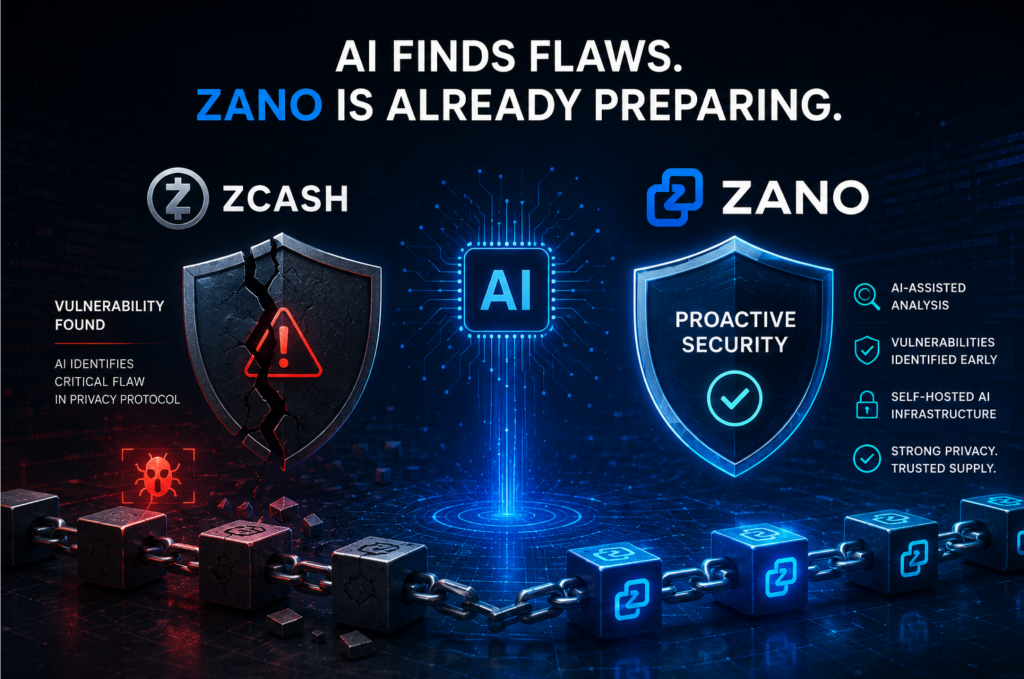
As AI Finds Flaws in Blockchain Protocols, Zano Is Already Preparing

The recent disclosure from the Zcash team caught the attention of many in the privacy coin space.

According to Zcash, Claude Opus 4.8 helped identify a vulnerability in its Orchard privacy pool that could have theoretically allowed counterfeit coins to be created without detection. The issue was fixed quickly and disclosed publicly.

While the vulnerability was addressed, the bigger story may be what it tells us about the future of blockchain security.

AI is becoming a powerful tool for reviewing code, identifying weaknesses, and helping developers find problems before they become real threats.

This is where Zano appears to be taking a proactive approach.

The Zano team has already been using AI-assisted analysis as part of its ongoing work leading up to Hardfork 6. Rather than waiting for problems to be discovered after deployment, the goal is to identify potential weaknesses before they ever reach mainnet.

In simple terms, Zano is using AI to help stress-test its technology before attackers have the chance to do it themselves.

This matters because privacy-focused blockchains face unique challenges. They must protect user privacy while also ensuring that every coin in circulation is legitimate and every transaction remains secure.

As AI tools become more advanced, projects that embrace them early may have an advantage.

The recent Zcash disclosure shows that even well-established privacy projects can benefit from AI-assisted security reviews. It also highlights why continuous testing and improvement are becoming increasingly important.

For Zano, AI is not just about automation. It is becoming another layer of defense.

The blockchain projects that succeed over the long term will likely be those that constantly test their assumptions, strengthen their code, and adapt to new technologies.

Based on its current approach, Zano appears determined to be one of them.

Source: Official Zano Community statement on AI-assisted blockchain security and Hardfork 6 preparation.

Zano Monthly Project Update #17 – February 2026

https://blog.zano.org/zano-monthly-project-update-17-february-2026