Bitcoin’s own official account has called it “trackable digital gold.” That’s because every Bitcoin transaction is permanently visible to anyone — who sent it, who got it, and how much. Forever.
That means your coins can be traced. And sometimes, exchanges flag or block coins just because of where they’ve been before, even if you did nothing wrong.
Zano is a privacy coin — it hides your balance and transactions so no one else can see them. That’s great for you, but it creates a problem: exchanges, apps, and bridges (the services that let you trade or move your crypto) usually need to “see” balances to work properly, and they can’t do that easily with Zano.
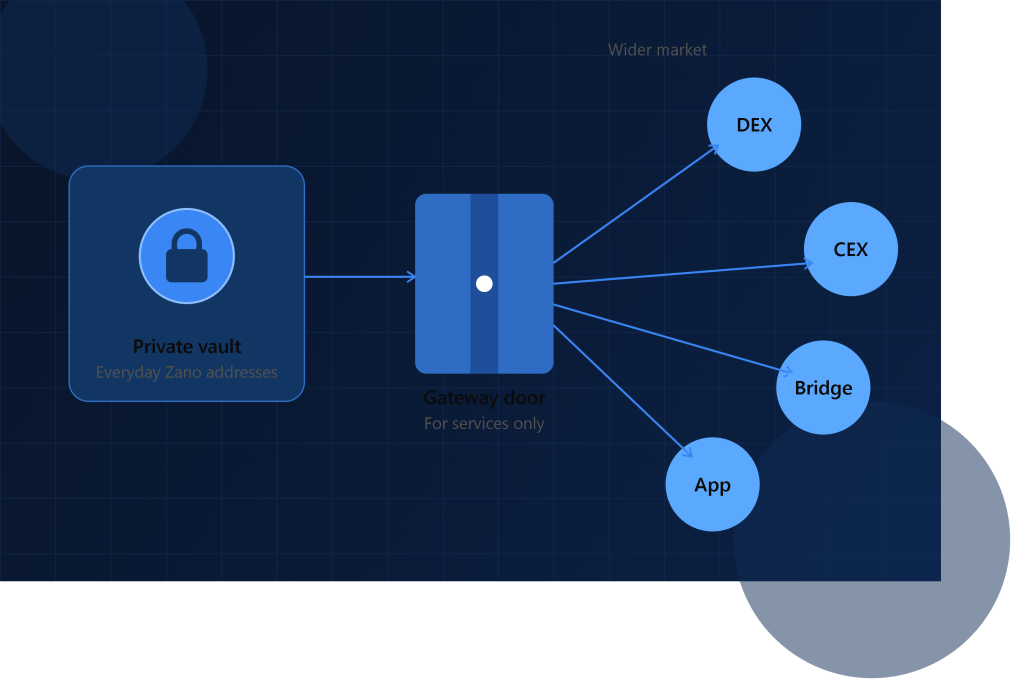
Zano’s new Gateway Addresses feature solves this. It gives exchanges and other services a way to work with Zano smoothly — without exposing your personal wallet or your everyday privacy. See the illustration below.
Think of a regular bank account: your balance is just one simple number the bank can check instantly.
Zano doesn’t work that way by design — for privacy reasons, your balance is spread across many hidden pieces of data instead of one visible number. That’s what keeps your funds private. But it also means that when an exchange or app tries to check “how much does this person have,” it has to do a lot of extra digging behind the scenes.
That extra work discouraged many exchanges and apps from supporting Zano at all — fewer places to trade it, and less flexibility for users.
2. What Gateway Addresses Actually Do
Gateway Addresses are basically a separate, special type of address made just for exchanges and services to use — like a dedicated front door for businesses, separate from your personal wallet.
Your everyday Zano address and your privacy stay exactly the same. Nothing changes for you.
Services that use a Gateway Address can see a simple, always-up-to-date balance, similar to a regular bank account, instead of having to dig through complicated data.
This makes it much faster and easier for exchanges and apps to support Zano.
One thing worth knowing: money moving through a Gateway Address is visible on the blockchain (that’s what makes it easy for services to track). But even then, the identity of who sent it stays hidden thanks to Zano’s existing privacy tools. Your personal wallet and daily use remain fully private either way.
3. Why This Is a Big Deal
Because Gateway Addresses make Zano easier to work with, it opens the door to:
More places to buy, sell, and trade ZANO — exchanges are more likely to support it.
Moving ZANO to other blockchains and back (like Ethereum, TON, and Solana) safely, without needing to trust a middleman.
Better odds of being listed on major exchanges, since some big platforms have avoided Zano in the past due to these technical hurdles.
More ways to use ZANO in the wider crypto world, while still being able to return to full privacy whenever you want.
4. When Is This Coming?
This feature is part of a bigger upgrade called Hard Fork 6 (HF6). It’s already been tested and is expected to go live on the main Zano network soon.
5. What You Need to Know as a User
You don’t need to do anything — your existing Zano address and wallet keep working exactly as before.
Your everyday privacy is not affected in any way.
Gateway Addresses only matter to businesses like exchanges and bridges that need to integrate with Zano — not to individual users going about normal transactions.
Over time, expect to see more exchanges, apps, and services supporting ZANO as a result of this upgrade.