
Paying with cryptocurrency is convenient, but it can also reveal more information than many people realise. When someone pays a merchant directly using USDT, the transaction is recorded on the blockchain. Depending on the wallet and address involved, the merchant may be able to explore previous transactions, balances, and other wallet activity.
Freedom Wallet is addressing this problem with a new feature called Private Pay, powered by fUSD (Freedom Dollar), a privacy-focused stablecoin built on the Zano blockchain.
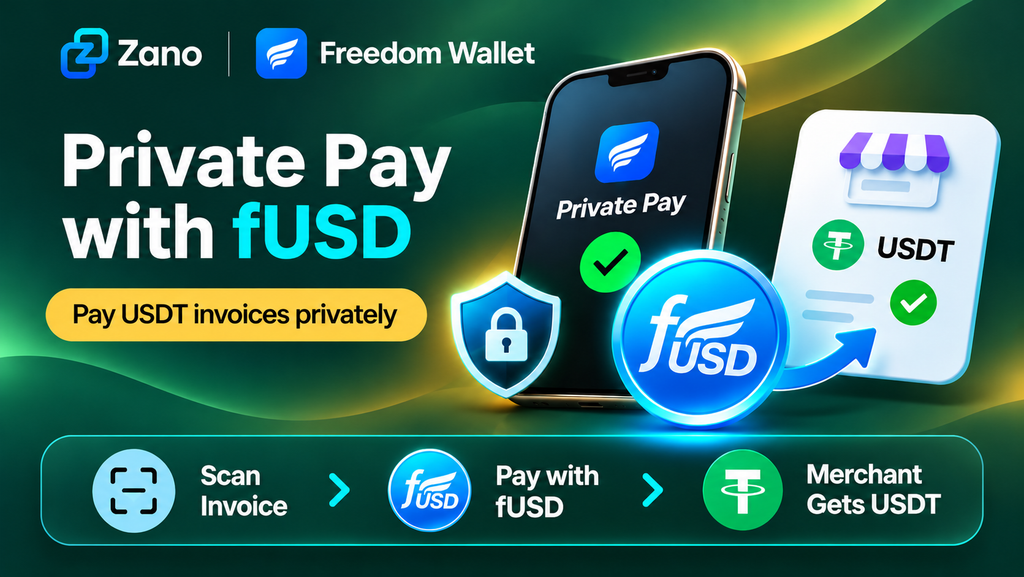
Announced by Freedom Wallet on November 22, Private Pay allows users to scan an existing USDT or USDC payment invoice and complete the payment using fUSD (Freedom Dollar). The merchant receives the exact stablecoin amount requested, while the user’s wallet balance and transaction history remain hidden from the merchant.
The idea is straightforward: pay the merchant what they requested without exposing your entire financial history.
Table of Contents
- What Is Freedom Wallet’s Private Pay?
- How Does Private Pay Work?
- How to Download Freedom Wallet and Get Started
- The Role of fUSD in Private Payments
- What Does the Merchant Actually See?
- Why Is This Important for Crypto Payments?
- How Zano Makes This Possible
- What This Could Mean for Everyday Crypto Adoption
- A More Private Way to Pay
- Where to Learn More
1. What Is Freedom Wallet’s Private Pay?
Private Pay is a payment feature introduced by Freedom Wallet that allows users to pay standard USDT or USDC invoices privately using fUSD.
Normally, when you pay someone directly with USDT, your transaction is publicly recorded on the blockchain. The recipient can potentially follow your wallet address and examine its transaction activity.
Private Pay takes a different approach.
Instead of sending USDT directly from your personal wallet, you use fUSD to complete the payment through Freedom Swap. The service handles the payout to the merchant in the stablecoin they originally requested.
For example, imagine receiving an invoice for 47.88 USDT for a web hosting subscription.
With Private Pay, you simply scan the invoice using Freedom Wallet, review the payment, and confirm it using fUSD.
The merchant receives 47.88 USDT, while your personal wallet balance and transaction history are not exposed to the merchant through that payment.
2. How Does Private Pay Work?
2. How Does Private Pay Work?
Private Pay makes it simple to pay a USDT or USDC invoice using fUSD. You don’t need to send USDT directly from your personal wallet.
Here is how the process works:
Step 1: Receive an invoice
The merchant sends you an invoice requesting payment in USDT or USDC. It usually includes a QR code with the payment amount and destination details.
Step 2: Scan the invoice
Open Freedom Wallet and scan the merchant’s QR code. The app reads the payment details and identifies the amount requested.
Step 3: Pay with fUSD
Review the payment details, including the amount and any applicable fees. Confirm the transaction using your fUSD balance.
Step 4: Merchant receives payment
Freedom Swap processes the payment, and the merchant receives the exact USDT or USDC amount requested. You don’t need to send USDT directly from your personal wallet.
In simple terms:
Scan the invoice → Pay with fUSD → Merchant receives USDT or USDC.
The merchant receives their payment without gaining direct visibility into your personal wallet balance and transaction history.
3. How to Download Freedom Wallet and Get Started
If you want to try Private Pay, the first step is to download Freedom Wallet.
Step 1: Download the wallet
Visit the official Freedom Wallet website and download the app for your device.
You can also find it directly on:
Step 2: Set up your wallet
Open the app and create a new wallet or restore an existing one. Make sure to safely back up your recovery phrase. Never share it with anyone.
Step 3: Get fUSD
Make sure your Zano wallet has an fUSD balance. You should also keep some ZANO available to cover network fees.
Step 4: Use Private Pay
Open Freedom Wallet, access the Private Pay feature and scan the merchant’s USDT or USDC invoice. Review the payment details and confirm the transaction.
Freedom Wallet processes the payment through Freedom Swap, allowing the merchant to receive the requested cryptocurrency without seeing your personal wallet.
For more information, visit the official Freedom Wallet website.
4. The Role of fUSD in Private Payments
At the centre of this feature is fUSD, also known as Freedom Dollar.
fUSD is a privacy-focused stablecoin built on the Zano blockchain. Unlike conventional stablecoins that operate on transparent blockchain networks, fUSD is designed to provide privacy for transactions.
This is important because blockchain transparency can create challenges for people who want to use cryptocurrency for everyday payments without making their financial activity publicly visible.
By using fUSD as the payment source, Freedom Wallet introduces a privacy-focused alternative to directly spending transparent stablecoins.
The merchant still receives the stablecoin they requested, while the user benefits from the privacy features associated with fUSD and Zano.
5. What Does the Merchant Actually See?
One of the most interesting aspects of Private Pay is the separation between the user’s wallet and the merchant’s payment.
Consider the example shown in Freedom Wallet’s demonstration:
- Invoice amount: 47.88 USDT
- Payment method: fUSD
- Merchant receives: Exactly 47.88 USDT
- User pays: The corresponding fUSD amount, plus applicable network or service fees.
The merchant sees the incoming USDT payment and can confirm that the invoice has been paid.
However, the merchant does not receive direct visibility into the user’s Freedom Wallet balance or complete transaction history through this payment process.
Freedom Wallet illustrates this with a simple message: “No trail to your wallet.”
This is an important distinction. The feature aims to prevent the merchant from linking the payment directly to the user’s private wallet activity. It does not mean that every part of the payment process is invisible to all parties or that all blockchain transactions become untraceable.
6. Why Is This Important for Crypto Payments?
Privacy is one of the challenges that comes with using public blockchain networks for everyday financial transactions.
While transparency can be useful for verification and accountability, it can also expose information that people would normally expect to keep private.
For example, when paying for an online service with USDT, a merchant could potentially examine the sending wallet’s public transaction history.
This can reveal more than just the amount paid.
Private Pay introduces a different approach, with several potential advantages:
Financial privacy: Users can make payments without giving merchants direct access to their personal wallet history.
Convenience: There is no need to ask the merchant to accept a different cryptocurrency. They receive the USDT or USDC they requested.
Familiar payment experience: Scanning an invoice and confirming a payment is already familiar to many cryptocurrency users.
Greater flexibility: Users can benefit from privacy-focused payments while continuing to interact with merchants that use conventional stablecoins.
For crypto payments to become more practical, privacy and convenience both matter. Private Pay attempts to bring these two elements together.
7. How Zano Makes This Possible
Zano provides the underlying blockchain infrastructure for fUSD.
Its privacy-focused technology is designed to protect transaction information, making it different from conventional transparent blockchain networks.
Through confidential transactions and privacy-focused assets, Zano aims to provide users with greater control over their financial information.
fUSD demonstrates how this technology can be applied beyond simply transferring cryptocurrency between wallets.
In this case, it becomes part of a payment solution that connects private blockchain transactions with merchants who continue receiving familiar stablecoins such as USDT and USDC.
This is an interesting example of how privacy-focused blockchain infrastructure can be integrated into existing payment experiences rather than requiring merchants and customers to completely change how they transact.
8. What This Could Mean for Everyday Crypto Adoption
One of the biggest obstacles to everyday cryptocurrency payments is making them practical for people who simply want to pay for something.
Most users do not want to understand blockchain explorers, transaction tracing, wallet addresses, or different networks every time they make a payment.
They want a simple experience: scan, pay, and receive confirmation.
Private Pay brings this familiar experience together with the privacy capabilities of Zano.
It also addresses an important practical challenge: merchants do not necessarily need to change their preferred payment currency to support a more private payment experience for customers.
If solutions like this continue to develop, privacy-focused stablecoins could find more use cases across online shopping, subscriptions, digital services, and other everyday payments.
For Zano, it also demonstrates a practical application of its technology through an existing wallet ecosystem.
9. A More Private Way to Pay
Private Pay introduces an interesting approach to one of cryptocurrency’s ongoing challenges: how to make payments convenient without unnecessarily exposing personal financial information.
By combining fUSD’s privacy-focused capabilities with Freedom Wallet’s payment experience, users can pay USDT and USDC invoices while merchants continue receiving the exact amounts they requested.
Rather than asking merchants to change how they accept payments, the feature focuses on changing what happens on the customer’s side.
It is a practical example of how Zano’s privacy technology can extend beyond individual wallet transfers and into everyday payment scenarios.
The bigger idea is simple: cryptocurrency payments should be convenient, but paying for something should not mean opening up your entire financial history.
10. Where to Learn More
Users interested in exploring Private Pay, fUSD, and the underlying Zano ecosystem can find more information through the official resources below.
Disclaimer: ZanoNews.com is an independent news and information website. This article is for informational purposes only and should not be considered financial or investment advice.