Lending, Borrowing & Earning with Zano πŸš€

Zano is preparing to give users more ways to use their digital assets.

With the upcoming Zano Execution Layer, users could eventually be able to lend, borrow, earn yield and provide liquidity using $ZANO and Confidential Assets such as $FUSD.

If terms like “DeFi” or “liquidity” sound complicated, don’t worry. Here’s what it means in simple terms.

Want to understand the Zano Execution Layer in more detail? πŸ‘‡
Read the full Zano Execution Layer (ZEL) explained article
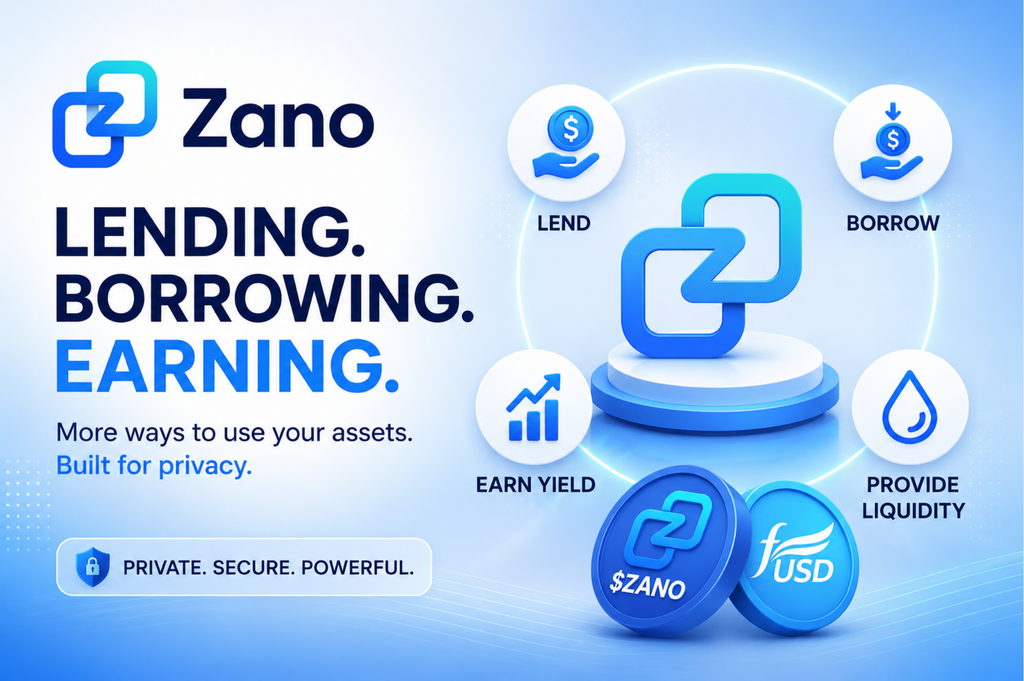
Table of Contents

  1. What is the Zano Execution Layer?
  2. What could you do with it?
  3. What does lending mean?
  4. What does borrowing mean?
  5. What does earning yield mean?
  6. What does providing liquidity mean?
  7. What about $ZANO and $FUSD?
  8. Why is this interesting?
  9. What happens next?

1. What is the Zano Execution Layer?

The Zano Execution Layer is being developed to bring more financial features to the Zano ecosystem.

Today, Zano can be used for private transactions and managing private digital assets.

The Execution Layer could take this further by allowing users to use their assets in different financial activities.

Simply put:

More ways to use your assets, while keeping privacy at the centre.

2. What could you do with it?

Zano says the Execution Layer will make activities such as these possible:

  • Lending
  • Borrowing
  • Earning yield
  • Providing liquidity

These are common activities in DeFi, which simply means using blockchain-based applications for financial services.

You don’t need to be a crypto expert to understand the basic idea.

It’s about giving your digital assets more uses than simply holding or sending them.

3. What does lending mean?

Imagine you have some $ZANO that you don’t need right now.

In the future, you could potentially lend those assets through a DeFi application and receive a return.

It’s similar to putting your money to work instead of simply leaving it unused.

The exact lending system and rates for Zano have not yet been announced.

4. What does borrowing mean?

Borrowing could allow users to access another asset without necessarily selling their $ZANO.

For example, you could potentially use your ZANO as collateral and borrow another asset.

This could be useful if you need access to funds but don’t want to sell your crypto.

The exact rules and requirements will depend on how the future Zano applications are designed.

5. What does earning yield mean?

Yield simply means earning a return from your assets.

Instead of only holding your assets, you could potentially put them into a DeFi application and earn something in return.

However, earning yield does not mean guaranteed profit.

DeFi can involve risks, so users should understand how a product works before putting their assets into it.

6. What does providing liquidity mean?

Liquidity simply means making your assets available so other people can trade between different assets.

For example, a decentralized exchange needs assets available in its pools so users can swap between them.

People who provide those assets may receive rewards.

The exact details of how liquidity provision will work on Zano have not yet been announced.

7. What about $ZANO and $FUSD?

Zano specifically mentioned $ZANO and Confidential Assets such as $FUSD..

This could be interesting because $FUSD is a private stablecoin within the Zano ecosystem.

The goal is to give users more ways to use these assets within the ecosystem instead of simply holding or transferring them.

8. Why is this interesting?

For everyday users, the biggest change could be simple:

Your Zano assets could have more uses.

Instead of just:

Buy β†’ Hold β†’ Send

the future could look more like:

Hold β†’ Lend β†’ Borrow β†’ Earn β†’ Provide Liquidity

And privacy remains an important part of the Zano approach.

The idea is to bring more financial functionality to an ecosystem built around private digital assets.

9. What happens next?

The Zano Execution Layer is still coming soon, so there are many details we don’t know yet.

Zano has not announced all the specific applications, rates, requirements or risks involved.

For now, the direction is clear.

Zano is looking beyond private payments and exploring what private digital assets can do next.

If the Execution Layer delivers on this vision, users could eventually have more ways to use and interact with their assets, while keeping privacy at the heart of the experience.

Sources

Disclaimer: ZanoNews.com is an independent news and information website. This article is for informational purposes only and does not constitute financial or investment advice.
Shops Don’t Accept ZANO? You Can Still Spend It πŸ’³

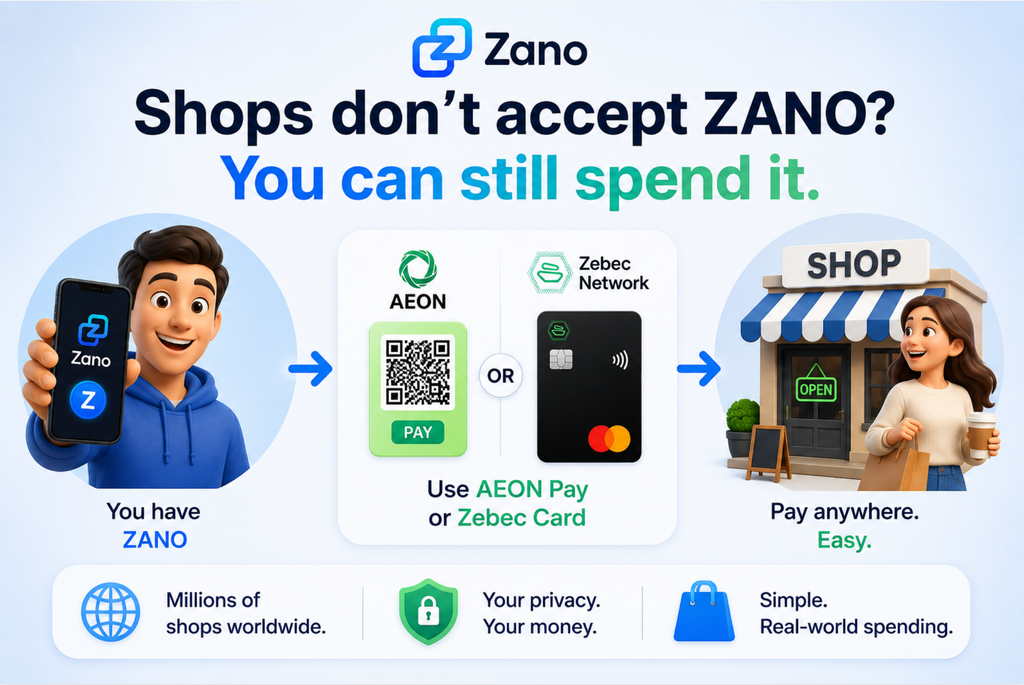
You might think you can only spend $ZANO or $fUSD at shops that directly accept them. But that is not necessarily the case.

Payment services like AEON Pay and Zebec can let you use your Zano assets while the shop continues receiving payment through its usual system.

Table of Contents

  1. Do Shops Need to Accept ZANO?
  2. How Does It Work?
  3. Pay With ZANO Using AEON Pay
  4. Spend With ZANO Using Zebec
  5. Why Does This Matter?
  6. What This Means for Everyday Users
  7. Learn More

1. Do Shops Need to Accept ZANO?

Not necessarily.

A shop does not need to have a Zano wallet or directly accept $ZANO or $fUSD for you to potentially spend them.

Instead, a payment service can handle the crypto side while the merchant receives payment through its existing system.

In simple terms:

Your ZANO or fUSD β†’ Payment service β†’ Shop

The shop can continue using the payment method it already supports.

2. How Does It Work?

Think of these services as a bridge between your crypto and everyday payments.

You use your ZANO or fUSD, while the payment service handles the conversion or payment processing in the background.

This means you don’t necessarily need to ask a shop:

β€œDo you accept ZANO?”

You may simply be able to pay through a supported payment service.

Two options highlighted by Zano are AEON Pay and Zebec.

3. Pay With ZANO Using AEON Pay

AEON Pay works as a mini app inside Telegram.

You can top it up with ZANO or fUSD, then scan a QR code at a supported checkout. The merchant receives payment in their local currency.

According to Zano, AEON Pay is accepted at 50M+ merchants worldwide, mainly across emerging markets.

We have already explained how it works in more detail:

πŸ‘‰ How to Spend ZANO with AEON Pay πŸ’³

4. Spend With ZANO Using Zebec

Zebec offers another way to spend ZANO and fUSD.

You can top up a supported Zebec card through the Zebec Super App using ZANO or fUSD, then use the card wherever Mastercard is accepted.

The shop does not need to accept ZANO directly. It simply processes your payment like any other Mastercard transaction.

We covered the Zebec card and how it works in more detail here:

πŸ‘‰ ZANO and Zebec Cards: How to Spend Private Crypto in the Real World

You can also read about the original Zano and Zebec integration:

πŸ‘‰ The Zebec Network x Zano Integration Is Now Live

5. Why Does This Matter?

Getting every shop to directly accept a cryptocurrency would be difficult.

Payment services can make things much simpler.

A recent Zano community poll highlighted the challenge, with 44% of respondents saying that nowhere they shop currently accepts ZANO or fUSD. But as the examples above show, direct merchant acceptance is not always necessary.

Instead of asking merchants to change how they accept payments, services like AEON Pay and Zebec can work with existing payment systems.

This could make ZANO and fUSD more practical for everyday spending.

6. What This Means for Everyday Users

Imagine you have $ZANO or $fUSD and want to buy something from a shop that has never heard of Zano.

You may still have a way to pay.

With services such as AEON Pay or Zebec, the merchant does not necessarily need to accept ZANO or fUSD directly.

You use your Zano assets. The payment service handles the rest. πŸ’³

Of course, availability depends on the service, country, merchant and applicable payment restrictions.

7. Learn More

Zano is continuing to explore ways to make its private assets more useful beyond simply holding or transferring them on the blockchain.

The bigger idea is easy to understand:

A shop doesn’t always need to accept ZANO for you to spend ZANO. 🌍

Sources

Disclaimer: ZanoNews.com is an independent news and information website. This article is for informational purposes only and does not constitute financial or investment advice.
Zano’s Private $fUSD Could Soon Reach More Crypto Markets

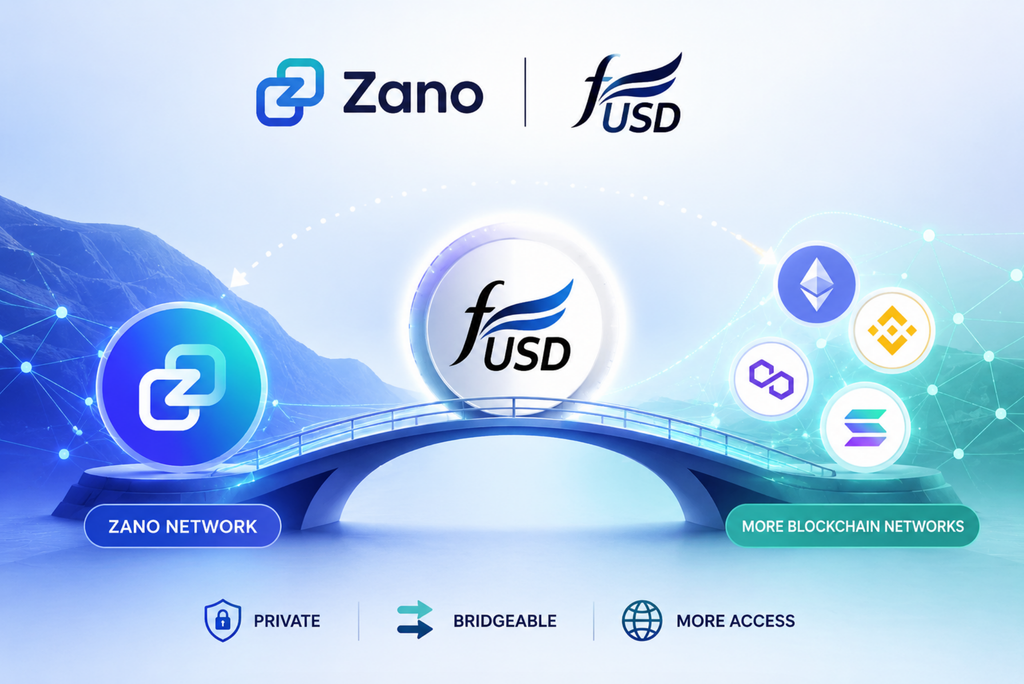
Zano is working on a way to connect its private stablecoin, $fUSD, with other crypto networks. This could let people keep their funds private on Zano while also accessing more crypto markets and services when they want.

Table of Contents

  1. Zano Is More Than $ZANO
  2. What Is $fUSD?
  3. Why Does $fUSD Need to Reach Other Networks?
  4. How Could Zano’s Execution Layer Help?
  5. A Simple Example
  6. What Could This Mean for Users?
  7. The Bigger Picture

1. Zano Is More Than $ZANO

When people hear about Zano, they often think about its native cryptocurrency, $ZANO.

But Zano is also building an ecosystem of private digital assets called Confidential Assets.

One example is $fUSD, a private stablecoin designed to maintain a value close to the US dollar while benefiting from Zano’s privacy features.

According to Zano, Confidential Assets such as fUSD will be able to move beyond the Zano network once the Zano Execution Layer arrives.

This could make private assets like fUSD useful in a much wider part of the crypto world.

2. What Is $fUSD?

A stablecoin is a type of cryptocurrency designed to keep a relatively stable value, usually by tracking a traditional currency such as the US dollar.

$fUSD is Zano’s private stablecoin.

The idea is to combine the convenience of a digital dollar with Zano’s focus on financial privacy.

For people who are new to crypto, you can think of fUSD as a private digital version of the US dollar that can be used within the Zano ecosystem.

If you want to understand fUSD before going deeper, check out our beginner friendly guide: πŸ‘‰ What Is fUSD? Zano’s Private Stablecoin

3. Why Does $fUSD Need to Reach Other Networks?

Why would a private stablecoin need to leave Zano?

The simple answer is access.

Some of the biggest crypto markets and financial applications operate on other blockchain networks.

These include DeFi, short for decentralized finance. DeFi allows people to trade, lend and borrow digital assets using blockchain based applications rather than traditional banks.

Today, a private stablecoin like fUSD has limited access to these wider markets.

Bridging could change that.

4. How Could Zano’s Execution Layer Help?

Zano is developing an Execution Layer designed to expand what can be built and used around the Zano ecosystem.

According to Zano, once the Execution Layer arrives, Confidential Assets such as fUSD will be bridgeable to other blockchain networks.

In simple terms, a bridge is a way to move an asset between different blockchain networks so it can be used in another ecosystem.

This could allow users to:

  1. Hold fUSD privately on Zano.
  2. Bridge it to a supported blockchain.
  3. Use it in available DeFi applications and markets.
  4. Bring it back to Zano when they want.

The bigger idea is to give users more choice without forcing them to give up the privacy benefits available on Zano.

5. A Simple Example

Imagine you have $1,000 worth of fUSD.

You want to keep your funds private, so you hold them on Zano.

Later, you want to use some of that money in a DeFi application operating on another blockchain.

With the planned bridging capability, you could potentially move your fUSD to that network and use the available services.

When you are finished, you could bring the asset back to the Zano ecosystem.

Think of it like a bridge between two cities.

You can keep your money in one place when you want, but when you need access to something in another place, you have a way to get there.

6. What Could This Mean for Users?

If the planned functionality becomes available, it could make fUSD more useful beyond the Zano network.

For everyday users, this could mean:

More choice: Use fUSD privately on Zano or access supported markets elsewhere.

More opportunities: Potentially use fUSD for trading, lending and other DeFi activities on supported networks.

Privacy when needed: Keep your funds within Zano when privacy is your priority.

Access to wider markets: Connect a private stablecoin with markets and services available on other blockchain networks.

This could help address one of the challenges faced by private cryptocurrencies today: having privacy while still being able to access the wider crypto ecosystem.

7. The Bigger Picture

Zano is working toward a future where private assets do not have to stay isolated from the rest of the crypto world.

With the planned Execution Layer, Confidential Assets such as $fUSD are expected to become bridgeable to other blockchain networks.

That could allow users to keep their funds private on Zano, access wider crypto markets when they want, and return to Zano when they need its privacy features.

The idea is simple:

Privacy does not have to mean isolation.

If successful, Zano could give users a way to combine the privacy of its network with access to a much wider range of crypto markets and DeFi services.

Sources:

Disclaimer: ZanoNews.com is an independent news and information website. This article is for informational purposes only and does not constitute financial or investment advice.
Zano’s Private Stablecoins: Why fUSD and DAIx Matter πŸ”

Stablecoins are cryptocurrencies designed to keep a stable value, usually around $1. But there is an important difference between a stablecoin that is simply stable and one that also protects your financial privacy.

On Zano, $fUSD and $DAIx are designed to bring dollar-based value into Zano’s private ecosystem.

Table of Contents

  1. What Are fUSD and DAIx?
  2. What Is fUSD?
  3. What Is DAIx?
  4. Why Privacy Matters
  5. What Makes Zano Different?
  6. What This Means for Users

1. What Are fUSD and DAIx?

Both are stablecoins or dollar-based crypto assets that can be used within the Zano ecosystem.

The main difference is where they come from:

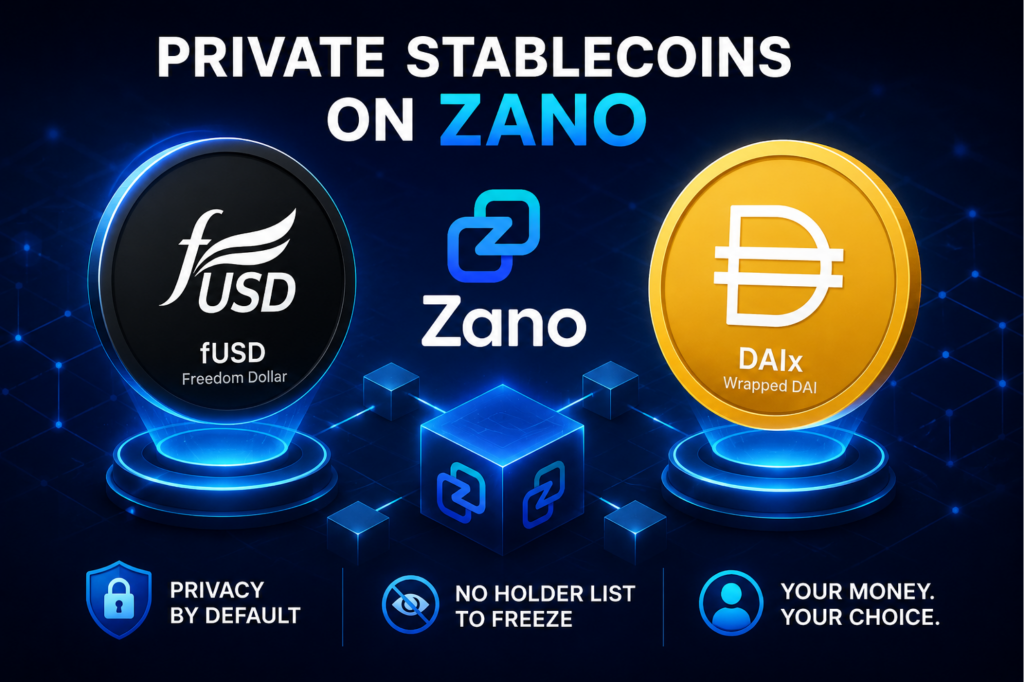
  • $fUSD (Freedom Dollar) is a private stablecoin built directly on the Zano blockchain and designed to stay close to $1 USD.
  • $DAIx (Wrapped DAI) is a private version of DAI that operates on the Zano blockchain while retaining its connection to the original DAI asset..

Both benefit from Zano’s privacy technology.

2. What Is fUSD?

fUSD stands for Freedom Dollar.

It is a decentralized stablecoin built on the Zano blockchain. Its goal is to maintain a value close to $1, while allowing users to make private transactions.

Unlike traditional stablecoins that operate on transparent blockchains, fUSD uses Zano’s privacy features to hide transaction details such as the sender, receiver and amount.

In simple terms:

fUSD = digital dollars + privacy.

πŸ‘‰ Learn more about fUSD and how Zano’s private stablecoin works here

3. What Is DAIx?

DAIx is a wrapped version of DAI that operates as a Confidential Asset on Zano.

DAI is a well-known decentralized stablecoin designed to track the value of the US dollar. Zano’s technology allows DAI to be brought into its private ecosystem as DAIx.

This means users can use a dollar-based asset on Zano while benefiting from the network’s privacy features. Zano’s documentation confirms DAIx as its Wrapped Dai asset.

In simple terms:

DAIx = DAI + Zano privacy.

4. Why Privacy Matters

Many stablecoins operate on public blockchains where transaction information can be viewed and analyzed.

Zano takes a different approach.

Its Confidential Assets are designed so that transaction details are hidden from outside observers. This applies to assets such as stablecoins as well as other tokens running on Zano.

This can provide users with more financial privacy when sending, receiving or holding stable-value assets.

5. What Makes Zano Different?

Zano is designed to make privacy the default, rather than something users need to turn on.

That means users can hold and transact with supported confidential assets without publicly revealing their balances, transaction amounts or counterparties.

For fUSD, the protocol also states that there is no central authority with the ability to freeze funds in a user’s wallet.

This is the point behind Zano’s latest message:

A stablecoin that can be frozen is still worth a dollar. It just isn’t your dollar.

6. What This Means for Users

The idea is simple.

A stablecoin can provide the stability of the US dollar, but users may also want privacy and control over their money.

With fUSD, Zano offers a dollar-based stablecoin built directly around privacy.

With DAIx, users can bring the familiar DAI asset into Zano’s private ecosystem.

Together, they show how Zano is trying to build a private financial ecosystem where stable-value assets can be used without putting every transaction on public display.

Sources:

Disclaimer: ZanoNews.com is an independent news and information website. This article is for informational purposes only and does not constitute financial or investment advice.
Zano Punches Above Its Weight as $ZANO and fUSD See Real-World Use

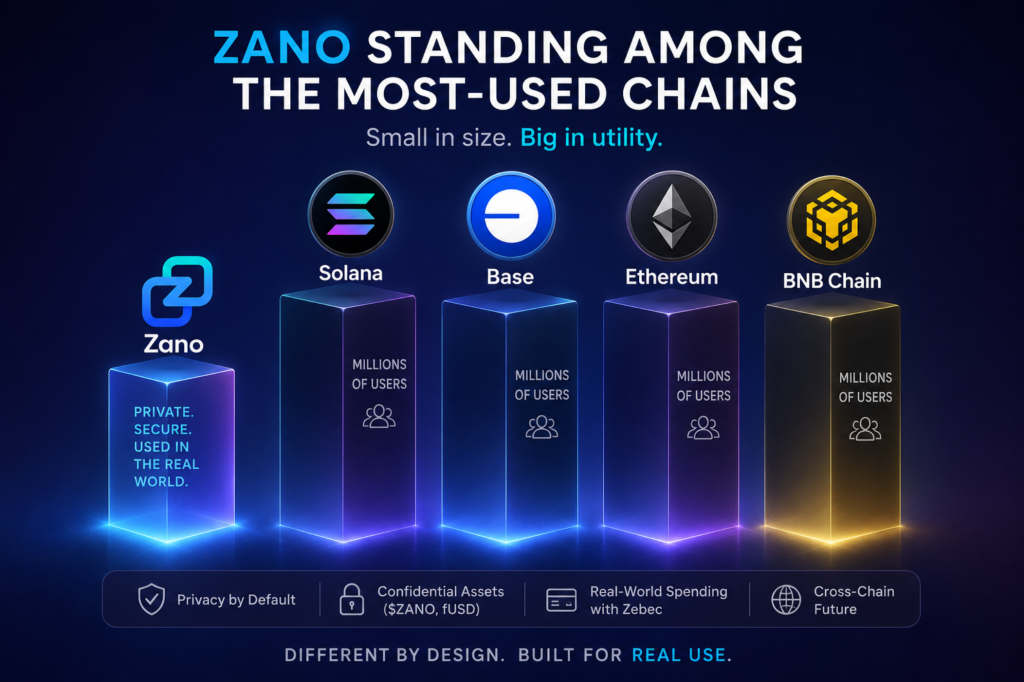
Zano may still have a relatively small market cap compared with major blockchains like Ethereum and Solana, but its real-world use is growing.

From private transactions and digital assets to everyday payments, Zano is becoming more than just another cryptocurrency.$ZANO and $fUSD are now being used through the Zebec ecosystem for real-world spending.

Zano is also standing alongside much larger networks such as Solana, Base, Ethereum and BNB Chain as one of the most-used chains on the Zebec mobile SuperApp.

That is what makes Zano interesting: small in market cap, but punching well above its weight when it comes to utility.

Table of Contents

  1. Why Zano Is Punching Above Its Weight
  2. Why Real-World Use Matters
  3. What Is the Zano and Zebec Connection?
  4. Why Zano’s Privacy Matters
  5. Why Zano Could Become More Important in Crypto
  6. What’s Next for Zano?
  7. The Bigger Picture
  8. Sources

1. Why Zano Is Punching Above Its Weight

Zano is much smaller than networks such as Ethereum, Solana and BNB Chain.

Yet it is appearing alongside them among the most-used chains on Zebec’s mobile SuperApp.

Why?

Because Zano offers something different: privacy-focused digital money that people can actually use.

2. Why Real-World Use Matters

Crypto is not only about buying and selling coins.

For crypto to become part of everyday life, people need to be able to use it for real payments.

Through its connection with Zebec, Zano users can use $ZANO and $fUSD for everyday spending.

This gives Zano a practical use case beyond simply holding or trading cryptocurrency.

3. What Is the Zano and Zebec Connection?

Zebec is a crypto payments platform that helps people use digital assets for everyday spending.

The basic idea is simple:

Hold $ZANO or fUSD β†’ use a supported Zebec card β†’ spend your crypto in the real world.

πŸ‘‰ Click here to see how it works: ZANO & Zebec Cards

4. Why Zano’s Privacy Matters

This is where Zano really stands apart.

Many major blockchains make transaction information publicly visible. Zano takes a different approach, with privacy built into the blockchain by default.

In simple terms, people can use Zano without having their financial activity openly visible on the blockchain.

For everyday digital payments, that can be a major advantage.

5. Why Zano Could Become More Important in Crypto

Zano is becoming increasingly interesting because it brings together three things:

Privacy + usable crypto + real-world payments.

Most people do not want their bank transactions publicly available for everyone to see.

As more people start using cryptocurrency for everyday payments, financial privacy could become even more important.

That is where Zano has a unique position.

It is not simply trying to be another large blockchain. It is building around the idea of private digital money that people can actually use.

6. What’s Next for Zano?

Zano is continuing to expand beyond payments.

The project is developing connections with other blockchain networks and working on ZEL, its upcoming smart-contract layer.

This could allow developers to build applications around Zano while keeping the main Zano blockchain focused on privacy.

Together with growing payment integrations, this could give Zano more ways to connect private digital money with the wider crypto economy.

7. The Bigger Picture

The latest Zebec update may look like a small announcement, but it highlights something important.

Zano is a fraction of the size of some of the biggest blockchain networks, yet it is already seeing real-world use through $ZANO and $fUSD.

That is the kind of utility the crypto industry needs to move beyond speculation.

Zano’s privacy-first blockchain, private assets and growing payment options give it a position that few other crypto projects can easily replicate.

Small in market cap, but increasingly big in utility.

If this growth continues, Zano could become an increasingly important name not only in privacy-focused crypto, but in the wider blockchain industry.

8. Sources

Disclaimer: ZanoNews.com is an independent news and information website. This article is for informational purposes only and should not be considered financial, investment, or legal advice.

ZANO and Zebec Cards: How to Spend Private Crypto in the Real World

Holding cryptocurrency is one thing. Actually using it in everyday life is another.

For Zano users, the integration with Zebec helps bridge that gap by connecting privacy-focused crypto with familiar card payments.

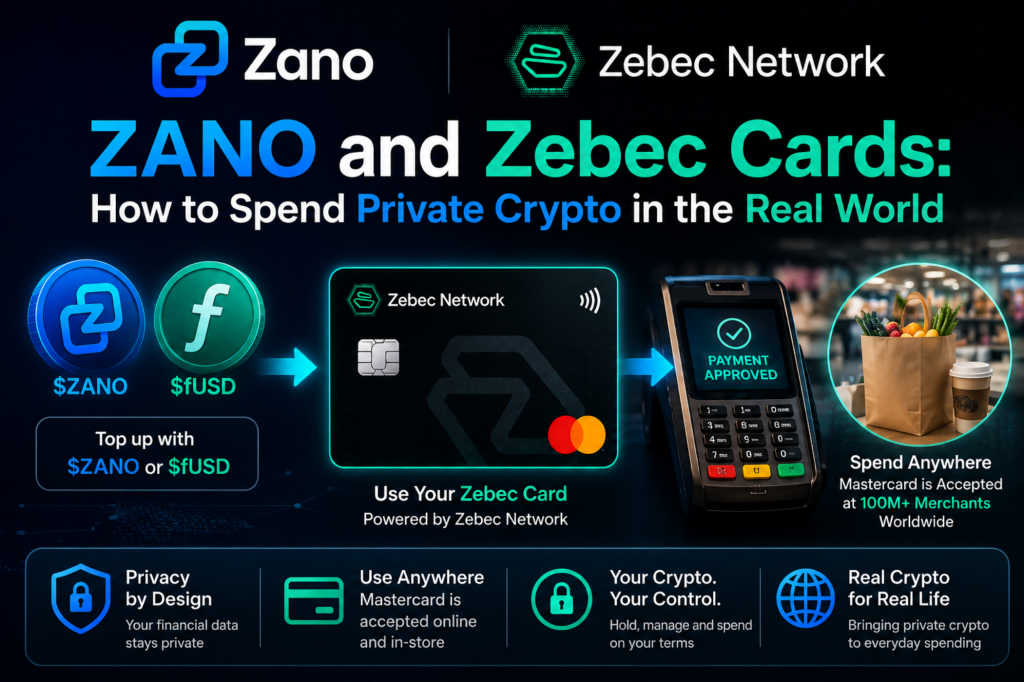
Users can use $ZANO and $fUSD with supported Zebec cards and spend through the Mastercard network, bringing Zano closer to everyday purchases such as groceries, travel, dining and online shopping.

Table of Contents

  1. What Is the Zano and Zebec Connection?
  2. What Are Zebec Cards?
  3. How Can You Spend ZANO?
  4. What About fUSD?
  5. A Simple Example: Buying Groceries
  6. Why This Matters for Privacy
  7. How This Builds on the Original Zano Γ— Zebec Integration
  8. What This Means for Zano Users
  9. The Road Ahead
  10. Sources

1. What Is the Zano and Zebec Connection?

Zano is a privacy-focused blockchain designed to give users greater control over their financial information.

Zebec focuses on making digital assets more useful in the real world, including through crypto payment cards.

The Zano and Zebec integration was first announced in August 2025, when Zano announced its integration with Zebec Network, making it possible to spend $ZANO through Zebec’s Mastercard payment cards.

The integration then went live, with $ZANO supported on Zebec Silver and Carbon cards.

Today, the idea is simple:

Hold ZANO privately β†’ load your supported Zebec card β†’ use it for everyday spending.

2. What Are Zebec Cards?

Zebec Cards are crypto-linked payment cards that allow users to spend supported digital assets through the Mastercard payment network.

For someone unfamiliar with crypto, the easiest way to think about it is:

Your crypto provides the funds, while the card gives you a familiar way to spend them.

You don’t need a supermarket, restaurant or online store to directly accept ZANO. The merchant simply needs to accept Mastercard, subject to the card’s availability and applicable terms.

This makes the experience much closer to using a traditional payment card.

3. How Can You Spend ZANO?

The process is designed to be straightforward.

You hold $ZANO in your wallet and use it to fund a supported Zebec card.

You can then use that card for everyday purchases wherever Mastercard is accepted.

For example:

ZANO β†’ Zebec Card β†’ Mastercard β†’ Your purchase

The merchant does not need to run a Zano wallet or understand blockchain technology.

For the customer, it can feel much like using any other payment card.

Zano has also confirmed that its custom Zano Card powered by Zebec can be used at Mastercard merchants and supports Apple Pay and Google Pay.

4. What About fUSD?

ZANO isn’t the only Zano ecosystem asset that can be used with Zebec.

fUSD, Zano’s privacy-focused stablecoin, can also be loaded onto a Zebec Mastercard and spent where Mastercard is accepted. Zano highlighted this functionality in its September 2025 project update.

The difference is simple:

$ZANO is Zano’s native cryptocurrency, while fUSD is designed to maintain a stable value.

This gives users another option when they want to spend within the Zano ecosystem without directly spending ZANO.

5. A Simple Example: Buying Groceries

Imagine you have ZANO in your wallet and want to buy groceries.

Traditionally, you might need to:

  1. Send ZANO to an exchange.
  2. Sell it for traditional currency.
  3. Withdraw the money.
  4. Use your bank card to buy your groceries.

A supported Zebec card can simplify that process.

You can use your ZANO to fund the card and then pay at a Mastercard-accepting supermarket.

Your crypto stays in the crypto ecosystem until you need to spend it.

That is the practical value of connecting Zano with an established payment network.

6. Why This Matters for Privacy

This is where the Zano connection becomes particularly interesting.

Zano is built around financial privacy. Its blockchain is designed to keep sensitive transaction information from being publicly exposed in the same way it can be on transparent blockchains.

But it is important to understand that Zano’s blockchain privacy does not mean a Mastercard card purchase is completely anonymous.

The two systems operate at different layers.

Zano: Provides the privacy-focused crypto asset and blockchain infrastructure.

Zebec: Provides the card-based spending infrastructure.

Mastercard: Provides the payment network used by participating merchants.

So the benefit is not that every part of a real-world card transaction becomes invisible.

The benefit is that users have a practical way to take a privacy-focused digital asset and use it in the existing payment system.

7. How This Builds on the Original Zano Γ— Zebec Integration

If you’ve read our earlier article, πŸ‘‰ β€œZANO will officially be integrated into Zebec Network, bringing real-world use for Zano and some Confidential Assets to the next level!”, this new development is the next part of that story.

The original article focused on the announcement of the integration and introduced Zebec’s different card options.

The integration subsequently went live, allowing ZANO to be spent through supported Zebec cards.

Since then, the ecosystem has continued to develop. Zano later confirmed the availability of its custom Zebec-powered card, as well as fUSD spending through a Zebec Mastercard.

So the story has moved from:

β€œZano is integrating with Zebec”

to:

β€œZano can be used through Zebec for real-world spending.”

8. What This Means for Zano Users

For Zano users, this gives their digital assets more practical utility.

Instead of simply:

Hold β†’ Send β†’ Trade

there are now more ways to use Zano:

Hold β†’ Send β†’ Trade β†’ Spend

And Zebec is only one part of Zano’s growing payment ecosystem.

Zano has also expanded real-world spending through other services, including AEON Pay and PrivacyGateway, giving users additional ways to use ZANO in everyday situations.

The bigger goal is simple: make privacy useful, not just something that exists on the blockchain.

9. The Road Ahead

For years, one of the biggest questions around cryptocurrency has been:

β€œWhat can I actually do with it?”

The answer is becoming increasingly practical.

With Zano and Zebec, users have another way to take privacy-focused digital assets such as ZANO and fUSD beyond the wallet and into everyday spending.

The important point is not that crypto is replacing Mastercard or traditional payment networks.

It is that these networks can become a bridge between privacy-focused digital money and the existing financial world.

For Zano, that represents another step toward making privacy more than a blockchain feature.

It makes privacy part of a broader, usable financial experience.

As more payment providers, merchants and services support Zano and its Confidential Assets, the gap between holding private digital money and actually using it in the real world can continue to shrink.

10. Sources

Disclaimer: ZanoNews.com is an independent news and information website. This article is for informational purposes only and should not be considered financial, investment, or legal advice.

How to Spend ZANO with AEON Pay πŸ’³

One of the biggest challenges in cryptocurrency has always been finding practical ways to use digital assets for everyday purchases. While many cryptocurrencies can be bought, sold, and traded, spending them at real merchants has often been difficult.

On July 16, 2026, Zano and AEON hosted a live Fireside Chat to discuss how users can spend $ZANO and $fUSD privately through AEON Pay. The session featured Mike, VP of Research & Partnerships at AEON, Ronne van Rijn, Managing Partnerships at Zano, and Idris Mustapha, Zano African Ambassador. Together, they shared how AEON Pay is helping bring privacy-focused cryptocurrency payments into everyday life.

Although the live event has already taken place, the discussion remains relevant because it demonstrates how blockchain technology is evolving beyond investing and becoming a practical payment solution.

Table of Contents

  1. What Is AEON Pay?
  2. How to Spend ZANO with AEON Pay
  3. Real-World Experience
  4. Why This Partnership Matters
  5. Privacy Comes First
  6. Looking Ahead
  7. Frequently Asked Questions (FAQ)
  8. Why It Matters Today

1. What Is AEON Pay?

AEON Pay is a cryptocurrency payment platform that allows users to pay participating merchants using supported digital assets.

Its goal is to make cryptocurrency simple and practical for everyday use by offering:

  • Fast and convenient payments
  • Support for privacy-focused cryptocurrencies
  • Real-world merchant payments
  • A simple way to spend crypto instead of only holding it

As more businesses begin accepting digital assets, payment platforms like AEON Pay help connect blockchain technology with everyday shopping.

2. How to Spend ZANO with AEON Pay

AEON Pay currently supports payments using:

This gives Zano users another practical way to use their digital assets beyond buying, selling, or staking.

Instead of leaving coins in a wallet, users can spend $ZANO and $fUSD at supported merchants while benefiting from Zano’s privacy-focused blockchain.

3. Real-World Experience

One of the highlights of the Fireside Chat was hearing from a user in Nigeria who shared their day-to-day experience using AEON Pay.

Rather than focusing on future possibilities, the discussion highlighted how privacy-focused cryptocurrency is already being used for everyday purchases.

Real-world examples like this show that crypto adoption is moving beyond speculation and becoming more practical for ordinary users.

4. Why This Partnership Matters

Many blockchain projects talk about real-world adoption, but successful adoption depends on practical payment solutions.

The collaboration between Zano and AEON Pay offers several benefits:

  • More real-world utility for ZANO
  • Private and secure payments
  • Greater value for cryptocurrency holders
  • Easier spending at participating merchants
  • Increased adoption of privacy-focused blockchain technology

As more payment providers support digital assets, partnerships like this help make cryptocurrency more useful in everyday life.

5. Privacy Comes First

Privacy remains one of the main reasons many people choose cryptocurrencies like Zano.

Traditional payment systems often collect and store personal financial information whenever a payment is made. Zano was designed to provide confidential transactions while maintaining speed, security, and ease of use.

The integration with AEON Pay shows that users don’t have to choose between privacy and convenienceβ€”they can enjoy both.

6. Looking Ahead

The Fireside Chat highlighted how cryptocurrency is steadily moving beyond trading and investing.

As payment platforms continue expanding their merchant networks and supporting more digital assets, services like AEON Pay could play an important role in bringing cryptocurrency into everyday commerce.

For the Zano ecosystem, this partnership represents another step toward broader adoption and greater real-world utility.

7. Frequently Asked Questions (FAQ)

1. What is AEON Pay?

AEON Pay is a cryptocurrency payment platform that allows users to spend supported digital assets at participating merchants.

2. Can I spend ZANO with AEON Pay?

Yes. AEON Pay supports $ZANO, allowing users to make payments at participating merchants where the service is available.

3. What is fUSD?

$fUSD is a stable digital asset within the Zano ecosystem that can also be used through AEON Pay.

4. Why is the July 16, 2026 Fireside Chat still relevant?

The event showcased how Zano and AEON Pay are making private cryptocurrency payments more practical. Although the live discussion has ended, the partnership continues to demonstrate how blockchain can be used for everyday spending.

5. Why is this partnership important for Zano?

The collaboration expands the real-world utility of ZANO by giving users more opportunities to spend their cryptocurrency while maintaining the privacy and security that Zano is known for.

8. Why It Matters Today

Although the Fireside Chat took place on July 16, 2026, its message continues to matter today.

The collaboration between $ZANO, AEON Pay, and $fUSD shows that privacy-focused cryptocurrency is becoming more than just an investmentβ€”it is becoming a practical way to pay for everyday goods and services.

As cryptocurrency adoption continues to grow, partnerships like this help strengthen the Zano ecosystem and demonstrate how private, secure, and easy-to-use digital payments can become part of everyday life.

To learn more, visit:

Disclaimer: ZanoNews.com is an independent news and information website. This article is for informational purposes only and should not be considered financial, investment, or legal advice.