
Zano Explorer Introduces Three New Developer Tools for Transaction Decoding and Debugging ๐Ÿ› ๏ธ

The Zano ecosystem has introduced three new developer tools to its Block Explorer, making it easier for developers and users to inspect addresses, understand transaction structures, and investigate transaction outputs.
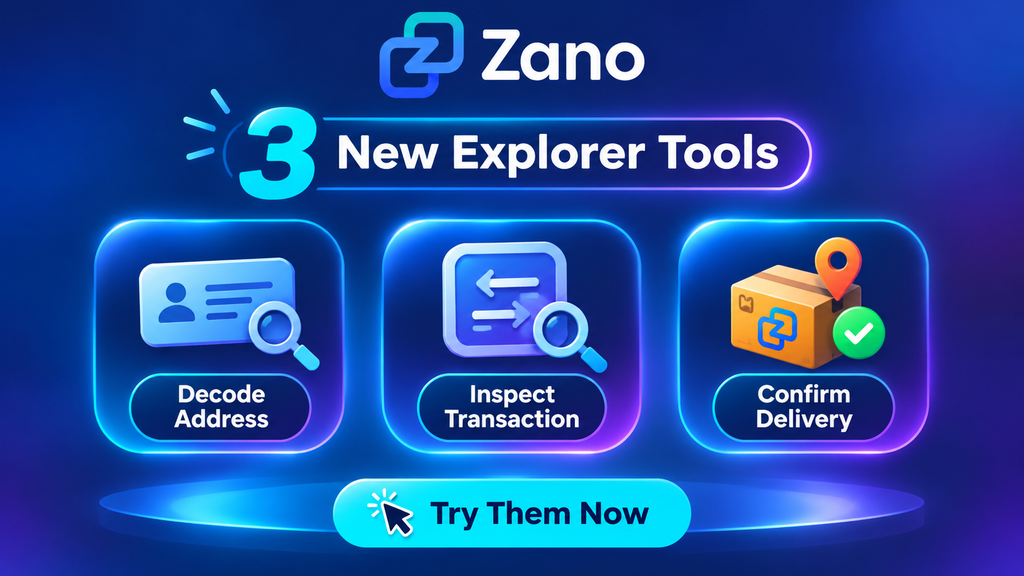
The new tools are designed to support developers integrating with the Zano blockchain, but they can also be useful for anyone who wants to verify their own transactions or understand why a transaction did not reach its expected destination.

All three tools are now available through the official Zano Block Explorer.

Table of Contents

  1. Introduction to the New Zano Developer Tools
  2. Address Decoder: Understanding Zano Addresses
  3. Transaction Decoder: Inspecting Transaction Structures
  4. Transaction Output Decryptor: Verifying Transaction Destinations
  5. Who Can Benefit From These Tools?
  6. Where to Access the New Tools?
  7. Making Zano Development and Transaction Debugging More Accessible

1. Introduction to the New Zano Developer Tools

Blockchain explorers are essential for checking transactions and understanding activity on a blockchain. However, developers sometimes need more detailed information than a standard transaction page provides.

To address these needs, Zano has added three dedicated tools to its Block Explorer:

  • Address Decoder
  • Transaction Decoder
  • Transaction Output Decryptor

Each tool serves a different purpose, helping users extract address information, inspect transaction structures, and verify where transaction outputs were sent.

These additions are particularly useful for developers working on integrations, applications, and services built around the Zano blockchain.

2. Address Decoder: Understanding Zano Addresses

The Address Decoder extracts information that is already encoded within a Zano address.

Instead of manually trying to interpret the different components of an address, developers can use this tool to view the information in a more understandable format.

This can be helpful when building applications that interact with Zano addresses or when checking address details during integration and testing.

In simple terms, it helps developers understand what information is contained within a Zano address.

3. Transaction Decoder: Inspecting Transaction Structures

The Transaction Decoder allows users to inspect the internal structure of a transaction using its transaction secret key.

This provides developers with another way to examine transaction details when investigating how a transaction was constructed or processed.

For developers integrating Zano into their applications, understanding transaction structures can be important when testing payment functionality, investigating unexpected behaviour, or troubleshooting integration issues.

Rather than relying only on the visible transaction information, the decoder provides access to additional transaction details using the supplied secret key.

4. Transaction Output Decryptor: Verifying Transaction Destinations

The third addition is the Transaction Output Decryptor.

Its purpose is to help users confirm what was sent and where the transaction output landed.

The tool processes the information server-side using the transaction secret key and the destination addresses supplied by the user.

This can be particularly useful when someone sends a transaction but wants to verify whether the funds reached the intended destination.

For example, if a developer is testing a payment integration and a transaction does not appear where expected, the decryptor can help investigate the transaction outputs and identify what was actually sent.

It adds another practical option for troubleshooting transactions on the Zano network.

5. Who Can Benefit From These Tools?

Although these tools are primarily designed with developers in mind, their usefulness extends beyond software development.

Some practical use cases include:

  • Blockchain developers: Inspect transaction structures and understand address information when building Zano integrations.
  • Application developers: Test payment functionality and investigate unexpected transaction behaviour.
  • Businesses integrating Zano: Verify transactions as part of payment and application testing.
  • Regular users: Investigate their own transactions and better understand where their funds were sent.

The tools bring several technical operations together in one place, making transaction investigation and integration work more straightforward.

6. Where to Access the New Tools?

All three developer tools are now live and accessible through the official Zano Block Explorer.

You can find them here:

Explore Zano’s New Developer Tools ๐Ÿ‘ˆ

The tools are available directly through the explorer, providing developers and users with a dedicated place to inspect address information, decode transactions, and investigate transaction outputs.

7. Making Zano Development and Transaction Debugging More Accessible

The introduction of these three tools adds another practical set of resources to the Zano ecosystem.

By bringing address decoding, transaction inspection, and output verification into the Block Explorer, Zano is making it easier for developers to work with the network and investigate issues during integration.

For anyone building applications on Zano or simply looking to understand their own transactions in more detail, these tools provide additional ways to explore what is happening behind the scenes.

Learn More

To learn more about Zano and its growing ecosystem, visit the following resources:

Disclaimer: ZanoNews.com is an independent news and information website. This article is for informational purposes only and should not be considered financial or investment advice.
Why Privacy by Default Matters in Blockchain ๐Ÿ”’

Blockchain technology is often praised for transparency, but should every transaction be visible to everyone?

Some blockchains offer optional privacy features that allow users to hide their transactions or balances. However, Zano highlights a potential problem with this approach: when privacy is optional, choosing to use it can make a transaction stand out.

Zano takes a different approach, making privacy the default for every transaction.

๐ŸŽฅ See why Zano makes every transaction private by default. ๐Ÿ‘‡

Table of Contents

  1. The Problem with Optional Privacy
  2. What Is an Anonymity Set?
  3. How Privacy by Default Works
  4. Why Zano Takes a Different Approach
  5. Why This Matters for Everyday Users
  6. A Different Approach to Blockchain Privacy

1. The Problem with Optional Privacy

Some blockchain networks allow users to choose whether they want their transactions to be public or private.

While this provides flexibility, it can also create an unexpected problem.

When most transactions are public and only a small number use privacy features, those private transactions become easier to identify.

In other words, choosing to hide your activity can attract attention to it.

Zano argues that privacy should not be something users have to switch on when they want to keep their financial activity private.

2. What Is an Anonymity Set?

Anonymity set is a term used to describe the group of transactions or users among which someone’s activity is difficult to distinguish.

Think of it like standing in a crowd.

If you are standing among thousands of people, it becomes harder to identify you. But if you are standing in a group of only five people, there are fewer places to blend in.

The same principle applies to blockchain privacy.

When only a small number of transactions are private, the anonymity set is limited. A larger group makes it harder to distinguish individual activity.

3. How Privacy by Default Works

Zano takes a different approach.

Rather than offering a separate shielded mode, Zano makes transaction privacy the default.

This means users do not need to choose between making a public transaction and a private one.

Every transaction follows the same privacy approach, so there is no separate opt-in privacy activity that immediately distinguishes users who choose it.

The idea is simple: privacy should be part of the network itself, rather than an optional feature.

4. Why Zano Takes a Different Approach

According to Zano, optional privacy can create patterns that blockchain analytics companies may monitor.

In some cases, transactions involving privacy tools can also attract additional attention from exchanges and compliance systems.

This does not necessarily mean someone has done anything wrong. It highlights how choosing a privacy feature can sometimes create unwanted attention.

Zano’s approach aims to avoid this distinction by applying privacy consistently across the network.

5. Why This Matters for Everyday Users

Financial privacy is not necessarily about hiding something wrong.

People expect privacy when managing their bank accounts, paying bills or making personal purchases.

Blockchain users should also have the ability to keep their financial activity private.

For everyday users, privacy by default means they do not have to make a separate decision every time they want to protect their transactions.

It also supports a more consistent approach to financial privacy across the network.

6. A Different Approach to Blockchain Privacy

Blockchain transparency has its advantages, particularly when it comes to verifying transactions and understanding network activity.

However, transparency does not always need to mean exposing everyone’s financial activity.

Zano takes the position that privacy should be available to everyone by default, rather than reserved for those who actively choose to use a privacy feature.

The idea is straightforward: when everyone benefits from privacy, nobody needs to stand out just for choosing it. ๐Ÿ”’

Learn More

Disclaimer: ZanoNews.com is an independent news and information website. This article is for informational purposes only and should not be considered financial or investment advice.
Freedom Wallet Adds ZANO: Bringing Private, Self-Custodial Money Together in One Wallet ๐Ÿ”

Holding your own cryptocurrency is an important step towards financial independence. But having control over your wallet is only part of the picture. What about the privacy of the money you hold?

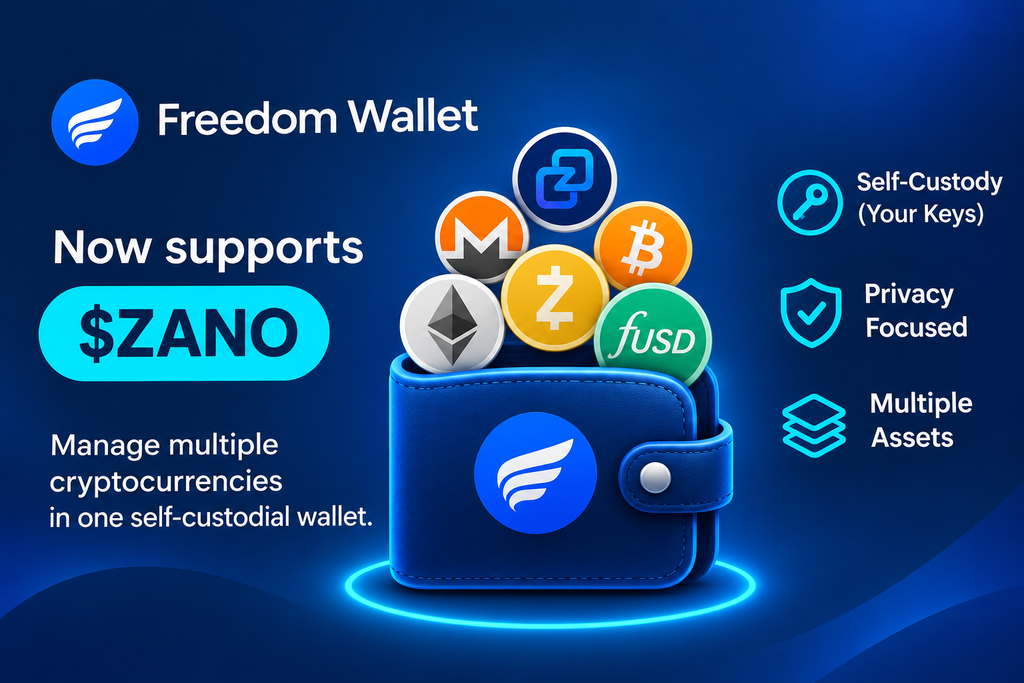
With $ZANO now available in Freedom Wallet, users can access Zano alongside several other cryptocurrencies in a wallet designed around self-custody and privacy.

The idea is simple: you should control your keys, and you should have access to money that offers stronger privacy protections.

This is the message behind a recent post from the Zano team, highlighting the availability of $ZANO in Freedom Wallet.

But what exactly does this mean, what can Freedom Wallet do, and how can you download it?

Let’s take a closer look.

Table of Contents

  1. What Is Freedom Wallet?
  2. Why Is $ZANO’s Availability Important?
  3. What Can You Do With Freedom Wallet?
  4. Understanding Self-Custody and Privacy
  5. How to Download Freedom Wallet
  6. Important Things to Remember
  7. Why This Matters for the Zano Ecosystem

1. What Is Freedom Wallet?

Freedom Wallet is a self-custodial cryptocurrency wallet available for iPhone, Android and desktop computers.

In simple terms, it allows you to store, send and receive supported cryptocurrencies while keeping control of your private keys.

Unlike a traditional custodial exchange, where a company holds your cryptocurrency on your behalf, Freedom Wallet puts the responsibility for controlling and securing your wallet in your hands.

According to its official website, the wallet supports several cryptocurrencies, including:

  • ๐Ÿ”ต ZANO โ€“ Privacy-focused digital money.
  • ๐ŸŸ  Bitcoin (BTC) โ€“ The original cryptocurrency.
  • ๐ŸŸฃ Ethereum (ETH) โ€“ A blockchain network supporting smart contracts.
  • ๐ŸŸก Monero (XMR) โ€“ A cryptocurrency with transaction privacy by default.
  • ๐Ÿ›ก๏ธ Zcash (ZEC) โ€“ A cryptocurrency offering shielded transactions.
  • ๐Ÿ’ต Freedom Dollar (fUSD) โ€“ A dollar-targeting digital asset on the Zano blockchain.

The wallet also supports other assets, including USDT, USDC, Bitcoin Cash (BCH) and TRON (TRX), depending on the device and network.

The main idea is to bring several cryptocurrencies together in one place without requiring users to hand over control of their funds to a centralised custodian.

2. Why Is $ZANO’s Availability Important?

The Zano team recently highlighted an important point in its announcement:

Holding your own keys is step one. Step two is using private money nobody can censor or freeze.

This message touches on two important concepts in cryptocurrency: self-custody and financial privacy.

Self-custody means you control your wallet’s private keys rather than relying on an exchange or another company to manage your funds.

Privacy is a different part of the equation.

Bitcoin and Ethereum transactions are recorded on public blockchains, meaning transaction information can generally be viewed by anyone using a blockchain explorer.

Zano takes a different approach.

Zano is designed with transaction privacy enabled by default. Its protocol protects transaction information, including amounts and addresses, rather than requiring users to manually activate privacy for ordinary transactions.

By making $ZANO available through Freedom Wallet, users have another way to access and manage their ZANO alongside other supported cryptocurrencies.

This combination of self-custody and protocol-level privacy is what makes the integration interesting.

3. What Can You Do With Freedom Wallet?

Freedom Wallet brings several useful cryptocurrency features together in one application, making it easy to manage your digital assets.

Here are some of its main features:

๐Ÿ”น Send and receive crypto

Send and receive cryptocurrencies using wallet addresses or QR codes. You can also check your balances and transaction history.

๐Ÿ”น Swap cryptocurrencies

Exchange supported cryptocurrencies directly within the wallet. You can review exchange rates and provider fees before confirming.

๐Ÿ”น Manage multiple cryptocurrencies

Keep ZANO, Bitcoin, Ethereum, Monero, Zcash and other supported assets in one application instead of using separate wallets.

๐Ÿ”น Use Zano and Monero without downloading the full blockchain

Access Zano and Monero without storing the entire blockchain on your phone. Synchronisation and transaction confirmations may still take time.

๐Ÿ”น Desktop support

Freedom Wallet is also available for Windows, macOS and Linux. Desktop users can access additional features, including private payroll.

4. Understanding Self-Custody and Privacy

One of the most important things to understand about Freedom Wallet is that it is self-custodial.

But what does that actually mean?

Imagine keeping money in a bank. The bank manages your account, controls access to its services and processes transactions on your behalf.

With a self-custodial cryptocurrency wallet, you hold the private keys that give you control over your funds.

Freedom Wallet explains that your recovery phrase and private keys stay on your device. The company cannot access or recover your funds if you lose your recovery phrase.

However, there is an important distinction between owning your keys and having private transactions.

Not every cryptocurrency offers the same level of privacy.

CryptocurrencyTransaction privacy
ZANOPrivate by default
Monero (XMR)Private by default
Zcash (ZEC)Available through shielded addresses
Bitcoin (BTC)Public blockchain
Ethereum (ETH)Public blockchain

This distinction matters because simply using a self-custodial wallet does not automatically make every cryptocurrency private.

With Zano, transaction privacy is built into the underlying blockchain protocol.

For users who value financial privacy, this is an important difference.

5. How to Download Freedom Wallet

Getting started with Freedom Wallet is relatively straightforward. The application is available for iPhone, Android and desktop computers.

You can download it directly from the official website:

Official website: FreedomWallet.com

Follow these steps to get started.

Step 1. Visit the official website

Open your browser and visit:www.freedomwallet.com

You will see the main page introducing Freedom Wallet and its supported cryptocurrencies.

Click the Download button.

Step 2. Select your device

Choose the version that matches your device.

  • iPhone: Download through the Apple App Store.
  • Android: Download through Google Play.
  • Windows: Download the Windows installer.
  • macOS: Download the macOS application.
  • Linux: Download the Linux AppImage.

You can also access the official download options directly:

For security, always use the official website or the verified app store listings.

Step 3. Install and open the application

Once the download is complete, install Freedom Wallet and open the application.

You will be greeted with a welcome screen where you can select the cryptocurrency network for your first wallet.

Step 4. Select Zano

docs.cakewallet.com

Select Zano from the list of available cryptocurrencies.

You can also add other supported networks, such as Bitcoin, Ethereum, Monero and Zcash.

Step 5. Create or restore your wallet

Follow the application’s instructions to create a new wallet or restore an existing one using your recovery phrase.

If you are creating a new wallet, make sure you:

  1. Follow the wallet creation instructions.
  2. Securely back up your recovery phrase.
  3. Store it somewhere private and offline.
  4. Set up your wallet’s security options.

Important: Never share your recovery phrase with anyone. Anyone who obtains it could gain control of your cryptocurrency.

Step 6. Access and manage your ZANO in Freedom Wallet

Once you have created your wallet and selected Zano, you can access your ZANO wallet directly within the Freedom Wallet application.

From there, you can:

  1. View your balance: Check how much ZANO you hold.
  2. Receive ZANO: Copy your wallet address and share it with someone sending you ZANO.
  3. Send ZANO: Enter the recipient’s Zano address and the amount you want to transfer.
  4. Manage other cryptocurrencies: Add and manage other supported assets, such as Bitcoin, Ethereum and Monero, within the same application.

That’s it! You can now use Freedom Wallet to manage your ZANO and other supported cryptocurrencies while keeping control of your private keys.

6. Important Things to Remember

While self-custody offers greater control, it also comes with responsibility.

Here are a few things to keep in mind:

  • ๐Ÿ” Protect your recovery phrase: Keep it private and store a secure offline backup.
  • ๐Ÿ“ฑ Use official downloads: Avoid unofficial websites and unknown installation files.
  • ๐Ÿ”Ž Check wallet addresses: Always double-check the recipient’s address before sending cryptocurrency.
  • ๐Ÿ’ธ Understand transaction fees: Blockchain network fees and third-party swap provider fees may apply.
  • ๐Ÿ›ก๏ธ Understand privacy differences: Bitcoin and Ethereum transactions remain publicly visible even when accessed through Freedom Wallet.

Also, while Zano provides protocol-level transaction privacy, this does not mean that every interaction with an exchange, service provider or external application is immune to restrictions.

Self-custody and transaction privacy offer important protections, but they should not be confused with an absolute guarantee that funds or transactions can never be restricted.

7. Why This Matters for the Zano Ecosystem

The availability of $ZANO in Freedom Wallet is another step towards making privacy-focused cryptocurrency easier to access.

For years, cryptocurrency users have discussed the importance of controlling their own funds rather than relying entirely on centralised platforms.

But financial independence involves more than simply holding private keys. It also involves understanding how transactions work, what information is publicly visible and how different blockchain networks approach privacy.

Zano brings privacy into the underlying blockchain protocol, while Freedom Wallet provides another way for users to access and manage their ZANO.

The combination makes it easier for people to explore self-custody and private digital money without needing to understand every technical detail behind the technology.

For newcomers, it offers another entry point into the Zano ecosystem. For existing ZANO holders, it provides an additional wallet option.

The bigger question is simple: should financial privacy be something users have to activate, or should it be part of the system from the beginning?

Zano’s approach is built around the second idea.

You can learn more about the project at Zano.org and explore Freedom Wallet at FreedomWallet.com.

Sources:

  1. Zano Official Website
  2. Zano’s announcement on X
  3. Freedom Wallet Official Website
  4. Zano Wallets and Supported Options

Disclaimer: ZanoNews.com is an independent news and information website. This article is for informational purposes only and should not be considered financial or investment advice.

Zano.fun: Explore the Zano Blockchain Like Never Before ๐Ÿš€

The blockchain can be difficult to understand if youโ€™re not familiar with crypto. But what if you could watch it come to life through a live, interactive experience?

Thatโ€™s the idea behind Zano.fun, a live network visualisation project built by @ZanoChad, introduced by the Zano team.

Instead of looking at blockchain data on a screen full of numbers, Zano.fun gives you a more visual way to explore whatโ€™s happening across the network.

Table of Contents

  1. What is Zano.fun?
  2. Battlefield: Watch the Market in Action
  3. Mission Control: Follow the Blockchain
  4. ZanoStreet: Private Transactions in Motion
  5. Why This Matters for Zano
  6. Official Links & Resources

1. What Is Zano.fun?

Zano.fun offers three different ways to explore the Zano ecosystem, each with its own visual style.

Whether you’re an experienced crypto user or simply curious about how blockchain works, the idea is to make network activity easier and more interesting to follow.

Here’s what you can explore.

2. Battlefield: Watch the Market in Action โš”๏ธ

Think of a crypto market as a place where buyers and sellers compete to get the price they want.

The Battlefield visualisation presents this activity like a battle, bringing the order book to life. An order book is simply a list of buy and sell orders waiting to be matched.

It gives users a more engaging way to look at market activity rather than just reading figures on a trading screen.

3. Mission Control: Follow the Blockchain ๐Ÿš€

Ever wondered what happens as a blockchain produces new blocks?

Mission Control presents the chain like a space mission, offering a visual way to follow its progress.

For newcomers, a blockchain is essentially a shared digital record that gets updated as new blocks are added. This visual approach makes that process more approachable, even if you don’t understand all the technical details.

4. ZanoStreet: Private Transactions in Motion ๐Ÿ”’

This is where Zano’s focus on privacy becomes especially interesting.

ZanoStreet represents transactions as people walking down a street. You can see activity happening, but the idea is that outsiders cannot simply look at a transaction and see what it carries.

Zano is designed to support private transactions, helping protect financial information that public blockchains often expose.

Privacy is important because financial activity can reveal a lot about a person or business. Being able to transact without unnecessarily exposing sensitive details is a valuable part of financial freedom.

5. Why This Matters for Zano ๐ŸŒ

Blockchain technology doesn’t have to be presented as complicated charts and technical jargon.

Projects like Zano.fun make network activity more visual, interactive and approachable. They also offer the curious a different way to explore what is happening behind the scenes.

For the Zano community, it’s another way to experience the network beyond simply checking the price of $ZANO.

Curious to see it for yourself?

Explore the live visualisations at Zano.fun and discover the Zano network from a different perspective.

Disclaimer: ZanoNews.com is an independent news and information website. This article is for informational purposes only and should not be considered financial or investment advice.
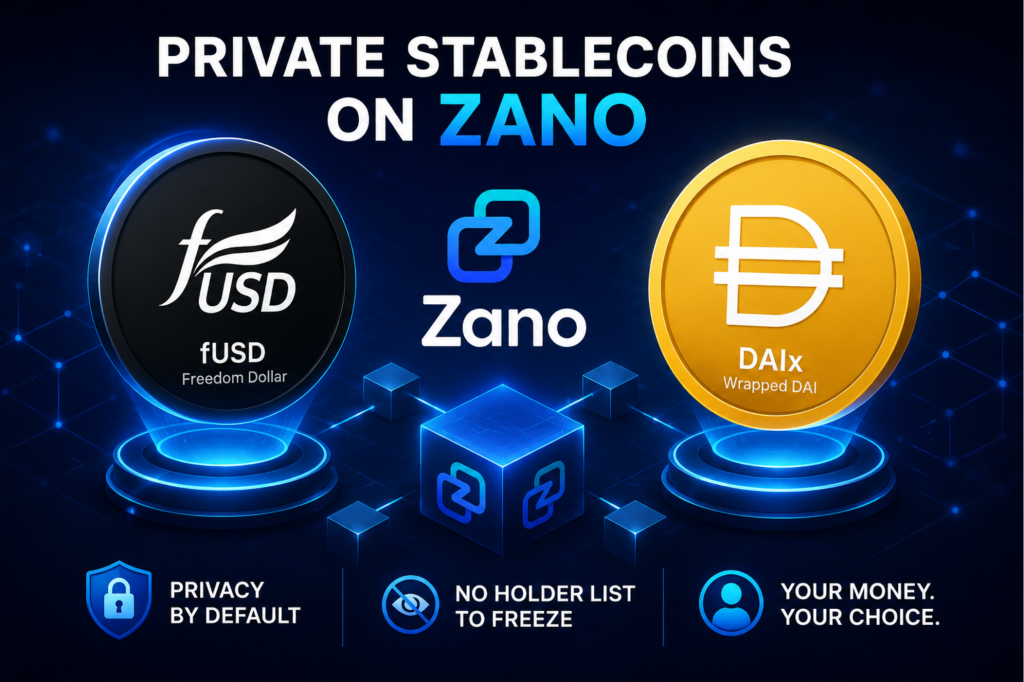
Zanoโ€™s Private Stablecoins: Why fUSD and DAIx Matter ๐Ÿ”

Stablecoins are cryptocurrencies designed to keep a stable value, usually around $1. But there is an important difference between a stablecoin that is simply stable and one that also protects your financial privacy.

On Zano, $fUSD and $DAIx are designed to bring dollar-based value into Zanoโ€™s private ecosystem.

Table of Contents

  1. What Are fUSD and DAIx?
  2. What Is fUSD?
  3. What Is DAIx?
  4. Why Privacy Matters
  5. What Makes Zano Different?
  6. What This Means for Users

1. What Are fUSD and DAIx?

Both are stablecoins or dollar-based crypto assets that can be used within the Zano ecosystem.

The main difference is where they come from:

  • $fUSD (Freedom Dollar) is a private stablecoin built directly on the Zano blockchain and designed to stay close to $1 USD.
  • $DAIx (Wrapped DAI) is a private version of DAI that operates on the Zano blockchain while retaining its connection to the original DAI asset..

Both benefit from Zanoโ€™s privacy technology.

2. What Is fUSD?

fUSD stands for Freedom Dollar.

It is a decentralized stablecoin built on the Zano blockchain. Its goal is to maintain a value close to $1, while allowing users to make private transactions.

Unlike traditional stablecoins that operate on transparent blockchains, fUSD uses Zanoโ€™s privacy features to hide transaction details such as the sender, receiver and amount.

In simple terms:

fUSD = digital dollars + privacy.

๐Ÿ‘‰ Learn more about fUSD and how Zanoโ€™s private stablecoin works here

3. What Is DAIx?

DAIx is a wrapped version of DAI that operates as a Confidential Asset on Zano.

DAI is a well-known decentralized stablecoin designed to track the value of the US dollar. Zanoโ€™s technology allows DAI to be brought into its private ecosystem as DAIx.

This means users can use a dollar-based asset on Zano while benefiting from the networkโ€™s privacy features. Zano’s documentation confirms DAIx as its Wrapped Dai asset.

In simple terms:

DAIx = DAI + Zano privacy.

4. Why Privacy Matters

Many stablecoins operate on public blockchains where transaction information can be viewed and analyzed.

Zano takes a different approach.

Its Confidential Assets are designed so that transaction details are hidden from outside observers. This applies to assets such as stablecoins as well as other tokens running on Zano.

This can provide users with more financial privacy when sending, receiving or holding stable-value assets.

5. What Makes Zano Different?

Zano is designed to make privacy the default, rather than something users need to turn on.

That means users can hold and transact with supported confidential assets without publicly revealing their balances, transaction amounts or counterparties.

For fUSD, the protocol also states that there is no central authority with the ability to freeze funds in a user’s wallet.

This is the point behind Zano’s latest message:

A stablecoin that can be frozen is still worth a dollar. It just isn’t your dollar.

6. What This Means for Users

The idea is simple.

A stablecoin can provide the stability of the US dollar, but users may also want privacy and control over their money.

With fUSD, Zano offers a dollar-based stablecoin built directly around privacy.

With DAIx, users can bring the familiar DAI asset into Zano’s private ecosystem.

Together, they show how Zano is trying to build a private financial ecosystem where stable-value assets can be used without putting every transaction on public display.

Sources:

Disclaimer: ZanoNews.com is an independent news and information website. This article is for informational purposes only and does not constitute financial or investment advice.