Why Financial Privacy Matters in the Digital Age🗝️

Every time you pay with a bank card, more people may know about that transaction than you realize. Your bank, the card network, payment processors, and sometimes even data brokers can all become part of the payment process.

As more of our lives move online, financial privacy is becoming an important topic. A recent video from the Zano team explains why this matters and how privacy-focused digital payments aim to solve this challenge.
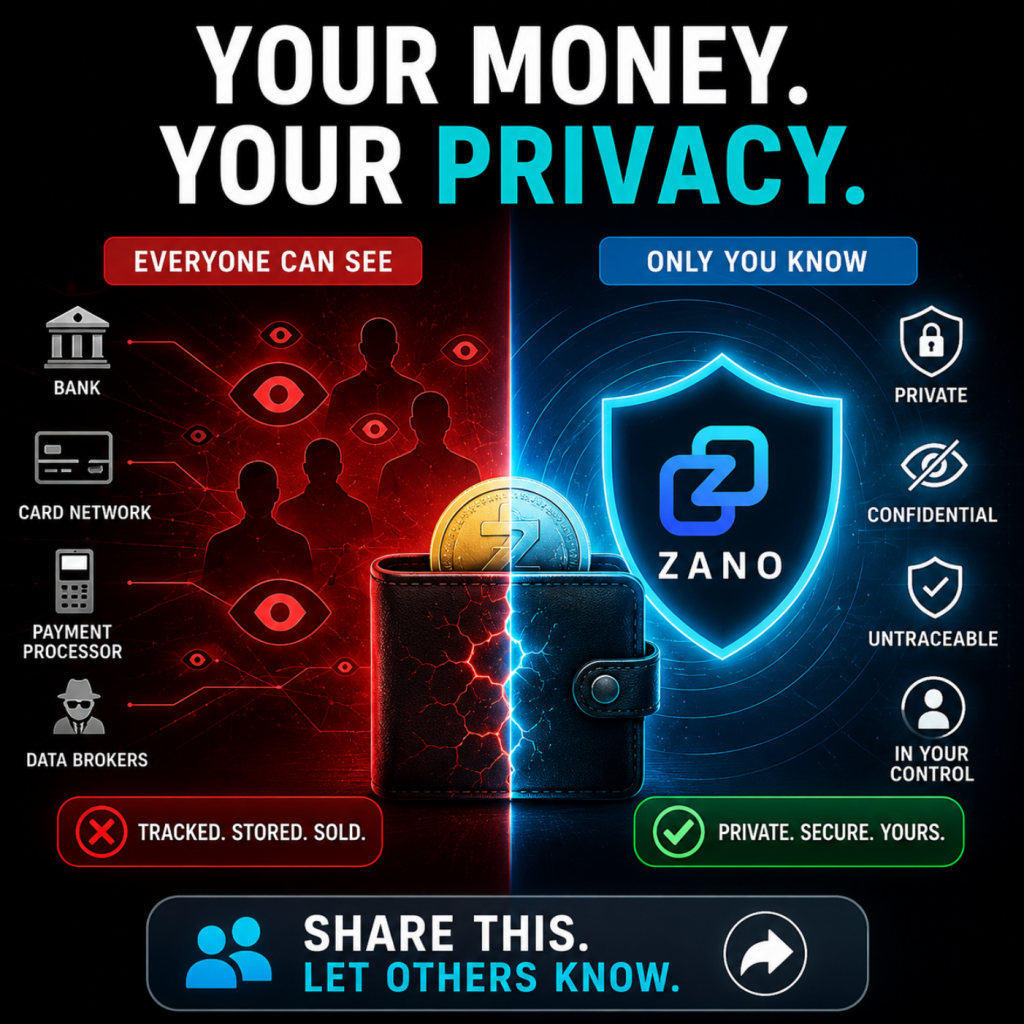
Table of Contents

  1. What Happens When You Pay With a Card?
  2. Isn’t Crypto Already Private?
  3. Why Transparent Blockchains Can Be a Problem
  4. How Zano Takes a Different Approach
  5. Why This Is Important

1. What Happens When You Pay With a Card?

When you make a payment using a credit or debit card, the transaction doesn’t just stay between you and the seller.

Your payment may be seen by:

  • Your bank
  • The card network
  • The merchant’s payment processor
  • Companies that collect and analyze financial data

For many people, this happens without them ever thinking about it.

2. Isn’t Crypto Already Private?

Many people assume that all cryptocurrencies are private.

In reality, most are not.

On public blockchains like Bitcoin, every transaction is permanently recorded. Anyone can see:

  • Wallet addresses
  • Transaction amounts
  • Payment history

While your real name isn’t displayed by default, wallet activity can sometimes be linked back to individuals over time.

3. Why Transparent Blockchains Can Be a Problem

Because blockchain records are public, companies can analyze wallet activity and build profiles based on transaction history.

According to the Zano explainer video, this can sometimes lead to unexpected problems. For example, cryptocurrency received today may have passed through a wallet that was flagged years earlier, which could create issues with certain centralized services.

Unlike cash, where payments leave little public record, many blockchain transactions remain visible forever.

Watch the Official Zano Explainer

The official Zano team explains why financial privacy matters and how transparent blockchains differ from privacy-focused digital payments.

4. How Zano Takes a Different Approach

Zano is a privacy-focused blockchain designed to keep financial information confidential by default.

Its goal is to provide digital payments that offer greater privacy while allowing users to remain in control of their own funds.

According to the Zano team, financial privacy should be a normal part of digital money—not something users have to sacrifice.

5. Why This Is Important

As digital payments continue to replace cash, many people are asking an important question:

Should every payment remain visible forever?

Financial privacy isn’t about hiding wrongdoing. For many people, it’s about protecting personal information, just as they protect their passwords, messages, or medical records.

Privacy-focused technologies like Zano aim to give users more control over their financial information while helping preserve an important aspect of personal freedom in the digital age.

To learn more, visit:

Disclaimer: ZanoNews.com is an independent news and information website. This article is for informational purposes only and should not be considered financial, investment, or legal advice.
Why Paying for a VPN With Crypto Can Protect More Than Your Browsing 🕵️

A VPN helps keep your internet activity private by hiding your IP address and encrypting your connection. But there is one thing many people overlook—how they pay for the VPN.

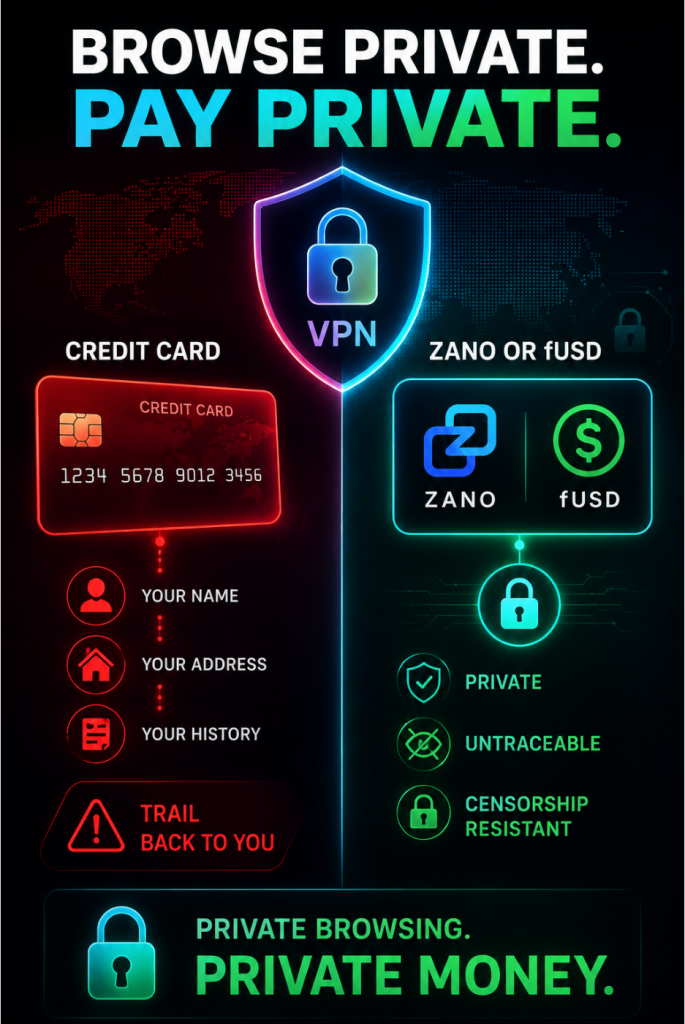
If you pay with a credit card, your VPN provider usually receives your name, billing address, and payment details. That creates a record linking your identity to your purchase. This is why payment privacy is becoming more important for people around the world. Recently, VPNET announced that it now accepts $ZANO and Freedom Dollar ($fUSD), giving users another way to pay while protecting more of their privacy.

Table of Contents

  1. What Does a VPN Protect?
  2. Why Credit Card Payments Leave a Trail
  3. How Crypto Payments Improve Privacy
  4. Why ZANO and fUSD Are Different
  5. VPNET Now Accepts ZANO and fUSD
  6. Who Can Benefit From Private Payments?
  7. Why This Is Important

1. What Does a VPN Protect?

A Virtual Private Network (VPN) helps keep your online activity more private. It can:

  • Hide your IP address
  • Encrypt your internet connection
  • Protect your data on public Wi-Fi
  • Make it harder for websites to track your activity

However, a VPN does not automatically make your payment private.

2. Why Credit Card Payments Leave a Trail

When you pay with a credit or debit card, the transaction usually includes personal information such as:

  • Your full name
  • Billing address
  • Payment history
  • Transaction records

Even though your internet traffic is encrypted, your payment can still be linked to your identity.

For many people this is not an issue, but others prefer to keep both their browsing and payment information private.

3. How Crypto Payments Improve Privacy

Many cryptocurrencies allow people to make payments without sharing personal banking information.

Instead of using a bank or card company, payments are sent directly between digital wallets.

Not all cryptocurrencies offer the same level of privacy. Public blockchains often allow anyone to view transaction history, while privacy-focused cryptocurrencies are designed to keep transaction details confidential.

4. Why ZANO and fUSD Are Different

ZANO is a privacy-focused blockchain built to protect users’ financial information.

Its ecosystem also includes Freedom Dollar ($fUSD), a private stablecoin designed to maintain a stable value while keeping transactions confidential.

Together, they offer features such as:

  • Private transactions
  • Confidential wallet balances
  • Self-custody, so users control their own funds
  • Resistance to censorship
  • Protection from account freezes by centralized payment providers

These features make them attractive for people who value financial privacy.

5. VPNET Now Accepts ZANO and fUSD

According to the official Zano announcement, VPNET now accepts both $ZANO and $fUSD as payment methods.

This gives users the option to combine:

  • Private internet browsing with a VPN
  • Private payments using $ZANO or $fUSD

Instead of relying only on traditional payment methods, users now have another option if they want greater financial privacy.

6. Who Can Benefit From Private Payments?

Private payments may be useful for:

  • Privacy-conscious individuals
  • Businesses protecting financial information
  • Journalists and researchers
  • Remote workers
  • Frequent travelers
  • Cryptocurrency users who prefer self-custody

Many people simply want to keep their financial information as private as their personal messages or passwords.

7. Why This Is Important

Privacy is about more than hiding your internet activity. If your payment method still reveals your personal information, part of your digital footprint remains visible.

By accepting $ZANO and Freedom Dollar ($fUSD), VPNET gives users another payment option that aligns with the privacy goals of using a VPN. For people who value greater control over both their online activity and their financial information, combining a VPN with privacy-focused digital payments can provide a more complete privacy experience.

To learn more, visit:

Disclaimer: ZanoNews.com is an independent news and information website. This article is for informational purposes only and does not constitute financial or investment advice.

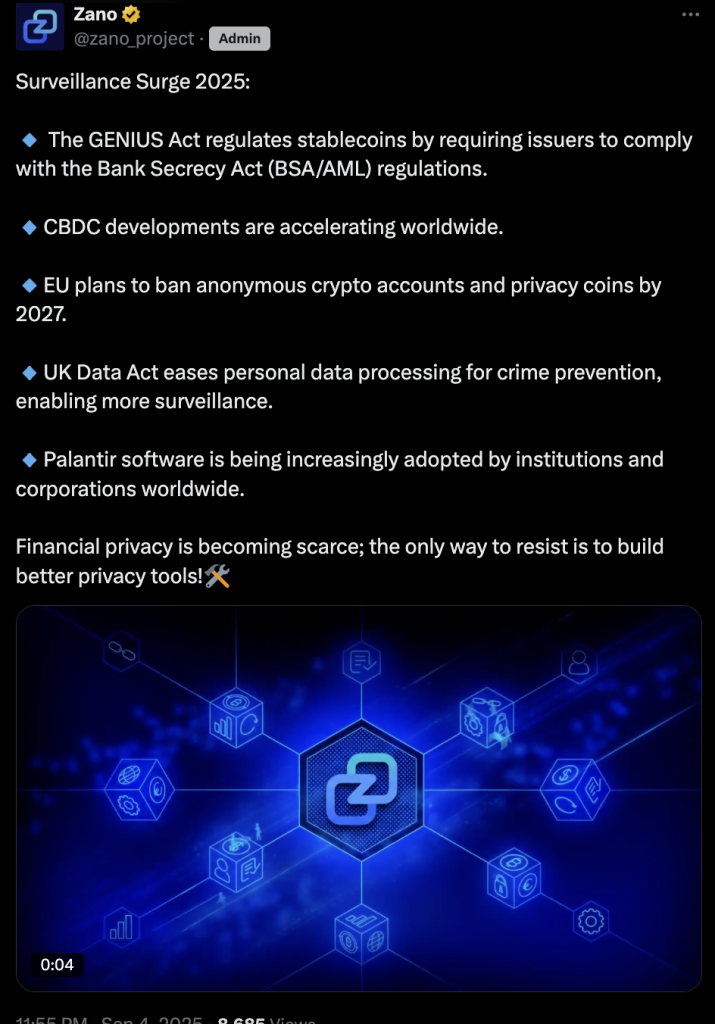
Why Financial Privacy Matters More Than You Think

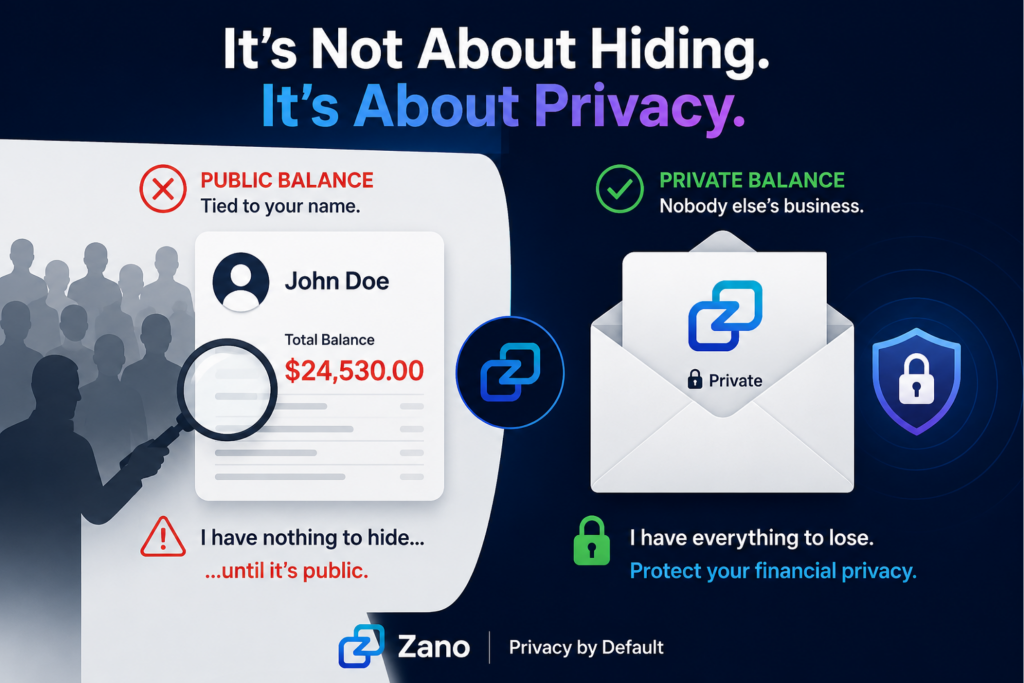
Many people say, “I have nothing to hide.” But that mindset often changes when personal financial information becomes public.

Imagine if anyone could see your bank balance, savings, investments, or cryptocurrency holdings simply by knowing your name. Suddenly, it’s no longer about hiding something—it’s about protecting your personal information.

That’s the point the Zano team highlights with a simple comparison.

We seal letters inside envelopes, not because we’re doing anything wrong, but because the contents are private. Financial information deserves the same level of respect.

Privacy isn’t about secrecy—it’s about having control over who can access your personal data.

As digital payments and blockchain technology continue to grow, protecting financial privacy is becoming increasingly important. Keeping your balances and transaction history private can help reduce unwanted attention, protect personal security, and give individuals greater control over their own financial lives.

Financial privacy isn’t about having something to hide. It’s about recognizing that your personal finances are your business—not everyone else’s.

Source:
Zano Official X Post

Disclaimer: ZanoNews.com is an independent news and information website. This article is for informational purposes only and does not constitute financial or investment advice.

When Your Crypto Balance Is Public, Privacy Becomes a Safety Issue

Crypto security is usually discussed in terms of hacks, scams and stolen passwords.

But there is another serious concern: physical attacks on crypto holders.

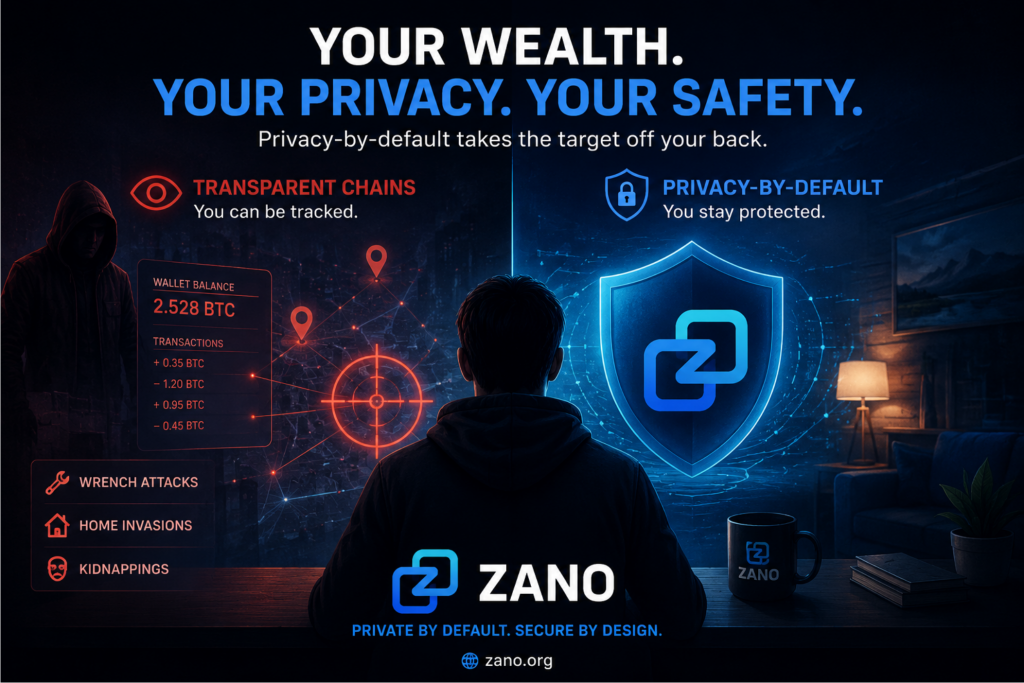
Wrench attacks. Home invasions. Kidnappings.

A recent Zano post raised a simple point: when financial information is publicly visible on a blockchain, privacy can become more than a digital issue. It can become a personal safety issue.

Table of Contents

  1. What Is a Wrench Attack?
  2. The Risk of Transparent Blockchains
  3. Where Zano Fits In
  4. Privacy Can Also Mean Personal Security
  5. Sources

1. What Is a Wrench Attack?

A wrench attack is when criminals use physical threats or force to pressure someone into giving up access to their crypto.

Unlike a hack, the target is not the computer.

The target is the person holding the wallet.

2. The Risk of Transparent Blockchains

On transparent blockchains, wallet balances and transaction histories can often be publicly viewed using a block explorer.

A wallet address does not automatically reveal someone’s name.

But if a wallet becomes connected to a real person, their crypto activity and holdings may become easier to track.

That can create a real-world risk.

As Zano recently explained:

“Privacy-by-default blockchains take that target off your back.”

The message is simple: financial privacy can also be personal security.

3. Where Zano Fits In

Zano is built with privacy by default.

Its technology is designed to keep transaction amounts and other financial information private rather than openly visible on the blockchain.

This does not mean privacy can prevent physical crime.

But it can reduce the amount of financial information publicly available for strangers to analyse.

If people cannot easily see what you hold, there is less information pointing a target at you.

4. Privacy Can Also Mean Personal Security

For years, blockchain privacy has often been treated as a niche crypto feature.

But the conversation is changing.

Privacy is not only about hiding transactions.

It is also about controlling who can see your financial information.

Sometimes, protecting your wallet starts with protecting the person behind it. 🔒

5. Sources

  1. Zano — Original X Post
  2. Zano Official Website

Disclaimer: ZanoNews.com is an independent news and information website. This article is for informational purposes only and does not constitute financial or investment advice.

Privacy Is “Common S3nse”: Why Zano’s Message Matters

Privacy should not be complicated.

Neither should security, controlling your own money, or sending a transaction without asking for permission.

That is the simple message behind a recent X post from Eléonore Blanc, reposted by Zano:

“Privacy is Common S3nse. Security is Common S3nse. Permissionless is Common S3nse. Censorship Resistance is Common S3nse. Self custody is Common S3nse.”

It is a short message, but it asks an important question:

Should financial privacy be a special feature, or something we simply expect?

Table of Contents

  1. What Does “Common S3nse” Mean?
  2. Why Financial Privacy Matters
  3. What Is Self-Custody?
  4. What Does Permissionless Mean?
  5. Understanding Censorship Resistance
  6. Where Zano Fits In
  7. Maybe Privacy Is Just Common Sense
  8. Sources

1. What Does “Common S3nse” Mean?

“S3nse” is a creative way of writing “sense.”

The message is simple.

Privacy, security and control over your own money should not feel unusual.

They should be normal.

2. Why Financial Privacy Matters

Imagine if anyone could see your bank balance and payment history.

Who you paid.

How much you sent.

When you sent it.

That would feel uncomfortable.

Yet many public blockchains allow transaction activity to be viewed through blockchain explorers.

Zano takes a different approach.

Zano is a privacy-focused blockchain where transactions are private by default. The goal is simple: your financial activity should remain your business.

3. What Is Self-Custody?

Self-custody means you control your crypto.

Instead of a bank or company holding your assets, you control your wallet and private keys.

This gives users more control, but also more responsibility.

Your keys.

Your wallet.

Your assets.

4. What Does Permissionless Mean?

Permissionless simply means you do not need approval from a company or bank to use the network.

There is no application form.

No opening hours.

No person deciding whether you are allowed to participate.

You can interact with the blockchain according to the network’s rules.

5. Understanding Censorship Resistance

Censorship resistance means making it difficult for one company or authority to simply stop a valid transaction.

Why does that matter?

Because owning money is one thing.

Being able to use it is another.

This idea has always been an important part of cryptocurrency.

6. Where Zano Fits In

Zano is building privacy directly into its blockchain.

Transactions are private by default.

Its Confidential Assets technology also allows private digital assets to be created and used on the Zano network.

The bigger idea is easy to understand:

Privacy is not an extra button you turn on. It is part of the system.

That is what makes Zano’s approach interesting.

7. Maybe Privacy Is Just Common Sense

We use passwords to protect our emails.

We lock our phones.

We close our curtains.

So why should our financial activity be completely public?

Privacy does not always mean someone has something to hide.

Sometimes, it simply means having control over what you choose to share.

Privacy.

Security.

Self-custody.

Financial freedom.

Maybe these ideas are not complicated after all.

Maybe they’re just Common S3nse.

Learn more about Zano at Zano.org.

8. Sources

Disclaimer: ZanoNews.com is an independent news and information website. This article is for informational purposes only and does not constitute financial or investment advice.

Use Ethereum Privately While Still Accessing DeFi ⟠

What if you could use Ethereum without making every transaction public? That’s exactly what Zano aims to solve.

Table of Contents

  1. What Is Changing?
  2. Why Ethereum Transactions Aren’t Private
  3. What Is ETHx?
  4. How the Bridge Works
  5. Trade Privately on Zano
  6. Spend ETHx in Everyday Life
  7. What’s Coming in Zano HF6?
  8. Why This Matters
  9. Final Thoughts
  10. Sources

1. What Is Changing?

For years, crypto users have had to make a choice:

  • Use Ethereum and access DeFi, but give up your privacy.
  • Use a privacy blockchain, but lose access to many DeFi opportunities.

Zano is helping remove that trade-off.

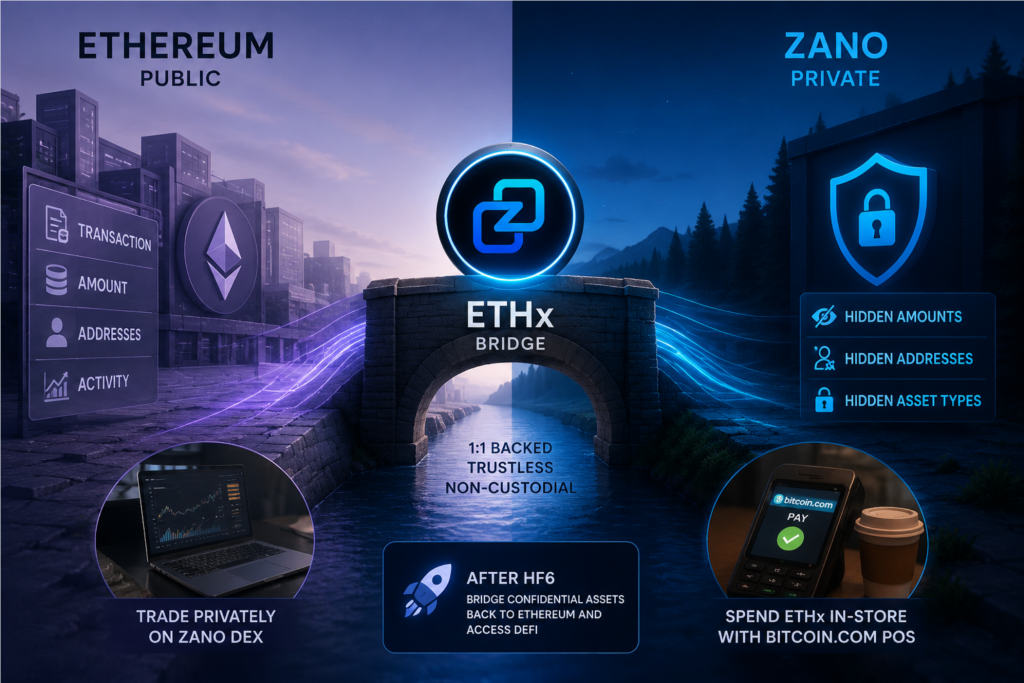
Using Bridgeless, users can now move Ethereum (ETH) into the Zano network as ETHx, allowing them to enjoy private transactions while still keeping their assets backed by real ETH.

2. Why Ethereum Transactions Aren’t Private

Ethereum is a public blockchain.

That means anyone can look up:

  • Your wallet address
  • How much ETH you own
  • Who you sent money to
  • How much you sent
  • Your transaction history

While this transparency has benefits, many people simply don’t want their financial activity visible to everyone.

This is where Zano offers a different approach.

3. What Is ETHx?

ETHx is a private version of Ethereum that exists on the Zano network.

When you bridge ETH into Zano:

  • Your ETH becomes ETHx.
  • Every ETHx is backed 1:1 by real ETH.
  • You can move and use it without exposing your financial information on a public blockchain.

Think of it as taking your Ethereum into a private environment while keeping its value the same.

4. How the Bridge Works

The process is straightforward:

  1. Bridge your ETH into Zano using Bridgeless.
  2. Receive ETHx on the Zano blockchain.
  3. Use ETHx privately for trading, transfers, or payments.
  4. In the future, bridge it back to Ethereum whenever needed.

The bridge is also:

  • Trustless – you don’t need to trust a third party.
  • Non-custodial – you stay in control of your crypto.
  • 1:1 backed – every ETHx represents one ETH.

This means your assets remain secure while gaining privacy.

5. Trade Privately on Zano

After receiving ETHx, you can trade it on the Zano Trade DEX.

Unlike many public decentralized exchanges, Zano hides:

  • Transaction amounts
  • Wallet addresses
  • Asset types

To anyone looking at the blockchain, your financial activity remains private.

6. Spend ETHx in Everyday Life

ETHx isn’t just for trading.

It can also be used through the Bitcoin.com Point-of-Sale (POS) system at participating physical stores.

This brings private cryptocurrency payments closer to everyday use.

7. What’s Coming in Zano HF6?

One of the biggest upcoming improvements is Hard Fork 6 (HF6).

After HF6, users will be able to bridge Confidential Assets from Zano back to Ethereum.

This means private assets will also be able to access Ethereum’s DeFi ecosystem.

In simple terms:

  • Keep your transactions private on Zano.
  • Move your assets back to Ethereum when you want to use DeFi.

This gives users much more flexibility than before.

8. Why This Matters

Privacy has become one of the biggest topics in crypto.

Many people don’t want every payment, investment, or wallet balance permanently visible online.

Zano is building a system where users don’t have to choose between privacy and utility.

Instead, they can have:

  • Private transactions
  • Access to DeFi
  • Full control of their assets
  • A trustless and non-custodial bridge

This is an important step toward making blockchain technology more practical for everyday users.

9. Final Thoughts

The ability to bridge Ethereum into Zano as ETHx is more than just another crypto feature.

It gives users a way to protect their financial privacy without giving up access to the wider crypto ecosystem.

With HF6 bringing confidential assets back to Ethereum, Zano is working toward a future where privacy and DeFi work together instead of competing.

As blockchain technology continues to evolve, solutions like ETHx could make private, secure, and flexible crypto transactions available to everyone.

10. Sources

Why Zano’s Confidential Assets Redefine Blockchain Privacy

Blockchain technology has transformed the way we transfer value, but it has also introduced a trade-off that many users overlook: transparency. On most public blockchains, every transaction is visible to anyone with access to a block explorer. While this improves accountability, it also means your financial activity is open for the world to see.

Table of Contents

  1. The Transparency Challenge
  2. How Zano Takes a Different Approach
  3. Why Confidential Assets Matter
  4. Privacy Without Sacrificing Security
  5. The Future of Private Digital Assets
  6. Sources

1. The Transparency Challenge

Networks like Bitcoin, Ethereum, and other public blockchains make transaction data easily accessible. Anyone can view:

  • The asset being transferred (BTC, ETH, USDT, etc.)
  • The amount sent
  • The sender’s wallet address
  • The recipient’s wallet address
  • The transaction history

Although wallet addresses are pseudonymous, they can often be linked to individuals or organizations through exchanges, analytics tools, or previous transactions. This creates significant privacy concerns for both individuals and businesses.

2. How Zano Takes a Different Approach

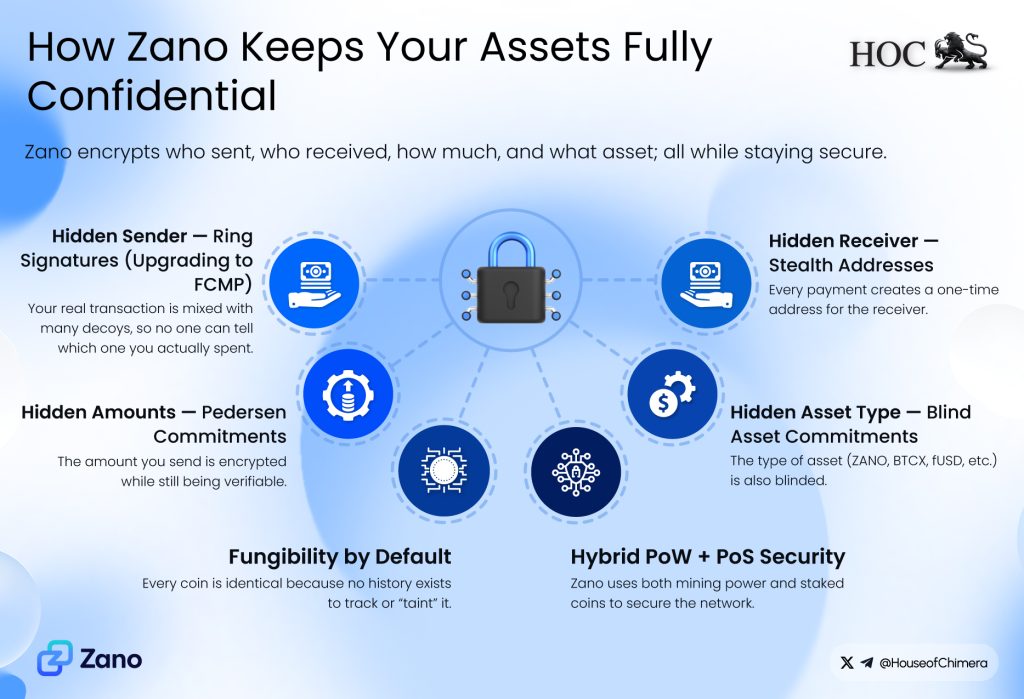
Zano was built with privacy at its core. Instead of exposing transaction details on-chain, Zano uses Confidential Assets, ensuring that every transaction appears identical on the blockchain.

Whether you’re transferring $ZANO,$fUSD, $BTCx, or any other Confidential Asset, observers cannot determine:

  • Which asset was transferred
  • The amount being sent
  • The sender’s address
  • The recipient’s address

All of this information remains encrypted while the network still verifies the transaction’s validity.

3. Why Confidential Assets Matter

Privacy isn’t about hiding wrongdoing—it’s about protecting legitimate financial activity.

Imagine paying employees, suppliers, or business partners. On a transparent blockchain, competitors or third parties could potentially monitor transaction amounts and business relationships. Individuals may also prefer to keep their savings and spending habits private rather than broadcasting them publicly.

Zano’s Confidential Assets solve this challenge by allowing users to transact securely without exposing sensitive information.

4. Privacy Without Sacrificing Security

Despite hiding transaction details, Zano maintains blockchain security and integrity through advanced cryptographic techniques. Transactions remain verifiable by the network without revealing confidential information to the public.

This means users receive the benefits of decentralization while preserving financial privacy—a feature that many believe will become increasingly important as blockchain adoption grows.

5. The Future of Private Digital Assets

As blockchain technology continues to evolve, privacy is becoming a critical feature rather than an optional extra. Businesses, institutions, and everyday users are increasingly demanding solutions that protect sensitive financial information without compromising security.

Zano’s Confidential Assets represent a significant step toward that future, offering a blockchain where privacy is built into the protocol rather than added as an afterthought.

For users who value financial confidentiality while still benefiting from decentralized technology, Zano provides a compelling alternative to traditional transparent blockchains.

6. Sources

Zano Co-Founder on Why Self-Custody Matters 🔐

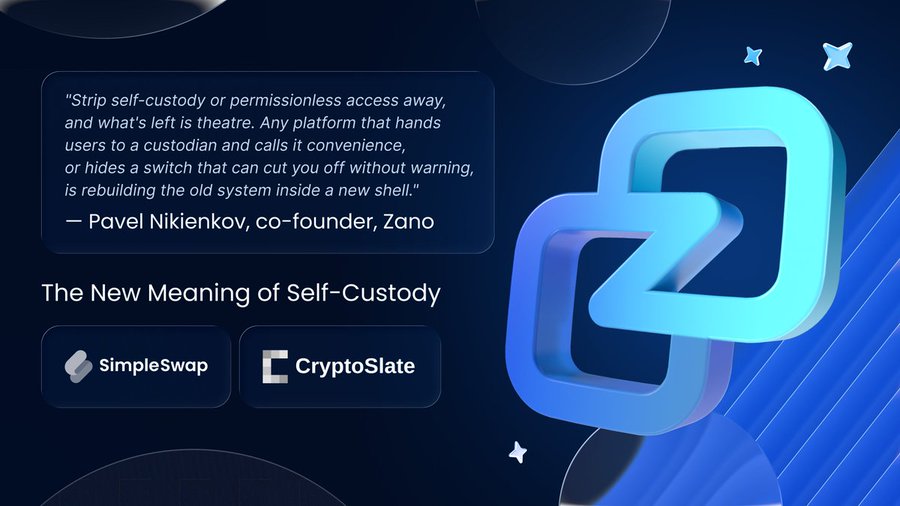
A recent post from @SimpleSwap shared a message from Zano co-founder Pavel Nikienkov:

“Strip self-custody or permissionless access away, and what’s left is theatre.”

His point is simple: if a crypto platform controls users’ funds or can remove access without warning, it may be rebuilding the same system that crypto was meant to improve.

Table of Contents

  1. What Self-Custody Means
  2. Why Permissionless Access Matters
  3. Zano’s Approach
  4. Sources

1. What Self-Custody Means

Self-custody means you control your own crypto assets and private keys.

You do not need to rely on an exchange, bank or other company to hold your funds. This gives users more control, but it also means they are responsible for keeping their recovery phrase and wallet access secure.

2. Why Permissionless Access Matters

Permissionless access means people can use a blockchain network without needing approval from a company or central authority.

This can reduce the risk of:

  • Account restrictions
  • Frozen withdrawals
  • Unexpected service shutdowns
  • Dependence on one platform

Convenient services can still be useful, but users should understand the trade-off between convenience and control.

3. Zano’s Approach

Zano focuses on privacy, self-custody and decentralised access. Its goal is to give users more control over their transactions and assets without relying on a central operator.

As crypto continues to grow, the key question remains: should users prioritise convenience, full control, or a balance of both?

4. Sources

Zano Joins Common S3nse: Why Privacy Is Becoming More Important in Crypto

Table of Contents

  1. What-Is-the-Announcement-About?
  2. What Is Common S3nse?
  3. Why Is Privacy Important in Crypto?
  4. How Is Zano Different?
  5. Why This Partnership Matters
  6. Final Thoughts
  7. Sources

What Is the Announcement About?

Zano has officially partnered with Common S3nse, an initiative supported by CryptoCanal that focuses on privacy, security, decentralization, and digital freedom.

The announcement highlights a growing concern in today’s digital world:

Most online activity and many blockchain transactions can be tracked and monitored.

Zano’s mission is to build something different — a digital economy where privacy is built into the system from the start, rather than added later as an optional feature.

What Is Common S3nse?

Common S3nse is a community-driven initiative that brings together people interested in:

✔️ Privacy

✔️ Cryptography

✔️ Digital rights

✔️ Decentralization

✔️ Secure technology

The goal is to educate, connect, and support projects that believe privacy should be a basic right in the digital age.

Zano joining this initiative shows its commitment to promoting privacy-focused technology and expanding awareness of financial privacy.

Why Is Privacy Important in Crypto?

Many people don’t realize that most blockchain transactions are publicly visible.

On many networks, anyone can:

  • View wallet balances
  • Track transactions
  • Analyze payment history
  • Monitor large holders

Imagine if anyone could look up your bank account balance or see where you spend your money.

Most people would not be comfortable with that.

Privacy supporters believe financial information should remain private, just like it is with traditional banking.

Privacy isn’t about hiding wrongdoing.

It’s about protecting personal information and maintaining financial freedom.

How Is Zano Different?

Zano was built with privacy as a core feature.

Instead of making privacy optional, it is included by default.

Some of Zano’s key features include:

FeatureBenefit
Private TransactionsTransaction details are hidden
Confidential AssetsAssets can be created and transferred privately
Private Wallet BalancesOthers cannot see your holdings
Hybrid PoW & PoSStrong network security
Private StakingEarn rewards while maintaining privacy
Decentralized Marketplace SupportBuild private applications and services

This approach allows users and businesses to use blockchain technology without exposing sensitive financial information.

Why This Partnership Matters

The partnership between Zano and Common S3nse is important because it reflects a larger trend happening across the crypto industry.

For years, the focus was mainly on:

  • Price
  • Trading
  • Market cycles

Today, more attention is being given to infrastructure and privacy.

Questions people are starting to ask include:

🔒 Should every blockchain transaction be visible?

🔒 Should businesses expose their financial activity?

🔒 Should users have more control over their personal information?

Projects like Zano are working to provide an alternative answer.

Final Thoughts

The Zano and Common S3nse partnership is about more than an event or a logo on a website.

It represents a growing movement toward privacy-first digital infrastructure.

As blockchain technology continues to evolve, privacy is becoming one of the most important discussions in the industry.

Whether you’re an investor, developer, business owner, or everyday user, the conversation around financial privacy is likely to become even more relevant in the years ahead.

For Zano, this partnership is another step toward building a digital economy where privacy is not an option — it’s the foundation.

Sources

Zano Features Explained: Confidential Assets

Table of Contents

  1. What Are Confidential Assets?
  2. How Are They Different From Regular Tokens?
  3. Why Privacy Matters
  4. What Can Confidential Assets Be Used For?
  5. Who Can Create a Confidential Asset?
  6. Why This Matters
  7. Sources

1. What Are Confidential Assets?

Confidential Assets are digital tokens built on the Zano blockchain that keep transaction details private.

Unlike many blockchains where anyone can view transactions, Zano hides important information such as:

  • The sender’s address.
  • The receiver’s address.
  • The amount being transferred.
  • Even the type of asset being sent.

This means your transactions remain private while still benefiting from the security of the blockchain.

2. How Are They Different From Regular Tokens?

On many blockchains, anyone can see what token was sent, who received it, and how much was transferred.

With Confidential Assets, that information stays private.

From a technical perspective, every Confidential Asset looks the same on the blockchain. Whether an asset represents a stablecoin, loyalty points, digital collectibles, or even tokenized real-world products, they are indistinguishable from one another on-chain.

This extra layer of privacy helps protect users and businesses from unwanted public exposure.

3. Why Privacy Matters

Privacy is becoming increasingly important as more financial activity moves online.

Without privacy, blockchain transactions can reveal information about your finances, business relationships, or spending habits.

Confidential Assets help solve this by allowing users to transfer digital assets without exposing sensitive information to the public.

For many individuals and businesses, privacy is not about hiding wrongdoing—it’s about protecting personal and commercial information.

4. What Can Confidential Assets Be Used For?

Confidential Assets are flexible and can represent almost any type of digital value, including:

  • Stablecoins.
  • Loyalty and reward points.
  • In-game currencies.
  • Tokenized real-world assets.
  • Digital vouchers.
  • Business or community tokens.

Because they are built on Zano, they all benefit from the network’s privacy technology.

5. Who Can Create a Confidential Asset?

One of Zano’s biggest advantages is that anyone can create their own Confidential Asset.

Using the Zano Desktop Wallet or Mobile Wallet, users can create a new asset quickly without needing to build their own blockchain or rely on a third party.

This makes launching private digital assets much simpler and more accessible for developers, businesses, and communities.

6. Why This Matters

Confidential Assets give users the ability to create, manage, and transfer digital assets while keeping transaction details private.

Instead of building an entirely new blockchain, projects can use Zano’s existing infrastructure to launch private assets quickly and efficiently.

As the Zano ecosystem continues to grow, Confidential Assets provide a foundation for new applications while helping users maintain greater control over their financial privacy.

7. Sources

Disclaimer: ZanoNews.com is an independent news and information website. This article is for informational purposes only and should not be considered financial, investment, or legal advice.
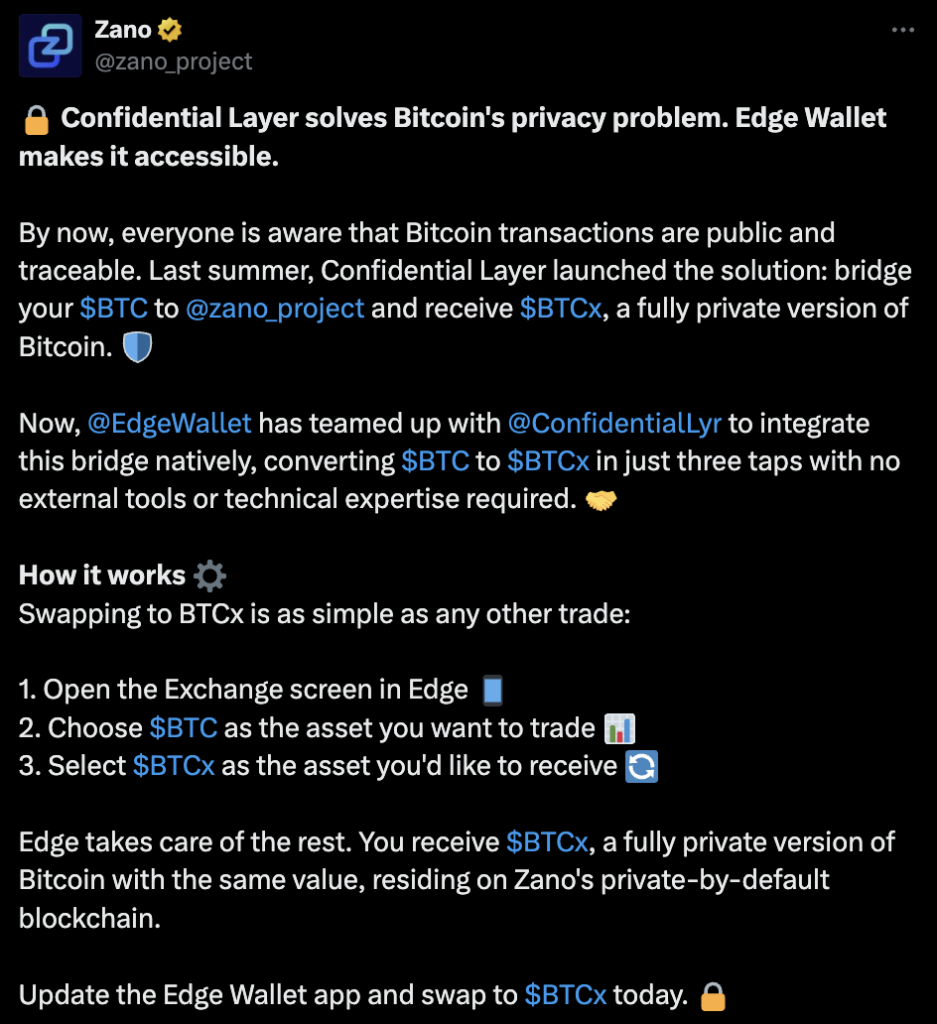
Confidential Layer solves Bitcoin’s privacy problem. Edge Wallet makes it accessible