Zano Hard Fork 6 Is Now Live: What It Means for Exchanges, Wallets and Users 🔥

Zano’s Hard Fork 6 (HF6) is now live, activating at block 3,833,000 on August 26, 2026.

The upgrade makes it easier for exchanges, wallets, bridges, DEXs and other crypto services to connect with Zano. For everyday users, this could eventually mean more ways to buy, sell, store and use ZANO, while keeping Zano’s privacy features.

HF6 also supports two-way cross-chain transfers, helping Zano connect with other blockchain networks.
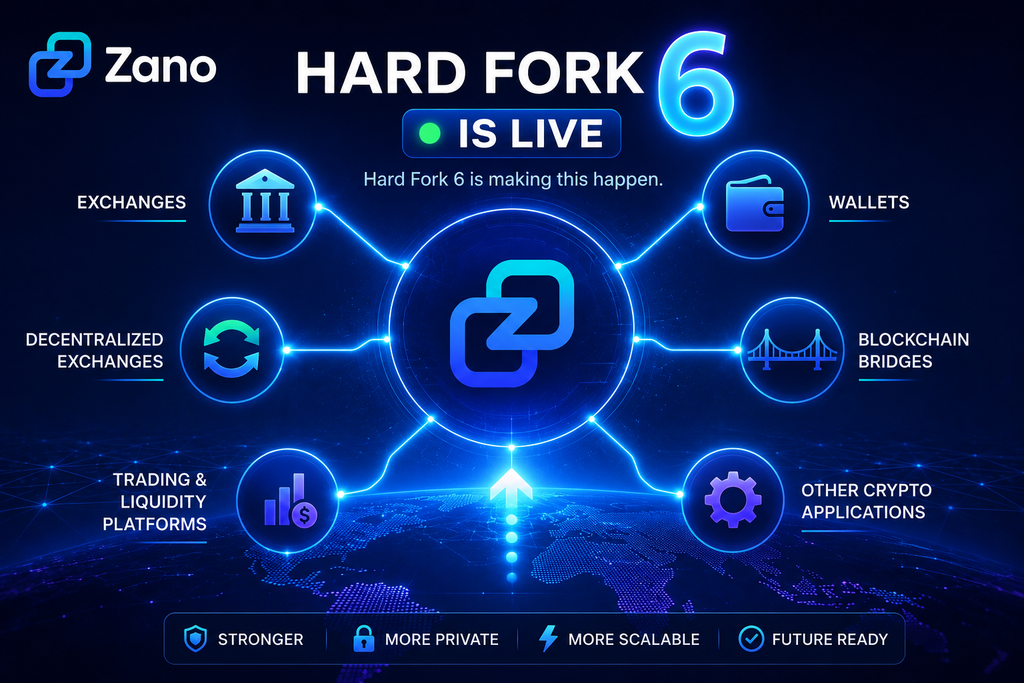
Table of Contents

  1. What Is Zano Hard Fork 6?
  2. What Changes With HF6?
  3. How Are HF6 and Gateway Addresses Connected?
  4. Why Gateway Addresses Matter
  5. Zano Can Now Move Across Chains
  6. What Does This Mean for Exchanges and Wallets?
  7. Does Hard Fork 6 Change Zano’s Privacy?
  8. What Do Zano Users Need to Know?
  9. Learn More About Hard Fork 6
  10. Sources

1. What Is Zano Hard Fork 6?

A hard fork is a major update to a blockchain.

Zano HF6 activated at block 3,833,000 on August 26, 2026, following more than a year of development.

The goal is simple: make Zano easier for the wider crypto industry to connect with while keeping its privacy-focused design.

2. What Changes With HF6?

One of the key changes is Gateway Addresses.

They give exchanges, bridges and other services a simpler way to work with Zano.

For regular Zano users, standard private Zano addresses continue to work as before.

👉 Want to understand Gateway Addresses in simple terms?
Read: How Gateway Addresses Could Bring Zano to More Exchanges

3. How Are HF6 and Gateway Addresses Connected?

Hard Fork 6 is the upgrade, and Gateway Addresses are one of its key features.

They are designed to make it easier for exchanges, wallets, bridges and DEXs to connect with Zano.

In simple terms:

HF6 → Gateway Addresses → Easier integration → More opportunities for Zano adoption.

Regular users can continue using Zano’s standard private addresses as before.

4. Why Gateway Addresses Matter

Imagine an exchange wants to support ZANO.

It needs an easy way to manage deposits, withdrawals and balances. Gateway Addresses are designed to make this simpler.

For everyday users:

Easier integration → more services can support Zano → more ways to use ZANO.

👉 Learn more about Gateway Addresses

HF6 also introduces per-output payment IDs, which can help exchanges identify deposits while protecting the recipient’s privacy.

5. Zano Can Now Move Across Chains

HF6 also supports two-way cross-chain transfers.

This means native ZANO and supported Confidential Assets can move between Zano and supported blockchain networks through bridging technology.

For example:

Zano → Bridge → Another blockchain

This can give ZANO access to more blockchain ecosystems, liquidity and potential DeFi applications.

👉 Want to understand how this works?
Read: How Does Zano’s Trustless Bridging Work After HF6? 🔗

6. What Does This Mean for Exchanges and Wallets?

This is where HF6 could become particularly important for everyday users.

If integrating Zano becomes easier, more services may have a simpler path toward supporting it.

That could include:

  • 🏦 Exchanges
  • 👛 Wallets
  • 🔄 Decentralized exchanges
  • 🌉 Blockchain bridges
  • 💱 Trading and liquidity platforms
  • 🛠️ Other crypto applications

The Zano team has previously discussed Gateway Addresses with platforms including THORChain, NEAR Intents and Maya Protocol, with the new infrastructure intended to make integrations easier.

This does not mean every exchange or wallet now supports Zano automatically.

Instead, HF6 removes an important technical barrier and gives these services a simpler way to integrate with the network.

7. Does Hard Fork 6 Change Zano’s Privacy?

No.

Zano’s privacy remains a core part of the network.

HF6 improves how external services can connect with Zano without replacing the privacy features of standard Zano addresses.

In simple terms:

More connectivity + privacy at the core. 🔒

8. What Do Zano Users Need to Know?

For most users, there is no complicated process involved with HF6.

If you use a full-node desktop wallet, make sure you are running the latest version and that it has fully synced with the network.

👉 Download the latest Zano wallet

If you use Zano through an exchange or third-party wallet, check that your provider has completed its HF6 upgrade where applicable.

9. Learn More About Hard Fork 6

Want to explore HF6 in more detail?

👉 Zano Hard Fork 6 Is Only a Few Days Away 🔥 — Introduction to HF6 and Gateway Addresses.

👉 How Gateway Addresses Could Bring Zano to More Exchanges — A simple explanation of Gateway Addresses.

👉 How Does Zano’s Trustless Bridging Work After HF6? 🔗 — How Zano can connect with other blockchains.

👉 How Does the Confidential Layer Bridge Work? — How BTC, ETH and other assets can move into Zano and use its privacy features.

👉 From Bitcoin to BTCx: A More Private Way to Use Bitcoin — How Bitcoin can become BTCx on Zano.

10. Sources

Disclaimer: ZanoNews.com is an independent news and information website. This article is for informational purposes only and does not constitute financial or investment advice.
Zano’s Private $fUSD Could Soon Reach More Crypto Markets

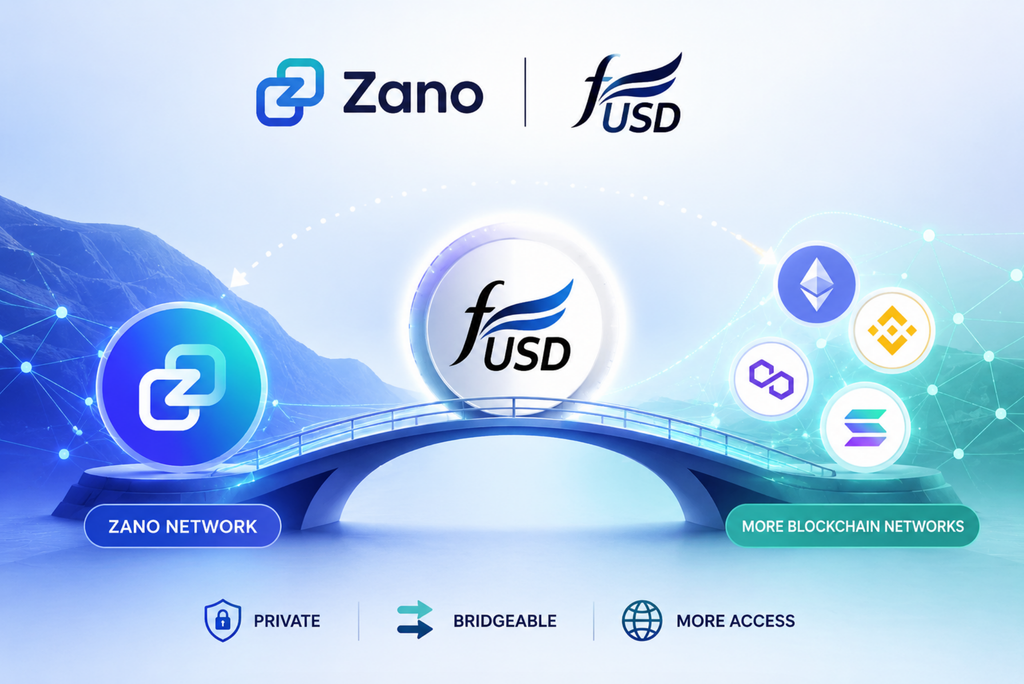
Zano is working on a way to connect its private stablecoin, $fUSD, with other crypto networks. This could let people keep their funds private on Zano while also accessing more crypto markets and services when they want.

Table of Contents

  1. Zano Is More Than $ZANO
  2. What Is $fUSD?
  3. Why Does $fUSD Need to Reach Other Networks?
  4. How Could Zano’s Execution Layer Help?
  5. A Simple Example
  6. What Could This Mean for Users?
  7. The Bigger Picture

1. Zano Is More Than $ZANO

When people hear about Zano, they often think about its native cryptocurrency, $ZANO.

But Zano is also building an ecosystem of private digital assets called Confidential Assets.

One example is $fUSD, a private stablecoin designed to maintain a value close to the US dollar while benefiting from Zano’s privacy features.

According to Zano, Confidential Assets such as fUSD will be able to move beyond the Zano network once the Zano Execution Layer arrives.

This could make private assets like fUSD useful in a much wider part of the crypto world.

2. What Is $fUSD?

A stablecoin is a type of cryptocurrency designed to keep a relatively stable value, usually by tracking a traditional currency such as the US dollar.

$fUSD is Zano’s private stablecoin.

The idea is to combine the convenience of a digital dollar with Zano’s focus on financial privacy.

For people who are new to crypto, you can think of fUSD as a private digital version of the US dollar that can be used within the Zano ecosystem.

If you want to understand fUSD before going deeper, check out our beginner friendly guide: 👉 What Is fUSD? Zano’s Private Stablecoin

3. Why Does $fUSD Need to Reach Other Networks?

Why would a private stablecoin need to leave Zano?

The simple answer is access.

Some of the biggest crypto markets and financial applications operate on other blockchain networks.

These include DeFi, short for decentralized finance. DeFi allows people to trade, lend and borrow digital assets using blockchain based applications rather than traditional banks.

Today, a private stablecoin like fUSD has limited access to these wider markets.

Bridging could change that.

4. How Could Zano’s Execution Layer Help?

Zano is developing an Execution Layer designed to expand what can be built and used around the Zano ecosystem.

According to Zano, once the Execution Layer arrives, Confidential Assets such as fUSD will be bridgeable to other blockchain networks.

In simple terms, a bridge is a way to move an asset between different blockchain networks so it can be used in another ecosystem.

This could allow users to:

  1. Hold fUSD privately on Zano.
  2. Bridge it to a supported blockchain.
  3. Use it in available DeFi applications and markets.
  4. Bring it back to Zano when they want.

The bigger idea is to give users more choice without forcing them to give up the privacy benefits available on Zano.

5. A Simple Example

Imagine you have $1,000 worth of fUSD.

You want to keep your funds private, so you hold them on Zano.

Later, you want to use some of that money in a DeFi application operating on another blockchain.

With the planned bridging capability, you could potentially move your fUSD to that network and use the available services.

When you are finished, you could bring the asset back to the Zano ecosystem.

Think of it like a bridge between two cities.

You can keep your money in one place when you want, but when you need access to something in another place, you have a way to get there.

6. What Could This Mean for Users?

If the planned functionality becomes available, it could make fUSD more useful beyond the Zano network.

For everyday users, this could mean:

More choice: Use fUSD privately on Zano or access supported markets elsewhere.

More opportunities: Potentially use fUSD for trading, lending and other DeFi activities on supported networks.

Privacy when needed: Keep your funds within Zano when privacy is your priority.

Access to wider markets: Connect a private stablecoin with markets and services available on other blockchain networks.

This could help address one of the challenges faced by private cryptocurrencies today: having privacy while still being able to access the wider crypto ecosystem.

7. The Bigger Picture

Zano is working toward a future where private assets do not have to stay isolated from the rest of the crypto world.

With the planned Execution Layer, Confidential Assets such as $fUSD are expected to become bridgeable to other blockchain networks.

That could allow users to keep their funds private on Zano, access wider crypto markets when they want, and return to Zano when they need its privacy features.

The idea is simple:

Privacy does not have to mean isolation.

If successful, Zano could give users a way to combine the privacy of its network with access to a much wider range of crypto markets and DeFi services.

Sources:

Disclaimer: ZanoNews.com is an independent news and information website. This article is for informational purposes only and does not constitute financial or investment advice.
Zano Punches Above Its Weight as $ZANO and fUSD See Real-World Use

Zano may still have a relatively small market cap compared with major blockchains like Ethereum and Solana, but its real-world use is growing.

From private transactions and digital assets to everyday payments, Zano is becoming more than just another cryptocurrency.$ZANO and $fUSD are now being used through the Zebec ecosystem for real-world spending.

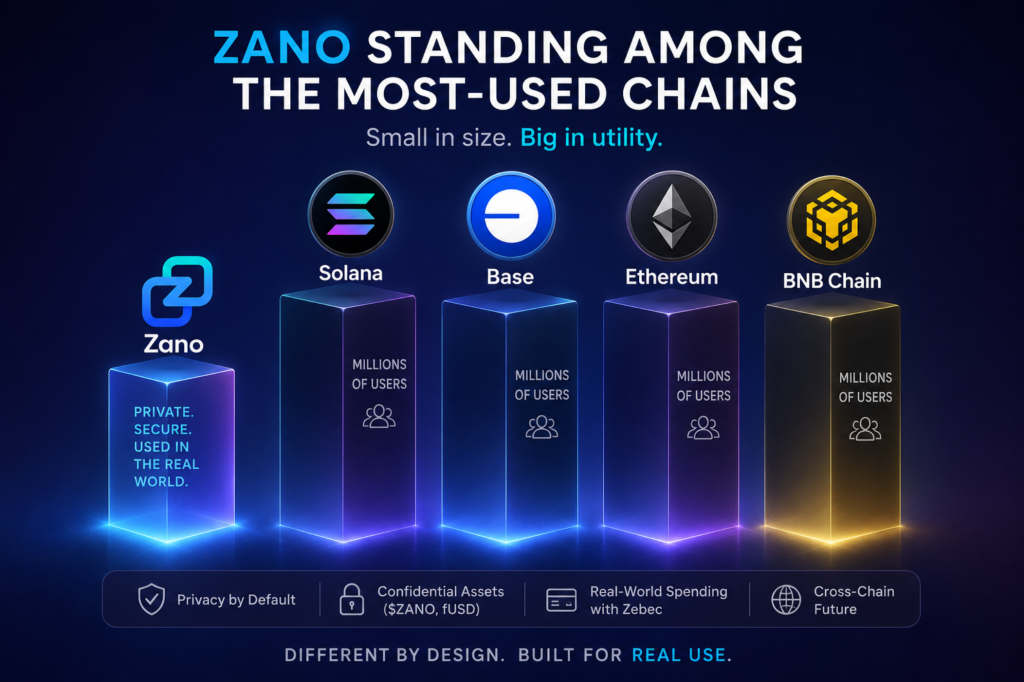
Zano is also standing alongside much larger networks such as Solana, Base, Ethereum and BNB Chain as one of the most-used chains on the Zebec mobile SuperApp.

That is what makes Zano interesting: small in market cap, but punching well above its weight when it comes to utility.

Table of Contents

  1. Why Zano Is Punching Above Its Weight
  2. Why Real-World Use Matters
  3. What Is the Zano and Zebec Connection?
  4. Why Zano’s Privacy Matters
  5. Why Zano Could Become More Important in Crypto
  6. What’s Next for Zano?
  7. The Bigger Picture
  8. Sources

1. Why Zano Is Punching Above Its Weight

Zano is much smaller than networks such as Ethereum, Solana and BNB Chain.

Yet it is appearing alongside them among the most-used chains on Zebec’s mobile SuperApp.

Why?

Because Zano offers something different: privacy-focused digital money that people can actually use.

2. Why Real-World Use Matters

Crypto is not only about buying and selling coins.

For crypto to become part of everyday life, people need to be able to use it for real payments.

Through its connection with Zebec, Zano users can use $ZANO and $fUSD for everyday spending.

This gives Zano a practical use case beyond simply holding or trading cryptocurrency.

3. What Is the Zano and Zebec Connection?

Zebec is a crypto payments platform that helps people use digital assets for everyday spending.

The basic idea is simple:

Hold $ZANO or fUSD → use a supported Zebec card → spend your crypto in the real world.

👉 Click here to see how it works: ZANO & Zebec Cards

4. Why Zano’s Privacy Matters

This is where Zano really stands apart.

Many major blockchains make transaction information publicly visible. Zano takes a different approach, with privacy built into the blockchain by default.

In simple terms, people can use Zano without having their financial activity openly visible on the blockchain.

For everyday digital payments, that can be a major advantage.

5. Why Zano Could Become More Important in Crypto

Zano is becoming increasingly interesting because it brings together three things:

Privacy + usable crypto + real-world payments.

Most people do not want their bank transactions publicly available for everyone to see.

As more people start using cryptocurrency for everyday payments, financial privacy could become even more important.

That is where Zano has a unique position.

It is not simply trying to be another large blockchain. It is building around the idea of private digital money that people can actually use.

6. What’s Next for Zano?

Zano is continuing to expand beyond payments.

The project is developing connections with other blockchain networks and working on ZEL, its upcoming smart-contract layer.

This could allow developers to build applications around Zano while keeping the main Zano blockchain focused on privacy.

Together with growing payment integrations, this could give Zano more ways to connect private digital money with the wider crypto economy.

7. The Bigger Picture

The latest Zebec update may look like a small announcement, but it highlights something important.

Zano is a fraction of the size of some of the biggest blockchain networks, yet it is already seeing real-world use through $ZANO and $fUSD.

That is the kind of utility the crypto industry needs to move beyond speculation.

Zano’s privacy-first blockchain, private assets and growing payment options give it a position that few other crypto projects can easily replicate.

Small in market cap, but increasingly big in utility.

If this growth continues, Zano could become an increasingly important name not only in privacy-focused crypto, but in the wider blockchain industry.

8. Sources

Disclaimer: ZanoNews.com is an independent news and information website. This article is for informational purposes only and should not be considered financial, investment, or legal advice.

Zano Shares More Details on How Smart Contracts Will Work Alongside Its Privacy Chain

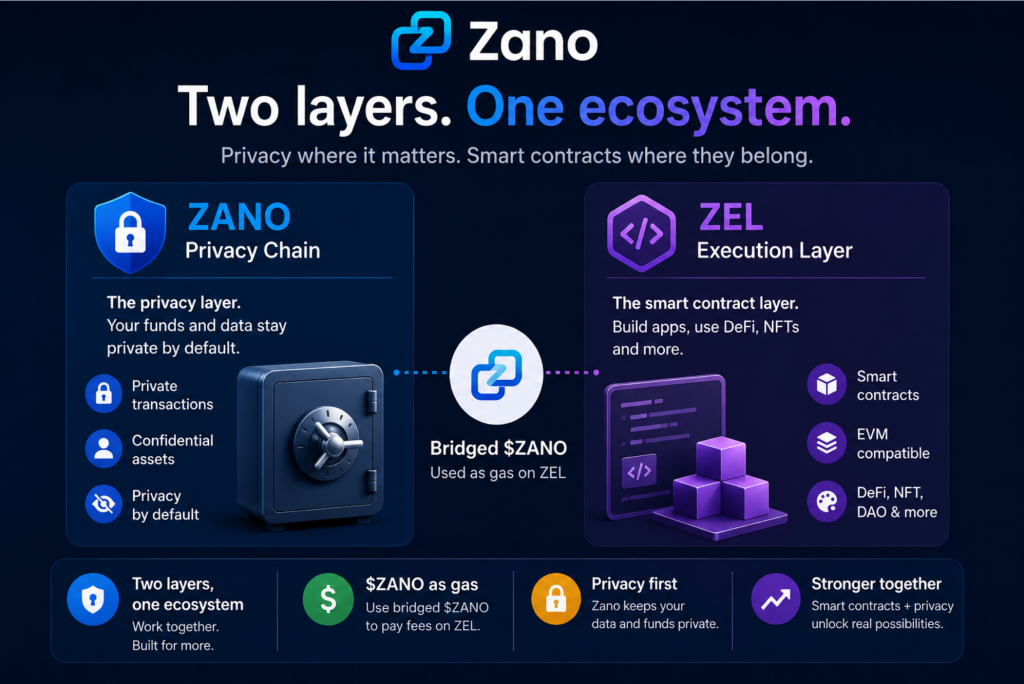
Zano has shared a clearer look at how its upcoming Zano Execution Layer (ZEL) will work alongside its privacy-focused blockchain.

In a recent post, Zano explained that ZEL will be a standard EVM environment running alongside Zano’s privacy-by-default blockchain.

Table of Contents

  1. How Zano and ZEL Will Work Together
  2. Where $ZANO Fits In
  3. Privacy and Smart Contracts Have Different Roles
  4. Learn More About ZEL

1. How Zano and ZEL Will Work Together

The idea is simple: Zano’s main blockchain remains focused on privacy, while ZEL provides an environment for smart contracts.

Smart contracts are programs that run on a blockchain. They can power applications such as decentralized exchanges, lending platforms and other Web3 services.

Instead of changing Zano’s privacy-focused Layer 1 to support these applications, ZEL will operate alongside it.

This gives the two layers different jobs:

  • Zano: Private transactions and assets
  • ZEL: Public and verifiable smart contracts

2. Where $ZANO Fits In

Bridged $ZANO will be used to pay for transactions and smart-contract activity on ZEL. These fees are known as “gas fees” and are similar to paying a small fee to use a service.

This means $ZANO will connect Zano’s privacy-focused blockchain with the new smart-contract environment on ZEL.

3. Privacy and Smart Contracts Have Different Roles

One of the key points from Zano’s post is that privacy and smart-contract transparency do not necessarily have to exist on the same layer.

Zano can keep its main blockchain focused on protecting private assets and transactions, while ZEL allows users and developers to interact with public, verifiable smart contracts.

In simple terms:

  • Private assets on Zano.
  • Verifiable smart contracts on ZEL.

The goal is to let each layer do what it was designed to do without compromising the other.

4. Learn More About ZEL

For readers who want a deeper explanation of how ZEL works, including the bridge between Zano and ZEL, what happens when $ZANO moves between the networks, and what developers could build on ZEL, read our full guide:

👉 Zano Execution Layer (ZEL) Explained: Smart Contracts Without Changing Zano’s Privacy

Zano’s roadmap currently lists the ZEL mainnet release as a Q4 2026 target, with the goal of bringing programmable smart contracts to the ecosystem while Zano L1 remains the privacy chain.

Sources

Disclaimer: ZanoNews.com is an independent news and information website. This article is for informational purposes only and should not be considered financial, investment, or legal advice.

Can THORChain Make a Comeback? Zano Joins Crypto Quorum Episode 63

THORChain’s future is up for debate as Zano joins the latest Crypto Quorum discussion. Episode 63 takes place on August 13 at 6:00 PM.

View the original Zano X post 👇

Table of Contents

  1. Crypto Quorum Episode 63
  2. What Is THORChain?
  3. Why Is a Comeback Being Discussed?
  4. Zano’s Role
  5. What to Watch

1. Crypto Quorum Episode 63

The latest Crypto Quorum episode will explore whether THORChain can regain its position and momentum in the crypto space.

Episode 63 is sponsored by Edge Wallet and co-hosted by Zano and THORChain.

2. What Is THORChain?

THORChain is a decentralized cross-chain liquidity protocol. In simple terms, it allows users to swap native cryptocurrencies across different blockchains without relying on a centralized exchange.

3. Why Is a Comeback Being Discussed?

THORChain has been an established name in cross-chain DeFi, but the crypto landscape has changed significantly.

The discussion will look at whether THORChain can attract new users, liquidity and attention while competing with newer projects.

4. Zano’s Role

Zano is joining the conversation as a co-host alongside THORChain, bringing another perspective to the discussion.

The episode should be interesting for anyone following privacy, DeFi and cross-chain technology.

5. What to Watch

The key question is simple: Can THORChain make a comeback, or is it too late?

Tune in to Crypto Quorum Episode 63 to hear the debate. ⚡

Sources:

Disclaimer: ZanoNews.com is an independent news and information website. This article is for informational purposes only and should not be considered financial, investment, or legal advice.

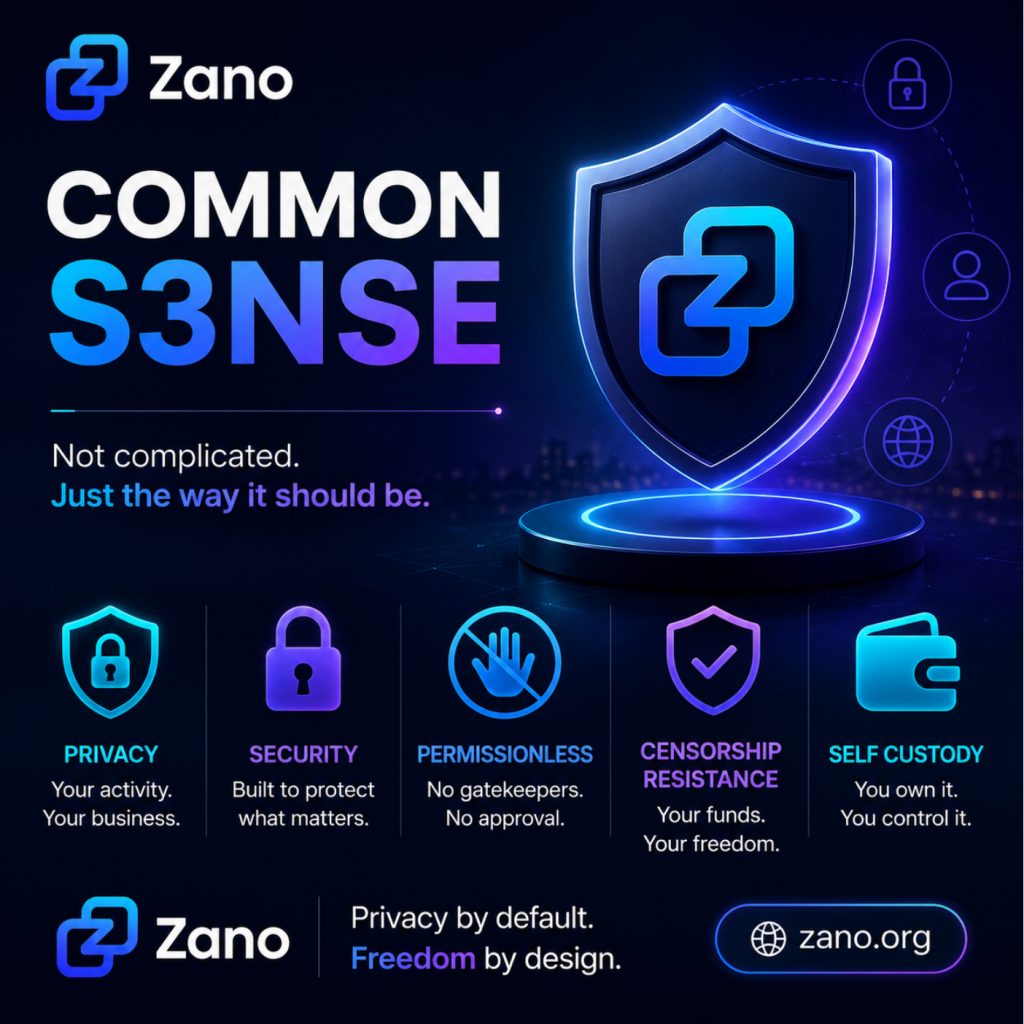
Privacy Is “Common S3nse”: Why Zano’s Message Matters

Privacy should not be complicated.

Neither should security, controlling your own money, or sending a transaction without asking for permission.

That is the simple message behind a recent X post from Eléonore Blanc, reposted by Zano:

“Privacy is Common S3nse. Security is Common S3nse. Permissionless is Common S3nse. Censorship Resistance is Common S3nse. Self custody is Common S3nse.”

It is a short message, but it asks an important question:

Should financial privacy be a special feature, or something we simply expect?

Table of Contents

  1. What Does “Common S3nse” Mean?
  2. Why Financial Privacy Matters
  3. What Is Self-Custody?
  4. What Does Permissionless Mean?
  5. Understanding Censorship Resistance
  6. Where Zano Fits In
  7. Maybe Privacy Is Just Common Sense
  8. Sources

1. What Does “Common S3nse” Mean?

“S3nse” is a creative way of writing “sense.”

The message is simple.

Privacy, security and control over your own money should not feel unusual.

They should be normal.

2. Why Financial Privacy Matters

Imagine if anyone could see your bank balance and payment history.

Who you paid.

How much you sent.

When you sent it.

That would feel uncomfortable.

Yet many public blockchains allow transaction activity to be viewed through blockchain explorers.

Zano takes a different approach.

Zano is a privacy-focused blockchain where transactions are private by default. The goal is simple: your financial activity should remain your business.

3. What Is Self-Custody?

Self-custody means you control your crypto.

Instead of a bank or company holding your assets, you control your wallet and private keys.

This gives users more control, but also more responsibility.

Your keys.

Your wallet.

Your assets.

4. What Does Permissionless Mean?

Permissionless simply means you do not need approval from a company or bank to use the network.

There is no application form.

No opening hours.

No person deciding whether you are allowed to participate.

You can interact with the blockchain according to the network’s rules.

5. Understanding Censorship Resistance

Censorship resistance means making it difficult for one company or authority to simply stop a valid transaction.

Why does that matter?

Because owning money is one thing.

Being able to use it is another.

This idea has always been an important part of cryptocurrency.

6. Where Zano Fits In

Zano is building privacy directly into its blockchain.

Transactions are private by default.

Its Confidential Assets technology also allows private digital assets to be created and used on the Zano network.

The bigger idea is easy to understand:

Privacy is not an extra button you turn on. It is part of the system.

That is what makes Zano’s approach interesting.

7. Maybe Privacy Is Just Common Sense

We use passwords to protect our emails.

We lock our phones.

We close our curtains.

So why should our financial activity be completely public?

Privacy does not always mean someone has something to hide.

Sometimes, it simply means having control over what you choose to share.

Privacy.

Security.

Self-custody.

Financial freedom.

Maybe these ideas are not complicated after all.

Maybe they’re just Common S3nse.

Learn more about Zano at Zano.org.

8. Sources

Disclaimer: ZanoNews.com is an independent news and information website. This article is for informational purposes only and does not constitute financial or investment advice.