Stablecoins are cryptocurrencies designed to keep a stable value, usually around $1. But there is an important difference between a stablecoin that is simply stable and one that also protects your financial privacy.
On Zano, $fUSD and $DAIx are designed to bring dollar-based value into Zano’s private ecosystem.
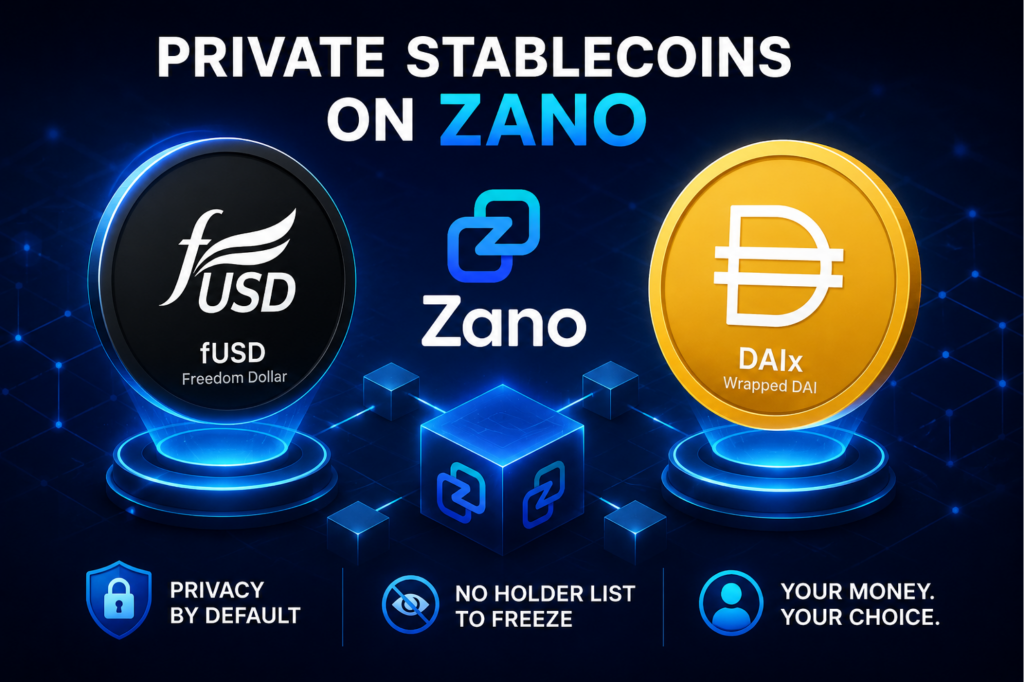
Table of Contents
- What Are fUSD and DAIx?
- What Is fUSD?
- What Is DAIx?
- Why Privacy Matters
- What Makes Zano Different?
- What This Means for Users
1. What Are fUSD and DAIx?
Both are stablecoins or dollar-based crypto assets that can be used within the Zano ecosystem.
The main difference is where they come from:
- $fUSD (Freedom Dollar) is a private stablecoin built directly on the Zano blockchain and designed to stay close to $1 USD.
- $DAIx (Wrapped DAI) is a private version of DAI that operates on the Zano blockchain while retaining its connection to the original DAI asset..
Both benefit from Zano’s privacy technology.
2. What Is fUSD?
fUSD stands for Freedom Dollar.
It is a decentralized stablecoin built on the Zano blockchain. Its goal is to maintain a value close to $1, while allowing users to make private transactions.
Unlike traditional stablecoins that operate on transparent blockchains, fUSD uses Zano’s privacy features to hide transaction details such as the sender, receiver and amount.
In simple terms:
fUSD = digital dollars + privacy.
👉 Learn more about fUSD and how Zano’s private stablecoin works here
3. What Is DAIx?
DAIx is a wrapped version of DAI that operates as a Confidential Asset on Zano.
DAI is a well-known decentralized stablecoin designed to track the value of the US dollar. Zano’s technology allows DAI to be brought into its private ecosystem as DAIx.
This means users can use a dollar-based asset on Zano while benefiting from the network’s privacy features. Zano’s documentation confirms DAIx as its Wrapped Dai asset.
In simple terms:
DAIx = DAI + Zano privacy.
4. Why Privacy Matters
Many stablecoins operate on public blockchains where transaction information can be viewed and analyzed.
Zano takes a different approach.
Its Confidential Assets are designed so that transaction details are hidden from outside observers. This applies to assets such as stablecoins as well as other tokens running on Zano.
This can provide users with more financial privacy when sending, receiving or holding stable-value assets.
5. What Makes Zano Different?
Zano is designed to make privacy the default, rather than something users need to turn on.
That means users can hold and transact with supported confidential assets without publicly revealing their balances, transaction amounts or counterparties.
For fUSD, the protocol also states that there is no central authority with the ability to freeze funds in a user’s wallet.
This is the point behind Zano’s latest message:
A stablecoin that can be frozen is still worth a dollar. It just isn’t your dollar.
6. What This Means for Users
The idea is simple.
A stablecoin can provide the stability of the US dollar, but users may also want privacy and control over their money.
With fUSD, Zano offers a dollar-based stablecoin built directly around privacy.
With DAIx, users can bring the familiar DAI asset into Zano’s private ecosystem.
Together, they show how Zano is trying to build a private financial ecosystem where stable-value assets can be used without putting every transaction on public display.
Sources:
Disclaimer: ZanoNews.com is an independent news and information website. This article is for informational purposes only and does not constitute financial or investment advice.