
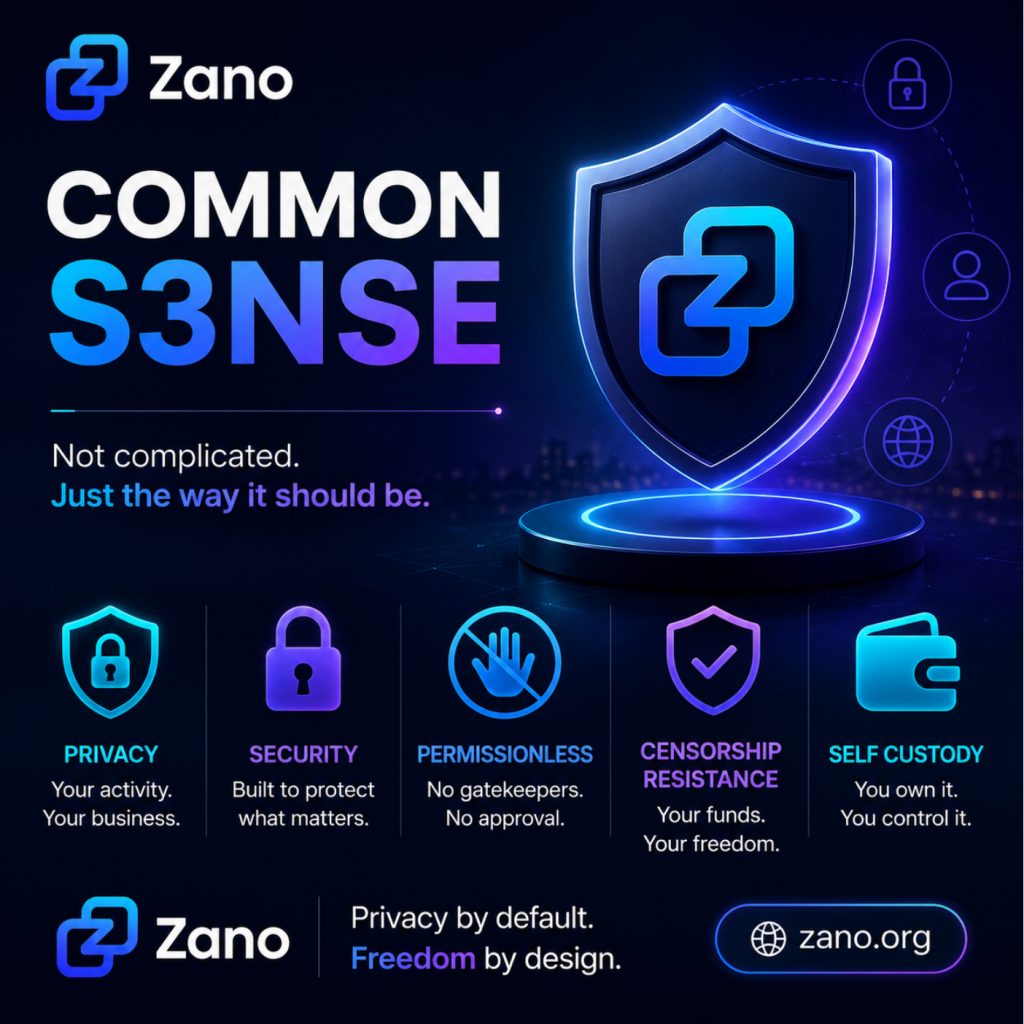
Privacy should not be complicated.
Neither should security, controlling your own money, or sending a transaction without asking for permission.
That is the simple message behind a recent X post from Eléonore Blanc, reposted by Zano:
“Privacy is Common S3nse. Security is Common S3nse. Permissionless is Common S3nse. Censorship Resistance is Common S3nse. Self custody is Common S3nse.”
It is a short message, but it asks an important question:
Should financial privacy be a special feature, or something we simply expect?
Table of Contents
- What Does “Common S3nse” Mean?
- Why Financial Privacy Matters
- What Is Self-Custody?
- What Does Permissionless Mean?
- Understanding Censorship Resistance
- Where Zano Fits In
- Maybe Privacy Is Just Common Sense
- Sources
1. What Does “Common S3nse” Mean?
“S3nse” is a creative way of writing “sense.”
The message is simple.
Privacy, security and control over your own money should not feel unusual.
They should be normal.
2. Why Financial Privacy Matters
Imagine if anyone could see your bank balance and payment history.
Who you paid.
How much you sent.
When you sent it.
That would feel uncomfortable.
Yet many public blockchains allow transaction activity to be viewed through blockchain explorers.
Zano takes a different approach.
Zano is a privacy-focused blockchain where transactions are private by default. The goal is simple: your financial activity should remain your business.
3. What Is Self-Custody?
Self-custody means you control your crypto.
Instead of a bank or company holding your assets, you control your wallet and private keys.
This gives users more control, but also more responsibility.
Your keys.
Your wallet.
Your assets.
4. What Does Permissionless Mean?
Permissionless simply means you do not need approval from a company or bank to use the network.
There is no application form.
No opening hours.
No person deciding whether you are allowed to participate.
You can interact with the blockchain according to the network’s rules.
5. Understanding Censorship Resistance
Censorship resistance means making it difficult for one company or authority to simply stop a valid transaction.
Why does that matter?
Because owning money is one thing.
Being able to use it is another.
This idea has always been an important part of cryptocurrency.
6. Where Zano Fits In
Zano is building privacy directly into its blockchain.
Transactions are private by default.
Its Confidential Assets technology also allows private digital assets to be created and used on the Zano network.
The bigger idea is easy to understand:
Privacy is not an extra button you turn on. It is part of the system.
That is what makes Zano’s approach interesting.
7. Maybe Privacy Is Just Common Sense
We use passwords to protect our emails.
We lock our phones.
We close our curtains.
So why should our financial activity be completely public?
Privacy does not always mean someone has something to hide.
Sometimes, it simply means having control over what you choose to share.
Privacy.
Security.
Self-custody.
Financial freedom.
Maybe these ideas are not complicated after all.
Maybe they’re just Common S3nse.
Learn more about Zano at Zano.org.
8. Sources
Disclaimer: ZanoNews.com is an independent news and information website. This article is for informational purposes only and does not constitute financial or investment advice.
One thought on “Privacy Is “Common S3nse”: Why Zano’s Message Matters”
Comments are closed.