
Zano’s upcoming Hard Fork 6 (HF6) is designed to make it easier for $ZANO to connect with other blockchains while keeping the network’s core privacy features intact.
One of the most important changes is the ability to bridge native $ZANO to networks such as EVM chains, TON and Solana through Bridgeless.
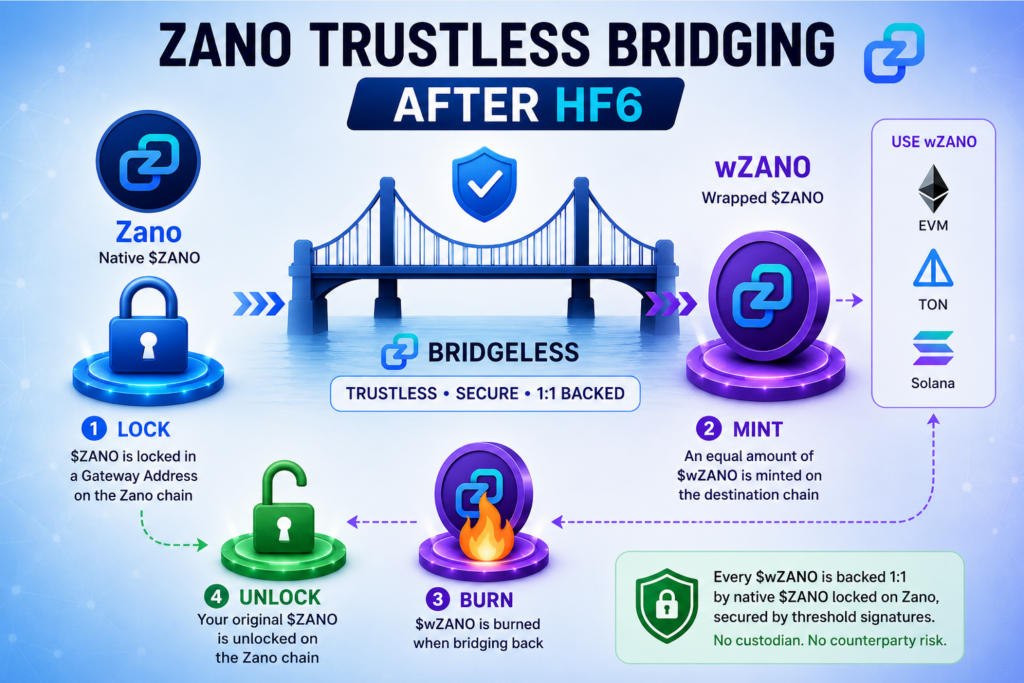
Table of Contents
- What Is Hard Fork 6?
- What Is Trustless Bridging?
- How Does Zano Bridging Work?
- Why Is This Important?
- What Happens to Privacy?
1. What Is Hard Fork 6?
Hard Fork 6 is a major Zano network upgrade introducing Gateway Addresses, among other improvements. Gateway Addresses are designed to make Zano easier for exchanges, wallets, bridges and other applications to integrate.
HF6 is scheduled to activate at block 3,833,000, expected between August 25 and 27, 2026.
For a more detailed explanation, see our previous article: Zano Hard Fork 6: A New Era for Wallets & Exchanges 🌍
2. What Is Trustless Bridging?
In simple terms, trustless bridging means users do not need to rely on a person or company to hold their funds.
Instead, the process is secured by blockchain infrastructure and cryptographic mechanisms. No single party controls the complete key needed to access the locked funds.
3. How Does Zano Bridging Work?
The process is straightforward:
1. Lock $ZANO
Your native $ZANO is locked in a Gateway Address on the Zano blockchain. The funds are held by the protocol rather than by a company or individual.
2. Mint $wZANO
An equivalent amount of $wZANO, a wrapped version of Zano, is minted on the destination blockchain. This can be an EVM network (blockchains that support Ethereum-compatible apps), TON (The Open Network) or Solana, three different blockchain networks where $wZANO can be used.
3. Use $wZANO
You can then use $wZANO within the supported ecosystem, including applications and DeFi platforms.
4. Bridge Back
When you want to return to Zano, your $wZANO is burned. The corresponding native $ZANO is then unlocked from the Gateway Address.
The important part is that $wZANO is backed 1:1 by native $ZANO locked on the Zano side. Threshold signatures are used so that no single party holds the complete private key.
4. Why Is This Important?
Previously, Zano’s privacy-focused design could make integration more complicated for exchanges and other services.
HF6’s Gateway Addresses provide infrastructure specifically designed for services such as bridges, exchanges and DEXs. This could make it easier for more platforms to support Zano.
For users, this could eventually mean:
- More ways to use $ZANO
- Greater access to DeFi
- More liquidity across different networks
- Easier integration with wallets and exchanges
5. What Happens to Privacy?
Zano’s standard privacy remains intact on the Zano network.
However, there is an important point to understand: when $ZANO is bridged to a transparent blockchain, activity on that destination network can be publicly visible. Users return to Zano’s privacy-focused environment when they bridge their funds back.
In simple terms, HF6 creates a way for native $ZANO to move between ecosystems without requiring a traditional centralized custodian to sit in the middle.
This could make Zano more accessible to the wider crypto ecosystem while keeping privacy at the center of the Zano network.
Source
- Zano Official Website
- Zano official announcement on X
- Official Zano Docs
- Zano Official Bridgeless Article
Disclaimer: ZanoNews.com is an independent news and information website. This article is for informational purposes only and should not be considered financial, investment, or legal advice.