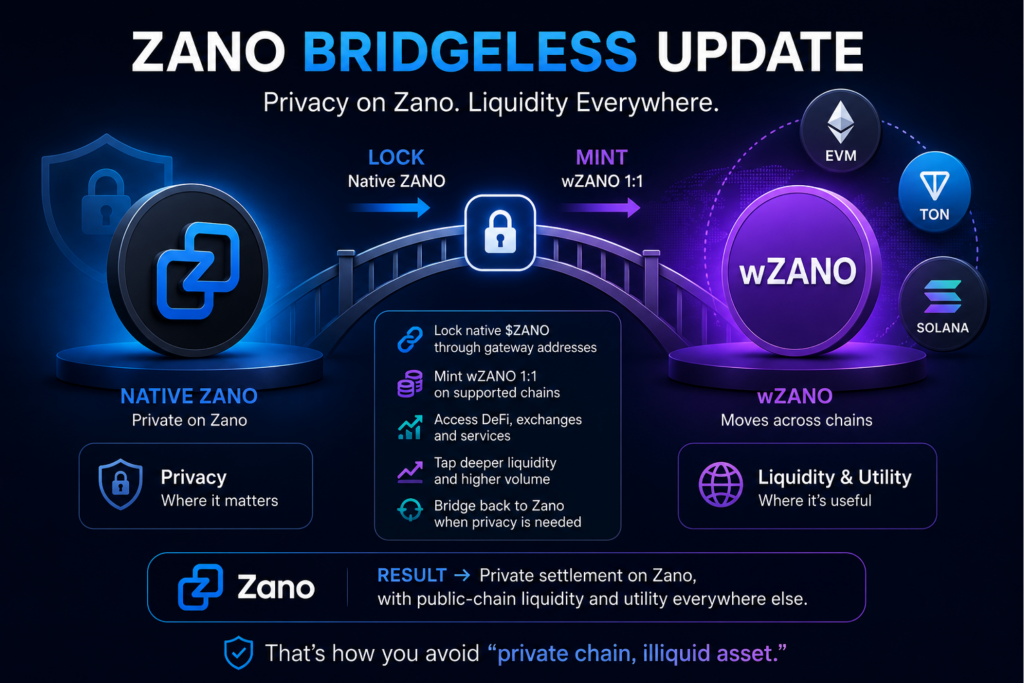
Zano Hard Fork 6 Is Now Live: What It Means for Exchanges, Wallets and Users ๐Ÿ”ฅ

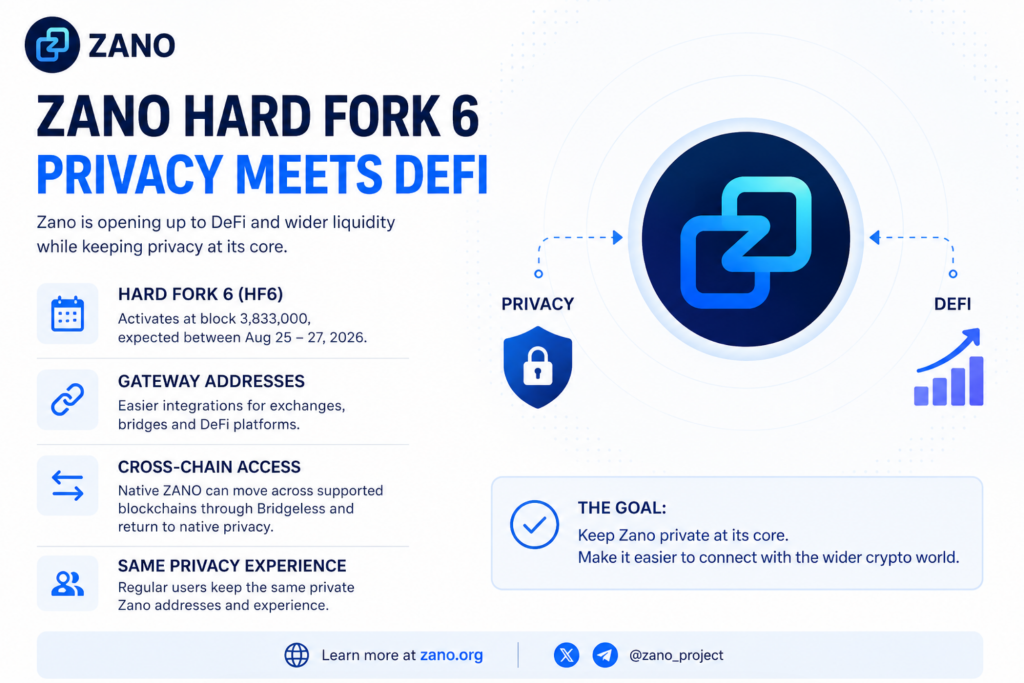
Zanoโ€™s Hard Fork 6 (HF6) is now live, activating at block 3,833,000 on August 26, 2026.

The upgrade makes it easier for exchanges, wallets, bridges, DEXs and other crypto services to connect with Zano. For everyday users, this could eventually mean more ways to buy, sell, store and use ZANO, while keeping Zanoโ€™s privacy features.

HF6 also supports two-way cross-chain transfers, helping Zano connect with other blockchain networks.
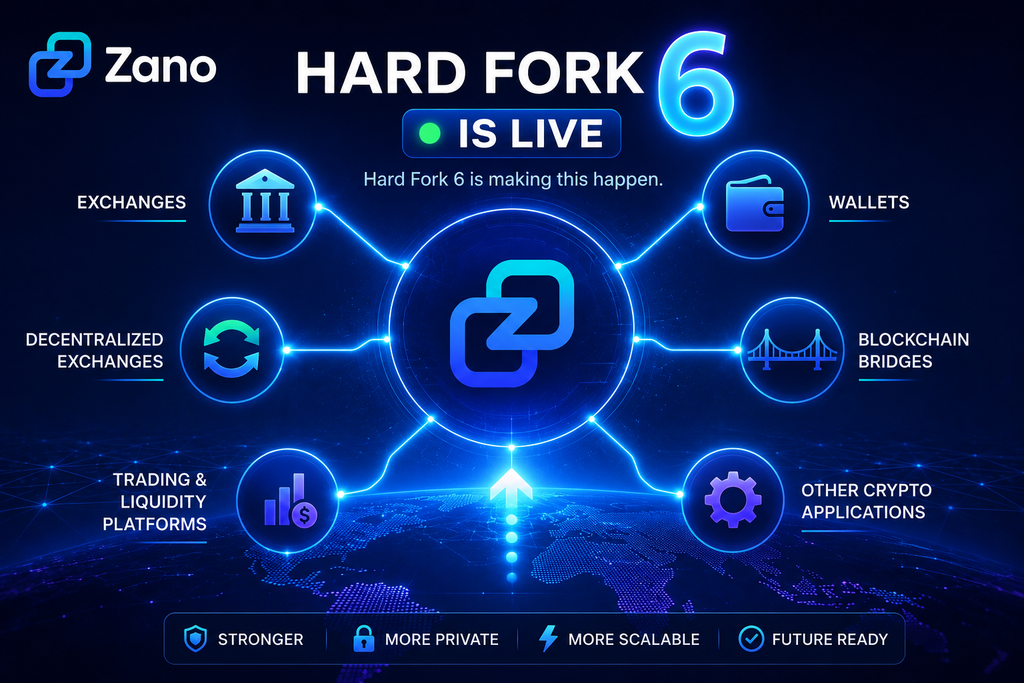
Table of Contents

  1. What Is Zano Hard Fork 6?
  2. What Changes With HF6?
  3. How Are HF6 and Gateway Addresses Connected?
  4. Why Gateway Addresses Matter
  5. Zano Can Now Move Across Chains
  6. What Does This Mean for Exchanges and Wallets?
  7. Does Hard Fork 6 Change Zanoโ€™s Privacy?
  8. What Do Zano Users Need to Know?
  9. Learn More About Hard Fork 6
  10. Sources

1. What Is Zano Hard Fork 6?

A hard fork is a major update to a blockchain.

Zano HF6 activated at block 3,833,000 on August 26, 2026, following more than a year of development.

The goal is simple: make Zano easier for the wider crypto industry to connect with while keeping its privacy-focused design.

2. What Changes With HF6?

One of the key changes is Gateway Addresses.

They give exchanges, bridges and other services a simpler way to work with Zano.

For regular Zano users, standard private Zano addresses continue to work as before.

๐Ÿ‘‰ Want to understand Gateway Addresses in simple terms?
Read: How Gateway Addresses Could Bring Zano to More Exchanges

3. How Are HF6 and Gateway Addresses Connected?

Hard Fork 6 is the upgrade, and Gateway Addresses are one of its key features.

They are designed to make it easier for exchanges, wallets, bridges and DEXs to connect with Zano.

In simple terms:

HF6 โ†’ Gateway Addresses โ†’ Easier integration โ†’ More opportunities for Zano adoption.

Regular users can continue using Zanoโ€™s standard private addresses as before.

4. Why Gateway Addresses Matter

Imagine an exchange wants to support ZANO.

It needs an easy way to manage deposits, withdrawals and balances. Gateway Addresses are designed to make this simpler.

For everyday users:

Easier integration โ†’ more services can support Zano โ†’ more ways to use ZANO.

๐Ÿ‘‰ Learn more about Gateway Addresses

HF6 also introduces per-output payment IDs, which can help exchanges identify deposits while protecting the recipientโ€™s privacy.

5. Zano Can Now Move Across Chains

HF6 also supports two-way cross-chain transfers.

This means native ZANO and supported Confidential Assets can move between Zano and supported blockchain networks through bridging technology.

For example:

Zano โ†’ Bridge โ†’ Another blockchain

This can give ZANO access to more blockchain ecosystems, liquidity and potential DeFi applications.

๐Ÿ‘‰ Want to understand how this works?
Read: How Does Zanoโ€™s Trustless Bridging Work After HF6? ๐Ÿ”—

6. What Does This Mean for Exchanges and Wallets?

This is where HF6 could become particularly important for everyday users.

If integrating Zano becomes easier, more services may have a simpler path toward supporting it.

That could include:

  • ๐Ÿฆ Exchanges
  • ๐Ÿ‘› Wallets
  • ๐Ÿ”„ Decentralized exchanges
  • ๐ŸŒ‰ Blockchain bridges
  • ๐Ÿ’ฑ Trading and liquidity platforms
  • ๐Ÿ› ๏ธ Other crypto applications

The Zano team has previously discussed Gateway Addresses with platforms including THORChain, NEAR Intents and Maya Protocol, with the new infrastructure intended to make integrations easier.

This does not mean every exchange or wallet now supports Zano automatically.

Instead, HF6 removes an important technical barrier and gives these services a simpler way to integrate with the network.

7. Does Hard Fork 6 Change Zanoโ€™s Privacy?

No.

Zanoโ€™s privacy remains a core part of the network.

HF6 improves how external services can connect with Zano without replacing the privacy features of standard Zano addresses.

In simple terms:

More connectivity + privacy at the core. ๐Ÿ”’

8. What Do Zano Users Need to Know?

For most users, there is no complicated process involved with HF6.

If you use a full-node desktop wallet, make sure you are running the latest version and that it has fully synced with the network.

๐Ÿ‘‰ Download the latest Zano wallet

If you use Zano through an exchange or third-party wallet, check that your provider has completed its HF6 upgrade where applicable.

9. Learn More About Hard Fork 6

Want to explore HF6 in more detail?

๐Ÿ‘‰ Zano Hard Fork 6 Is Only a Few Days Away ๐Ÿ”ฅ โ€” Introduction to HF6 and Gateway Addresses.

๐Ÿ‘‰ How Gateway Addresses Could Bring Zano to More Exchanges โ€” A simple explanation of Gateway Addresses.

๐Ÿ‘‰ How Does Zanoโ€™s Trustless Bridging Work After HF6? ๐Ÿ”— โ€” How Zano can connect with other blockchains.

๐Ÿ‘‰ How Does the Confidential Layer Bridge Work? โ€” How BTC, ETH and other assets can move into Zano and use its privacy features.

๐Ÿ‘‰ From Bitcoin to BTCx: A More Private Way to Use Bitcoin โ€” How Bitcoin can become BTCx on Zano.

10. Sources

Disclaimer: ZanoNews.com is an independent news and information website. This article is for informational purposes only and does not constitute financial or investment advice.
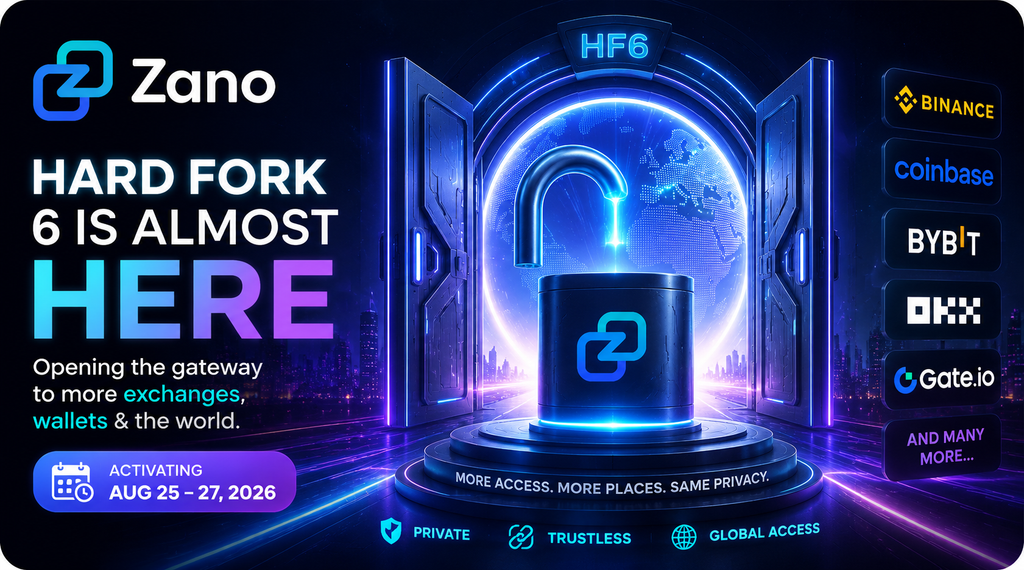
Zano Hard Fork 6 Is Only a Few Days Away ๐Ÿ”ฅ

Zanoโ€™s Hard Fork 6 is a major network upgrade designed to improve how Zano connects with exchanges, wallets, bridges and other crypto services, while keeping its privacy features intact.

Table of Contents

  1. When Is Hard Fork 6?
  2. What Is Changing?
  3. Why Do Gateway Addresses Matter?
  4. What Do Users Need to Do?
  5. How HF6 Improves Wallet Security
  6. What About Zanoโ€™s Privacy?
  7. Learn More About Hard Fork 6
  8. What Comes Next?

1. When Is Hard Fork 6?

Zano’s Hard Fork 6 activated at block 3,833,000 on August 26, 2026, marking a major upgrade for the Zano network.

โš ๏ธ Hard Fork 6 Wallet Update

Before the upgrade, the Zano team reminded full-node desktop wallet users to download the latest wallet and allow it to fully resync to stay connected to the network.

๐Ÿ‘‰ Download the latest Zano wallet

If you use a full-node desktop wallet, make sure you are running the latest version and that your wallet has fully synced.

2. What Is Changing?

One of the main changes coming with Hard Fork 6 is Gateway Addresses.

These are designed to make it easier for exchanges, wallets, bridges, DEXes and other services to connect with Zano.

We have already explained Hard Fork 6 and its main changes in more detail here:

๐Ÿ‘‰ Zano Hard Fork 6: Opening the Door to More Wallets, Exchanges and Apps ๐ŸŒ

3. Why Do Gateway Addresses Matter?

For everyday users, you do not need to understand all the technical details.

The simple idea is that Gateway Addresses can make it easier for crypto services to connect with Zano and support $ZANO.

This could help open the door to more exchanges, wallets, bridges and applications supporting Zano in the future.

HF6 also adds per output payment IDs. In simple terms, this makes it easier for exchanges and other services to match a deposit to the correct account while keeping the recipientโ€™s privacy protected. ๐Ÿ”’

We have also covered Gateway Addresses in more detail in our previous article:

๐Ÿ‘‰ What Are Gateway Addresses?

4. What Do Users Need to Do?

If you use a Zano wallet, make sure you are running the latest wallet version before Hard Fork 6 activates.

Zano has released the updated wallet, so users should update it and allow the wallet to fully sync with the network.

You can find the latest wallet here:

๐Ÿ‘‰ Zano Wallets

We also covered the wallet update ahead of HF6 here:

๐Ÿ‘‰ Zano Wallet Update Prepares Users for Hard Fork 6 ๐Ÿ”ฅ

If you run a node, mining pool, exchange or other Zano service, make sure your infrastructure is updated as well.

5. HF6 Also Brings Stronger Wallet Security

Hard Fork 6 is not only about making Zano easier for exchanges, wallets and bridges to integrate.

The HF6 wallet release also improves wallet file security by using ChaCha20 streaming encryption. This makes a stolen or copied wallet file much harder to crack.

For regular users, the takeaway is simple: if you are still using an older Zano wallet, update to the latest version before HF6.

๐Ÿ‘‰ Download the latest Zano wallet

6. What About Zanoโ€™s Privacy?

Hard Fork 6 is not about removing Zanoโ€™s privacy.

Zanoโ€™s core privacy remains intact.

Gateway Addresses are mainly designed to make integration easier for external services, while regular users can continue using Zanoโ€™s private addresses.

The goal is simple:

Make Zano easier to connect with without giving up its privacy.

7. Learn More About Hard Fork 6

If you want to understand the bigger picture, including Gateway Addresses and what HF6 could mean for exchanges, wallets and applications, check out our full guide:

๐Ÿ‘‰ Zano Hard Fork 6: Opening the Door to More Wallets, Exchanges and Apps ๐ŸŒ

You can also learn more about how Zanoโ€™s bridging technology fits into the post-HF6 ecosystem:

๐Ÿ‘‰ How Does Zanoโ€™s Trustless Bridging Work After HF6? ๐Ÿ”—

8. What Comes Next?

Hard Fork 6 is now just days away.

For regular Zano users, the main thing to do is simple: update your wallet, let it fully sync, and stay ready for the upgrade.

For exchanges, wallets, bridges and other services, HF6 could make integrating with Zano much easier.

The upgrade could be an important step toward making Zano more accessible to the wider crypto world while keeping privacy at its core. ๐Ÿ”ฅ

Sources

Disclaimer: ZanoNews.com is an independent news and information website. This article is for informational purposes only and does not constitute financial or investment advice.
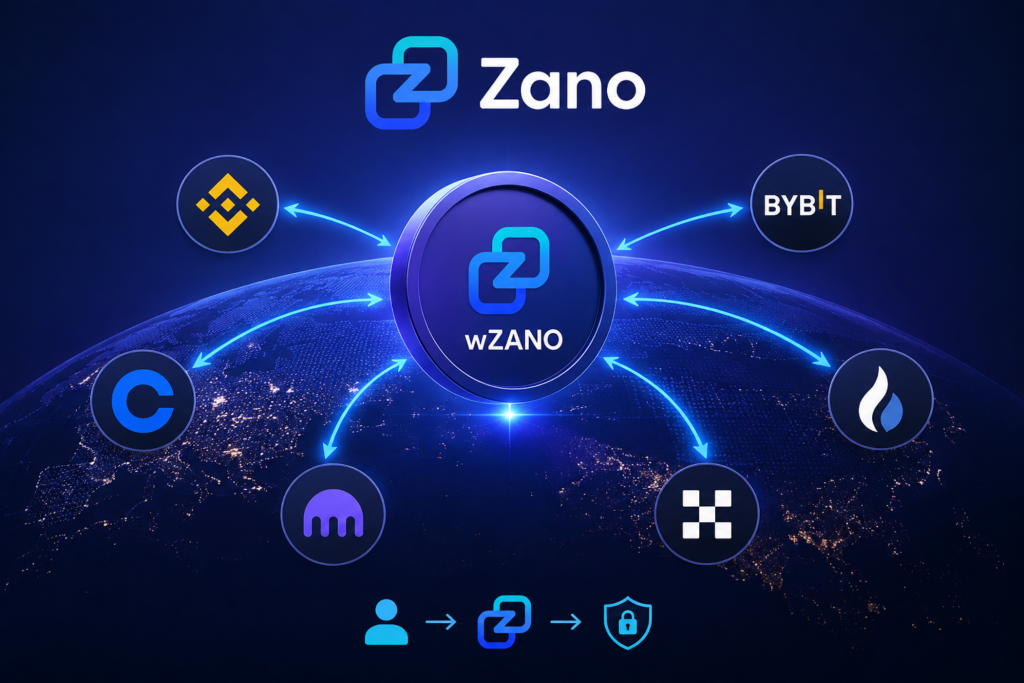
Buy wZANO with Your Card: What Hard Fork 6 Could Unlock ๐Ÿš€

Buying crypto could soon become a much simpler way to enter the Zano ecosystem.

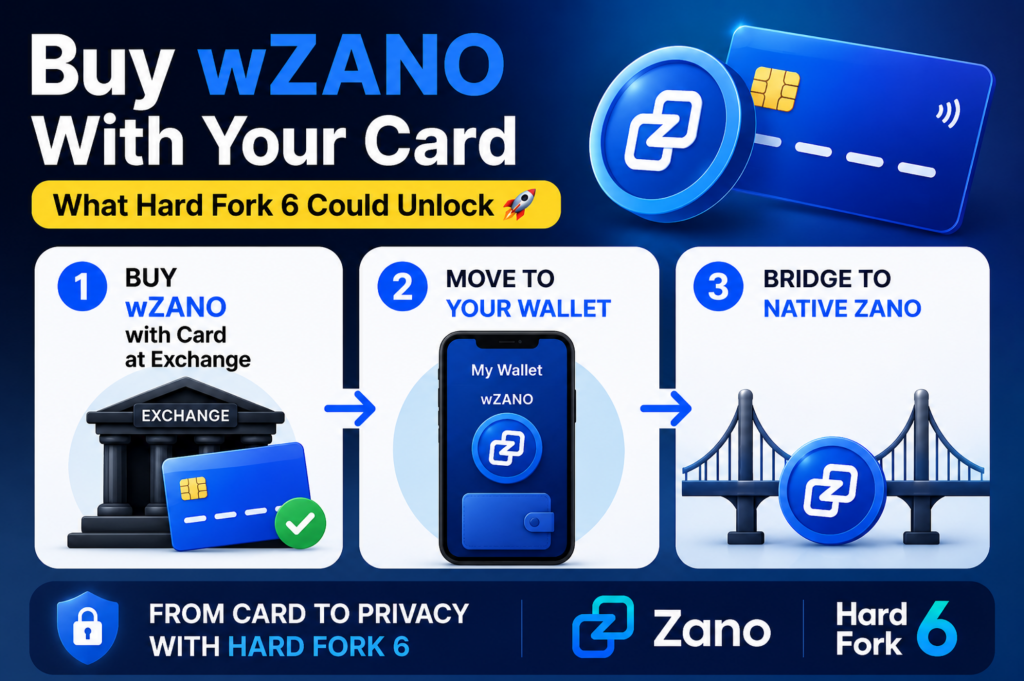
Zano has outlined a potential future path where users could buy $wZANO (Wrapped Zano) through Coinbase with a card or bank transfer, move it to their own wallet, and then bridge it to native $ZANO for financial privacy.

This is an important development because it could make Zano easier to access for people who are completely new to the project.

Table of Contents

  1. A Simpler Way to Access Zano
  2. How the Process Could Work
  3. Why wZANO Matters
  4. New to wZANO?
  5. How Hard Fork 6 Could Unlock This
  6. What It Could Mean for Zano

1. A Simpler Way to Access Zano

Today, buying and using privacy-focused cryptocurrency can feel complicated for new users.

Zano is working toward a much simpler experience.

The potential journey could look like this:

Card or bank transfer โ†’ $wZANO โ†’ your own wallet โ†’ native $ZANO โ†’ financial privacy

Instead of needing to understand complicated crypto infrastructure, the user could start with a familiar payment method and move toward Zano’s private network.

2. How the Process Could Work

The process could involve just three main steps:

1. Buy $wZANO

A user could purchase $wZANO through a supported platform such as Coinbase using a card or bank transfer.

2. Move it to your own wallet

The wZANO could then be withdrawn to a self-custody wallet that supports the token.

3. Bridge to native $ZANO

The user could bridge wZANO to native $ZANO on the Zano network.

Once on the native Zano network, users can benefit from Zano’s privacy-focused technology.

In simple terms:

Buy โ†’ Own โ†’ Bridge โ†’ Privacy ๐Ÿ”

3. Why wZANO Matters

This is where wZANO (Wrapped Zano) could make a major difference.

Native ZANO is designed for financial privacy, but that privacy can make it more difficult for traditional crypto platforms to integrate.

wZANO provides a version of Zano that can work with public blockchain infrastructure and wider crypto services.

This creates a potential connection between easy access and private transactions.

It could also give new users a more familiar starting point before moving into Zano’s privacy-focused ecosystem.

4. New to wZANO?

If you don’t know what wZANO is, don’t worry.

wZANO is a wrapped version of Zano designed to work across other blockchain networks.

You can ๐Ÿ‘‰ learn more about wZANO and how it could bring Zano to more crypto exchanges

That article explains the idea in simple terms and why wZANO could help Zano reach more users.

5. How Hard Fork 6 Could Unlock This

The potential card-to-privacy journey is closely connected to Zano Hard Fork 6.

Hard Fork 6 introduces Gateway Addresses, which are designed to make it easier for exchanges, bridges and other platforms to connect with Zano. ZanoNews has previously reported that the upgrade is expected to activate at block 3,833,000 between August 25 and 27, 2026.

This is important because the goal is not simply to make Zano easier to buy.

It is about making the entire journey into and out of the Zano ecosystem easier.

You can ๐Ÿ‘‰ read our full guide to Zano Hard Fork 6

6. What It Could Mean for Zano

If this vision becomes reality, getting into Zano could become much easier for everyday users.

Someone could potentially go from:

๐Ÿ’ณ Card payment โ†’ $wZANO โ†’ ๐Ÿ‘› Self-custody wallet โ†’ ๐Ÿ”„ Native $ZANO โ†’ ๐Ÿ” Privacy

That is much more than simply another way to buy a cryptocurrency.

It could give Zano a simple on-ramp for new users, while allowing those users to move into the privacy-focused Zano network when they want it.

For Zano, Hard Fork 6 and wZANO could therefore represent an important step toward making financial privacy easier to access for everyone.

Sources:

Disclaimer:ย ZanoNews.comย is an independent news and information website. This article is for informational purposes only and does not constitute financial or investment advice.
How wZANO (Wrapped Zano) Could Bring Zano to More Crypto Exchanges ๐ŸŒ

Zanoโ€™s privacy-focused blockchain has faced a challenge: privacy is one of its biggest strengths, but it has also made native $ZANO harder for some major exchanges to support. $wZANO is a wrapped version of ZANO designed to work across transparent EVM-compatible blockchains, making it easier to use with exchanges, wallets, and other blockchain applications. You can learn more about how wZANO works in Zanoโ€™s bridgeless update.

A new approach involving $wZANO could help change that.

Table of Contents

  1. The Challenge for Native $ZANO
  2. What Is $wZANO?
  3. Why $wZANO Could Be Easier to List
  4. How Users Could Move Between wZANO and ZANO
  5. Why Privacy Still Matters
  6. How Hard Fork 6 Fits In
  7. What This Could Mean for Zano

1. The Challenge for Native $ZANO

Zano is designed with privacy as a core feature. However, that privacy has also created difficulties when trying to integrate native $ZANO with some major cryptocurrency exchanges.

According to the Zano team, some tier-1 exchanges have rejected native $ZANO because of its privacy features.

This has created a barrier for new users who may want to buy ZANO through large, familiar exchanges.

2. What Is $wZANO?

$wZANO is a version of ZANO designed to work on transparent EVM-compatible blockchains.

EVM simply refers to the technology used by blockchains such as Ethereum and other networks that support Ethereum-compatible applications.

Unlike native $ZANO, transactions involving wZANO on a public EVM blockchain can be viewed on the blockchain.

This makes wZANO easier for existing crypto platforms and applications to work with.

3. Why $wZANO Could Be Easier to List

The key difference is transparency.

Because wZANO operates as a transparent blockchain asset, exchanges and other crypto services may find it easier to integrate and support.

This could potentially give Zano access to a much larger audience.

For a new user, the process could eventually look something like this:

Buy wZANO on a major exchange โ†’ withdraw it to a wallet โ†’ bridge it to native ZANO โ†’ use Zano with its full privacy features.

4. How Users Could Move Between wZANO and ZANO

The idea is to give users more flexibility.

Someone who wants easier access to exchanges and public blockchain applications could use wZANO.

Someone who wants Zanoโ€™s privacy features could move their assets back to native $ZANO.

This creates a bridge between the public crypto ecosystem and Zanoโ€™s private network.

5. Why Privacy Still Matters

The goal is not to remove privacy from Zano.

Instead, wZANO provides a more transparent option for situations where transparency and compatibility are important.

Once assets are moved back to native ZANO, users can benefit from Zanoโ€™s privacy-focused network.

This gives users a choice between accessibility and transparency on one side, and privacy on the other.

6. How Hard Fork 6 Fits In

This functionality is soon to be made possible through Hard Fork 6.

Hard Fork 6 introduces Gateway Addresses, which are designed to make it easier for exchanges, bridges and other blockchain applications to connect with Zano.

The upgrade is scheduled to activate at block 3,833,000, expected between August 25 and 27, 2026.

7. What This Could Mean for Zano

The introduction of wZANO could give Zano a new way to reach users who may never have discovered the project through privacy-focused exchanges.

Instead of asking major exchanges to directly support a privacy-focused asset, wZANO could provide a more familiar and transparent asset for integration.

If successful, this could mean more exchange access, easier onboarding for new users, and a simpler path from major crypto platforms to Zanoโ€™s privacy network.

The idea is simple: make Zano easier to access without giving up the privacy that makes it different.

Sources

Disclaimer:ย ZanoNews.comย is an independent news and information website. This article is for informational purposes only and does not constitute financial or investment advice.
Zano Shares More Details on How Smart Contracts Will Work Alongside Its Privacy Chain

Zano has shared a clearer look at how its upcoming Zano Execution Layer (ZEL) will work alongside its privacy-focused blockchain.

In a recent post, Zano explained that ZEL will be a standard EVM environment running alongside Zano’s privacy-by-default blockchain.

Table of Contents

  1. How Zano and ZEL Will Work Together
  2. Where $ZANO Fits In
  3. Privacy and Smart Contracts Have Different Roles
  4. Learn More About ZEL

1. How Zano and ZEL Will Work Together

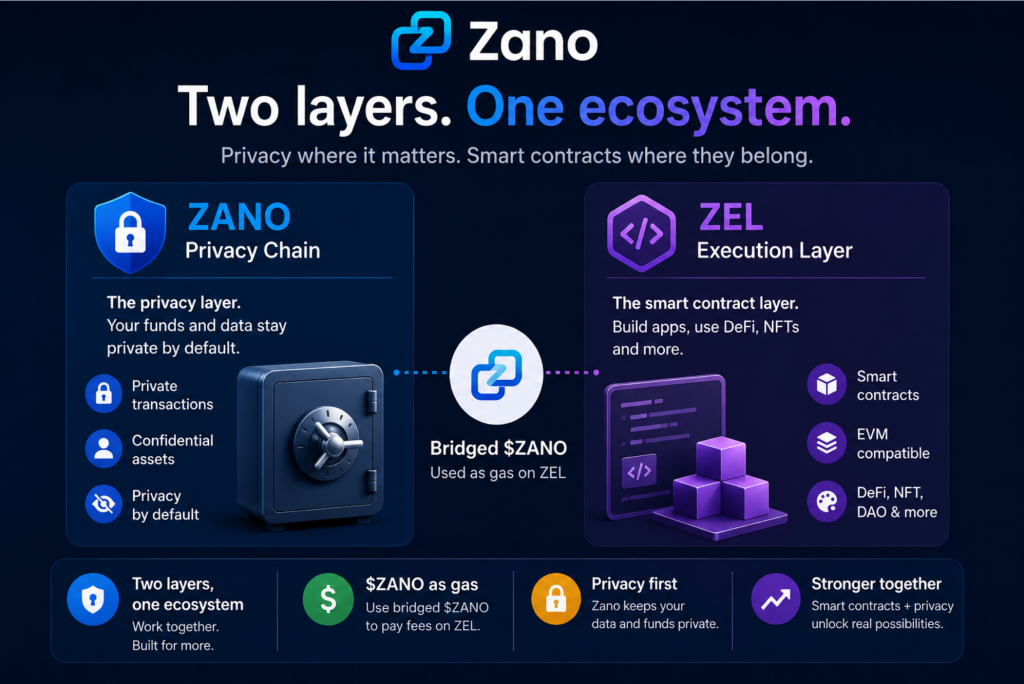
The idea is simple: Zano’s main blockchain remains focused on privacy, while ZEL provides an environment for smart contracts.

Smart contracts are programs that run on a blockchain. They can power applications such as decentralized exchanges, lending platforms and other Web3 services.

Instead of changing Zano’s privacy-focused Layer 1 to support these applications, ZEL will operate alongside it.

This gives the two layers different jobs:

  • Zano: Private transactions and assets
  • ZEL: Public and verifiable smart contracts

2. Where $ZANO Fits In

Bridged $ZANO will be used to pay for transactions and smart-contract activity on ZEL. These fees are known as โ€œgas feesโ€ and are similar to paying a small fee to use a service.

This means $ZANO will connect Zanoโ€™s privacy-focused blockchain with the new smart-contract environment on ZEL.

3. Privacy and Smart Contracts Have Different Roles

One of the key points from Zano’s post is that privacy and smart-contract transparency do not necessarily have to exist on the same layer.

Zano can keep its main blockchain focused on protecting private assets and transactions, while ZEL allows users and developers to interact with public, verifiable smart contracts.

In simple terms:

  • Private assets on Zano.
  • Verifiable smart contracts on ZEL.

The goal is to let each layer do what it was designed to do without compromising the other.

4. Learn More About ZEL

For readers who want a deeper explanation of how ZEL works, including the bridge between Zano and ZEL, what happens when $ZANO moves between the networks, and what developers could build on ZEL, read our full guide:

๐Ÿ‘‰ Zano Execution Layer (ZEL) Explained: Smart Contracts Without Changing Zanoโ€™s Privacy

Zano’s roadmap currently lists the ZEL mainnet release as a Q4 2026 target, with the goal of bringing programmable smart contracts to the ecosystem while Zano L1 remains the privacy chain.

Sources

Disclaimer:ย ZanoNews.comย is an independent news and information website. This article is for informational purposes only and should not be considered financial, investment, or legal advice.

How Does Zanoโ€™s Trustless Bridging Work After HF6? ๐Ÿ”—

Zanoโ€™s upcoming Hard Fork 6 (HF6) is designed to make it easier for $ZANO to connect with other blockchains while keeping the networkโ€™s core privacy features intact.

One of the most important changes is the ability to bridge native $ZANO to networks such as EVM chains, TON and Solana through Bridgeless.

Table of Contents

  1. What Is Hard Fork 6?
  2. What Is Trustless Bridging?
  3. How Does Zano Bridging Work?
  4. Why Is This Important?
  5. What Happens to Privacy?

1. What Is Hard Fork 6?

Hard Fork 6 is a major Zano network upgrade introducing Gateway Addresses, among other improvements. Gateway Addresses are designed to make Zano easier for exchanges, wallets, bridges and other applications to integrate.

HF6 is scheduled to activate at block 3,833,000, expected between August 25 and 27, 2026.

For a more detailed explanation, see our previous article: Zano Hard Fork 6: A New Era for Wallets & Exchanges ๐ŸŒ

2. What Is Trustless Bridging?

In simple terms, trustless bridging means users do not need to rely on a person or company to hold their funds.

Instead, the process is secured by blockchain infrastructure and cryptographic mechanisms. No single party controls the complete key needed to access the locked funds.

3. How Does Zano Bridging Work?

The process is straightforward:

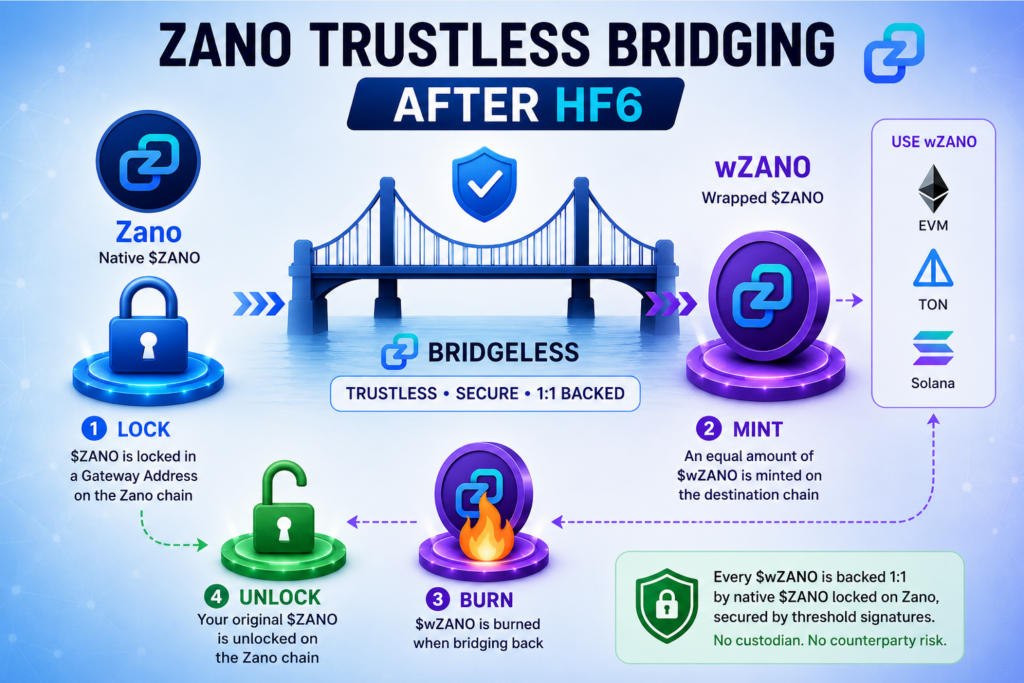
1. Lock $ZANO

Your native $ZANO is locked in a Gateway Address on the Zano blockchain. The funds are held by the protocol rather than by a company or individual.

2. Mint $wZANO

An equivalent amount of $wZANO, a wrapped version of Zano, is minted on the destination blockchain. This can be an EVM network (blockchains that support Ethereum-compatible apps), TON (The Open Network) or Solana, three different blockchain networks where $wZANO can be used.

3. Use $wZANO

You can then use $wZANO within the supported ecosystem, including applications and DeFi platforms.

4. Bridge Back

When you want to return to Zano, your $wZANO is burned. The corresponding native $ZANO is then unlocked from the Gateway Address.

The important part is that $wZANO is backed 1:1 by native $ZANO locked on the Zano side. Threshold signatures are used so that no single party holds the complete private key.

4. Why Is This Important?

Previously, Zanoโ€™s privacy-focused design could make integration more complicated for exchanges and other services.

HF6โ€™s Gateway Addresses provide infrastructure specifically designed for services such as bridges, exchanges and DEXs. This could make it easier for more platforms to support Zano.

For users, this could eventually mean:

  • More ways to use $ZANO
  • Greater access to DeFi
  • More liquidity across different networks
  • Easier integration with wallets and exchanges

5. What Happens to Privacy?

Zanoโ€™s standard privacy remains intact on the Zano network.

However, there is an important point to understand: when $ZANO is bridged to a transparent blockchain, activity on that destination network can be publicly visible. Users return to Zanoโ€™s privacy-focused environment when they bridge their funds back.

In simple terms, HF6 creates a way for native $ZANO to move between ecosystems without requiring a traditional centralized custodian to sit in the middle.

This could make Zano more accessible to the wider crypto ecosystem while keeping privacy at the center of the Zano network.

Source

Disclaimer: ZanoNews.com is an independent news and information website. This article is for informational purposes only and should not be considered financial, investment, or legal advice.

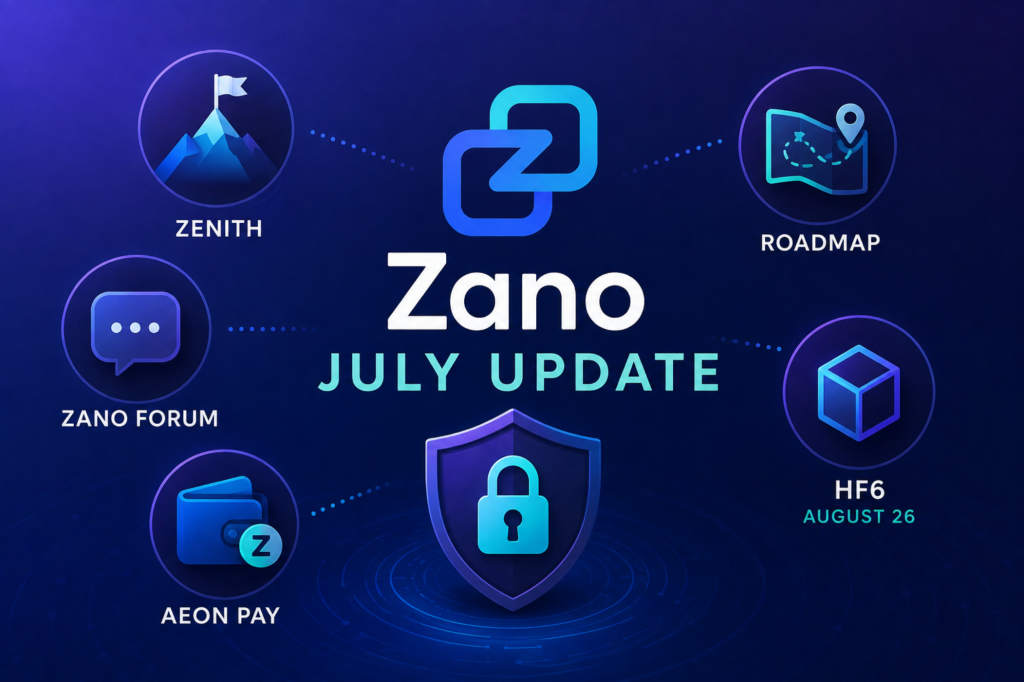
Zano July Project Update: Zenith, HF6, Forum and More ๐Ÿ”’

Zano has released its July Monthly Project Update, highlighting several important developments across the network, roadmap and community.

From the future move to pure Proof of Stake to the upcoming HF6 upgrade, July brought several updates worth knowing about.

Table of Contents

  1. Zenith Moves Toward Pure Proof of Stake
  2. Zano Execution Layer Added to the Roadmap
  3. Zano Forum Is Open
  4. HF6 Remains on Track
  5. AEON Pay Cashback Campaign
  6. What July Means for Zano
  7. Sources

1. Zenith Moves Toward Pure Proof of Stake

One of the biggest updates is the publication of the Zenith design, which outlines Zanoโ€™s planned move toward a pure Proof of Stake (PoS) system.

In simple terms, Proof of Stake allows users to help secure a blockchain by staking their coins instead of relying on mining.

Zenith represents a major part of Zanoโ€™s longer-term development and is designed to move the network away from its current hybrid approach.

2. Zano Execution Layer Added to the Roadmap

Zano has also updated its roadmap, with the Zano Execution Layer becoming a key addition.

The Execution Layer is part of Zanoโ€™s plans to expand what can be built and executed on the network.

This could become an important piece of Zanoโ€™s future as the ecosystem continues to develop beyond private transactions and assets.

3. Zano Forum Is Open

The Zano Forum is available at forum.zano.org, where users can sign in with their Zano alias.

Users can sign in using their Zano alias, connecting the forum experience with Zanoโ€™s on-chain identity system.

The new forum gives the community a dedicated place to discuss Zano, ask questions, share ideas and follow project developments.

4. HF6 Remains on Track

Hard Fork 6 (HF6) is also progressing as planned.

According to the July update, HF6 is scheduled to activate at block 3,833,000, with activation expected around August 26, 2026.

HF6 is an important network upgrade that introduces changes designed to improve Zanoโ€™s connectivity with the wider crypto ecosystem.

5. AEON Pay Cashback Campaign

The Zano and AEON Pay cashback campaign is also live.

The campaign gives Zano users another opportunity to use their cryptocurrency for payments through AEON Pay while participating in a cashback promotion.

This adds another practical use case to the growing Zano payment ecosystem.

6. What July Means for Zano

July’s update shows that Zano is working on several areas at the same time.

The project is looking ahead with Zenith and the Zano Execution Layer, improving community infrastructure with the new forum, preparing for HF6, and continuing to explore real-world payment use cases through AEON Pay.

Taken together, these updates show that Zano’s development is moving across multiple areas โ€” from blockchain infrastructure and consensus to community and everyday crypto payments.

7. Sources

Disclaimer: ZanoNews.com is an independent news and information website. This article is for informational purposes only and should not be considered financial, investment, or legal advice.

Zano HF6 Could Open More Doors to Exchanges and THORChain

Zano has spent years building privacy directly into its blockchain. Now, Hard Fork 6 is also addressing another important challenge: making ZANO easier to access through exchanges and other parts of the cryptocurrency market.

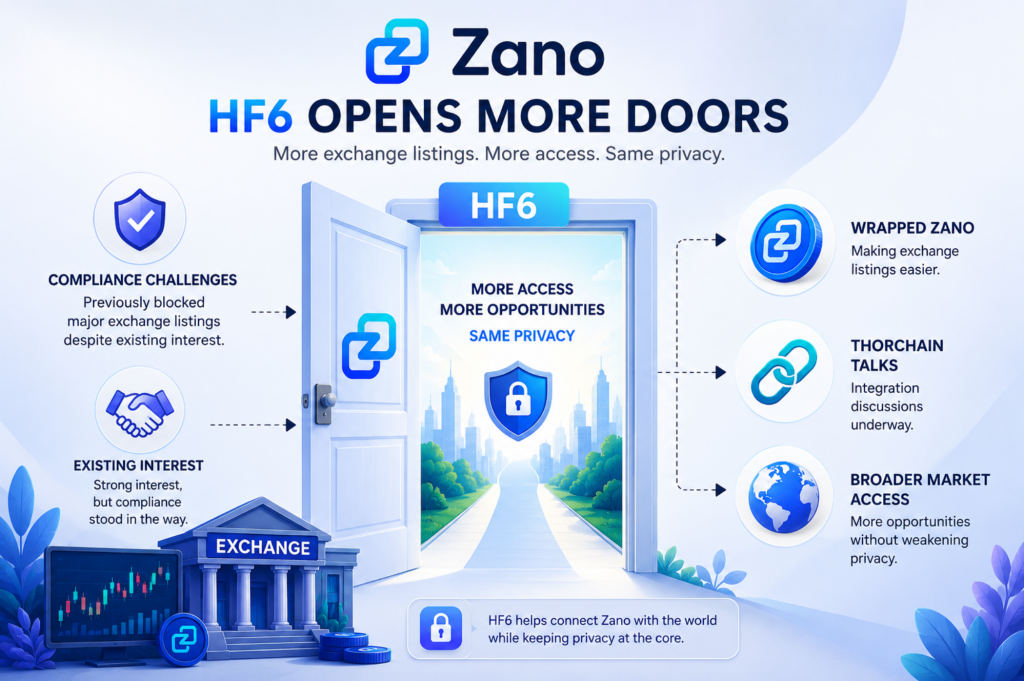
A recent post from House of Chimera highlighted how compliance requirements have created challenges for Zano when it comes to major exchange listings, despite existing interest.

Table of Contents

  1. Why Exchange Access Matters
  2. The Compliance Challenge
  3. What HF6 Could Change
  4. Wrapped ZANO
  5. THORChain Discussions
  6. Keeping Privacy at the Centre
  7. What It Could Mean for Zano
  8. Sources

1. Why Exchange Access Matters

Exchange availability can make a big difference to how easily people can buy, sell and access a cryptocurrency.

For Zano, this has been an important challenge because its privacy-focused design can create additional considerations for exchanges and other platforms.

The latest HF6 developments could help address some of these barriers and make ZANO more accessible to the wider crypto market.

2. The Compliance Challenge

According to House of Chimera, compliance has previously prevented some major exchange listings for Zano, even where there was interest in supporting the project.

For exchanges, listing an asset involves more than simply adding deposits and withdrawals. Platforms also need to consider their compliance requirements and how an asset fits within their existing systems.

This has made wider exchange access an important area for Zano to address.

3. What HF6 Could Change

HF6 is designed to make Zano easier to connect with exchanges, bridges and decentralized platforms.

Rather than changing Zano’s privacy-focused foundation, the upgrade aims to make the network more accessible to services that want to support it.

This could give Zano more opportunities to connect with the wider cryptocurrency ecosystem.

4. Wrapped ZANO

One of the developments highlighted in the recent discussion is Wrapped ZANO.

Wrapped ZANO is a version of ZANO that can be used on other blockchain networks, making it easier for exchanges and other platforms to support and trade ZANO.

This could be particularly useful when it comes to exchange listings and broader market access.

The idea is simple: provide additional ways to access ZANO while keeping native ZANO on its privacy-focused network.

5. THORChain Discussions

House of Chimera also highlighted that THORChain integration discussions are underway.

THORChain provides infrastructure for cross-chain cryptocurrency activity, so a potential connection could give ZANO another route into the wider crypto ecosystem.

At this stage, however, these are discussions rather than a confirmed integration.

6. Keeping Privacy at the Centre

The key point is that greater market access does not necessarily mean giving up Zano’s privacy principles.

The project is looking for ways to make ZANO easier for exchanges and other platforms to support while maintaining the privacy-focused nature of its native network.

This creates a simple goal:

More access without weakening privacy.

7. What It Could Mean for Zano

If these developments move forward, they could give ZANO more opportunities to reach users through exchanges and other crypto infrastructure.

Wrapped ZANO could provide additional market access, while potential cross-chain integrations could create more ways for users to interact with the asset.

For Zano, HF6 could therefore represent more than a technical upgrade. It could also help connect the privacy-focused project with a broader cryptocurrency market.

8. Sources

Disclaimer:ย ZanoNews.comย is an independent news and information website. This article is for informational purposes only and should not be considered financial, investment, or legal advice.

Zano Development Update: 20 Commits and 880 Lines of Code Added ๐Ÿ”ฅ

Development on Zano continued during the third week of August, with the project team reporting another week of activity across its codebase.

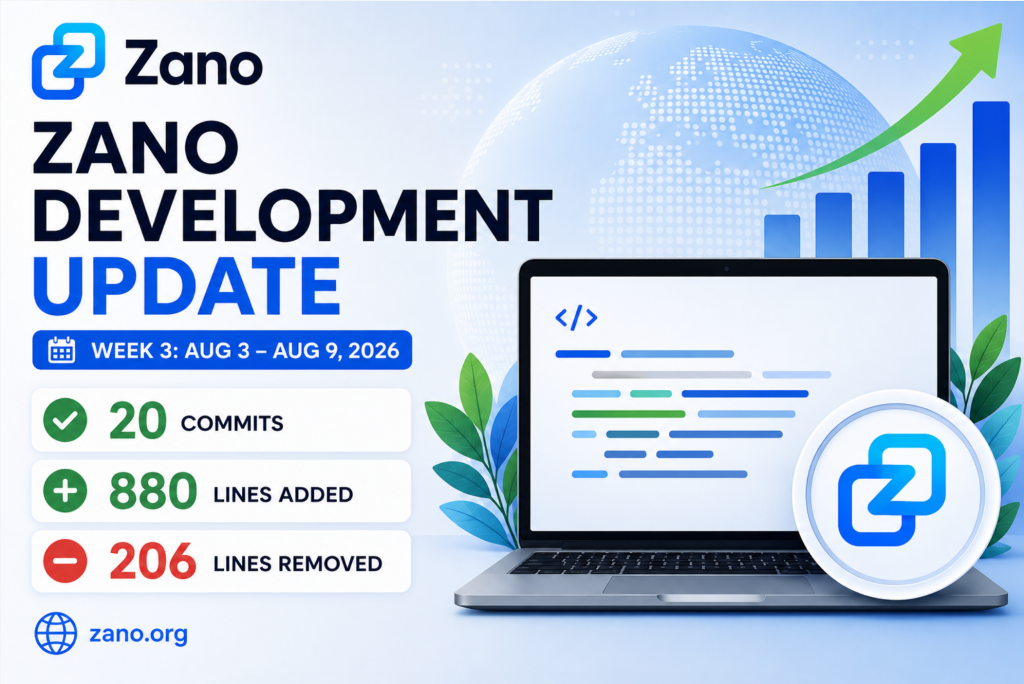
From August 3 to August 9, 2026, the Zano team recorded:

  • โœ… 20 commits
  • โž• 880 lines of code added
  • โž– 206 lines of code removed

But what do these numbers actually mean? Let’s break them down in simple terms.

Table of Contents

  1. What Happened During Week 3?
  2. What Is a Commit?
  3. What Do 880 Lines Added Mean?
  4. Why Were 206 Lines Removed?
  5. What Do These Numbers Tell Us?
  6. Why Development Activity Matters for Zano
  7. The Bigger Picture
  8. The Road Ahead
  9. Sources

1. What Happened During Week 3?

According to the latest development update shared by We Are Zano, the team recorded 20 commits between August 3 and August 9, 2026.

During the same period, developers:

Added: 880 lines of code
Removed: 206 lines of code

That gives a simple picture of continued development work happening behind the scenes.

Zano is a privacy-focused blockchain where privacy is built into the protocol by default. Its ecosystem includes private transactions, Confidential Assets, staking, trading and other applications.

2. What Is a Commit?

A commit is simply a recorded set of changes made to a software project.

Think of it like editing a document. You make several changes, save those changes as a group, and record what was changed. That recorded update is a commit.

So when Zano reports 20 commits, it means developers recorded 20 separate sets of changes to the project’s code during that week.

It doesn’t mean there were only 20 individual changes. A single commit can contain many different changes.

3. What Do 880 Lines Added Mean?

The team reported 880 lines added.

This means developers added 880 lines of code to the relevant project repositories during the week.

It’s important to remember that:

More lines of code don’t necessarily mean better software.

One line of code can be extremely important, while hundreds of lines can sometimes be removed or replaced with a more efficient solution.

The number is better understood as a measure of development activity, rather than a direct measurement of progress or software quality.

4. Why Were 206 Lines Removed?

The update also shows that developers removed 206 lines of code.

Removing code is completely normal in software development.

Developers may remove code when they:

  • Replace an older solution
  • Fix bugs
  • Simplify the software
  • Improve efficiency
  • Remove code that is no longer needed
  • Refactor existing components

In other words, removing code isn’t necessarily a bad thing.

Sometimes, taking code away can make software cleaner, easier to maintain and more efficient.

5. What Do These Numbers Tell Us?

The simplest takeaway is that Zano development remains active.

During one week, developers recorded 20 commits while making both additions and removals to the codebase.

The numbers don’t tell us exactly what every commit accomplished, however.

For that reason, it would be misleading to say that 880 lines added automatically means Zano became 880 lines “better.”

Instead, these figures give the community a quick snapshot of developer activity.

The individual code changes provide more detail, but the overall message is simple:

The project continues to be actively developed.

6. Why Development Activity Matters for Zano

Software projects need continuous development to remain useful, secure and adaptable.

This is especially important for a blockchain because the technology has to support several areas at the same time, including:

  • Network security
  • Privacy
  • Wallet functionality
  • Developer tools
  • Confidential Assets
  • Trading
  • Ecosystem applications

Zano’s developer resources include APIs, blockchain data tools, Confidential Asset tools and resources for developers building applications on the network.

Zano also continues to work on major network improvements. For example, Hard Fork 6 is scheduled to activate at block 3,833,000, expected between August 25 and August 27, 2026, according to Zano’s official announcement.

This puts weekly development activity into a bigger context: blockchain development is an ongoing process rather than something that happens only when a major update is released.

7. The Bigger Picture

It is easy to focus on major announcements in crypto:

New partnerships.
New listings.
New products.
Major upgrades.

But much of the work required to make those developments possible happens quietly in the codebase.

Weekly development statistics provide a small window into that work.

For Zano, this includes maintaining and improving a privacy-focused blockchain that supports not only $ZANO but also Confidential Assets and applications built around the network.

So while 20 commits, 880 lines added and 206 lines removed may not sound exciting to everyone, they represent another week of work behind the scenes.

8. The Road Ahead

The latest numbers provide a simple snapshot of where development activity stood during August 3โ€“9, 2026.

The more important question is what these ongoing development efforts contribute to over time.

For developers, the individual code changes matter.

For crypto users, what ultimately matters is what those changes deliver:

A more capable network, better tools, stronger privacy and a growing ecosystem.

As Zano continues developing its technology and preparing for major network changes such as Hard Fork 6, weekly development activity will remain one of the quieter but important parts of the project’s progress.

9. Sources

Disclaimer:ย ZanoNews.comย is an independent news and information website. This article is for informational purposes only and should not be considered financial, investment, or legal advice.

Zano Highlights How Gateway Addresses Make Services Simpler After Hard Fork 6

As Hard Fork 6 approaches, the Zano team continues to showcase how its new Gateway Addresses feature will improve the experience for exchanges, bridges, and decentralized exchanges (DEXs).

In a recent X post, Zano summarized the benefits in a simple message:

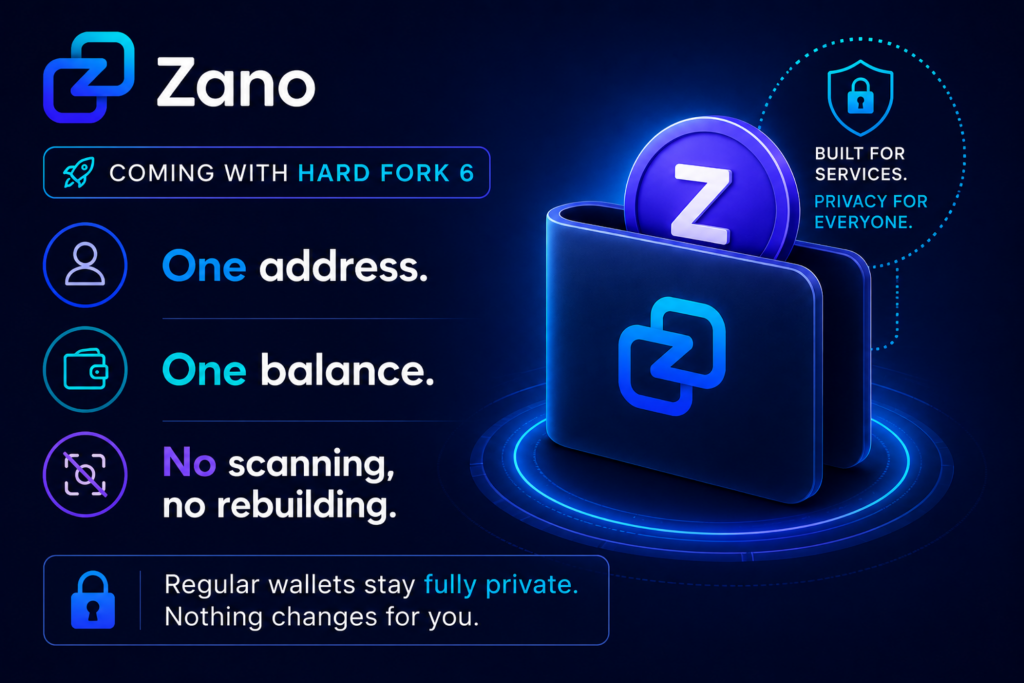
“One address. One balance. No scanning, no rebuilding.”

The announcement focuses on one of the biggest advantages of Gateway Addresses: making it much easier for services to integrate with Zano while keeping everyday users’ privacy exactly the same.

Table of Contents

1. One Address, One Balance
2. Learn About Gateway Addresses
3. Why This Matters for Services
4. Nothing Changes for Everyday Users
5. Looking Ahead

1. One Address, One Balance

Before Gateway Addresses, services built on Zano often had to scan the blockchain, rebuild wallet data, and manage complex infrastructure to keep balances up to date.

With Hard Fork 6, that process becomes much simpler.

Instead of constantly scanning the blockchain or rebuilding wallet information after downtime, services can work with a single address and a directly tracked balance. This reduces operational complexity and allows exchanges, bridges, and DEXs to get back online much faster after interruptions.

2. Learn About Gateway Addresses

๐Ÿ‘‰ What Are Gateway Addresses?

We’ve already covered Gateway Addresses in detail as part of our Hard Fork 6 guide. If you’re new to the feature, check out that article to learn how Gateway Addresses work and why they’re considered one of the most important upgrades coming to the Zano ecosystem.

3. Why This Matters for Services

For exchanges and other infrastructure providers, reliability is essential.

If a service goes offline, lengthy rescans and rebuilding wallet data can delay getting back online. Gateway Addresses remove much of that complexity by allowing services to access a single balance without performing the same time-consuming processes as before.

For businesses looking to integrate Zano, this means a simpler setup, easier maintenance, and a smoother experience for both operators and users.

4. Nothing Changes for Everyday Users

While Gateway Addresses introduce significant improvements for infrastructure providers, regular Zano users don’t need to change how they use their wallets.

Standard wallets continue to provide the same privacy protections that Zano is known for.

As the Zano team emphasized in its announcement:

“Regular wallets stay fully private. Nothing changes for you.”

5. Looking Ahead

Gateway Addresses are one of the headline features of Hard Fork 6, helping remove technical barriers for exchanges, bridges, and decentralized applications without compromising user privacy.

By making integrations easier while preserving Zano’s privacy-first design, Hard Fork 6 continues to move the ecosystem toward broader adoption and improved accessibility.

Sources

Disclaimer:ย ZanoNews.comย is an independent news and information website. This article is for informational purposes only and should not be considered financial, investment, or legal advice.

Zano Hard Fork 6: A New Era for Wallets & Exchanges ๐ŸŒ

The Zano team has announced another exciting update about its upcoming Hard Fork 6 (HF6), and it could become one of the project’s most important upgrades yet.

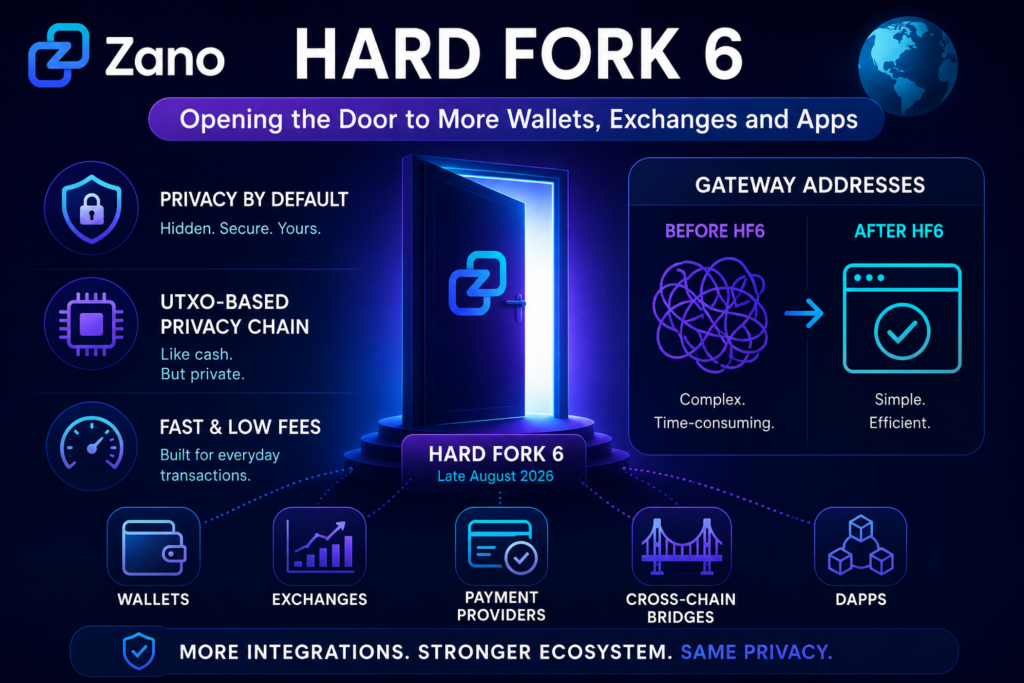
Instead of only improving performance, Hard Fork 6 aims to make Zano much easier for wallets, exchanges, payment providers, and decentralized applications (dApps) to integrate.

A new feature called Gateway Addresses is designed to simplify the process by removing one of the biggest technical barriers developers have faced when integrating Zano. This could help bring Zano to more wallets, exchanges, payment providers, and blockchain applications while preserving the privacy that makes the network unique.

In this article, we’ll explain in simple terms what Hard Fork 6, Gateway Addresses, and a UTXO-based privacy chain areโ€”and why this upgrade matters.

Table of Contents

  1. What Is Zano?
  2. What Is a UTXO-Based Privacy Chain?
  3. Why Has Integrating Zano Been Difficult?
  4. What Is Hard Fork 6?
  5. What Is a Gateway Address?
  6. Why This Upgrade Matters
  7. What It Means for Zano Users
  8. What This Upgrade Could Mean

1. What Is Zano?

Zano is a privacy-focused Layer 1 blockchain built for secure and confidential digital transactions.

Unlike many public blockchains where anyone can see wallet balances and transaction history, Zano keeps your financial activity private.

Some of its main features include:

  • Private transactions by default.
  • Hidden wallet balances.
  • Confidential Assets (privacy-preserving tokens built on Zano).
  • Low transaction fees.
  • Fast transaction processing.
  • A hybrid Proof-of-Work (PoW) and Proof-of-Stake (PoS) consensus model.

Its mission is simple: give users complete financial privacy while remaining secure and decentralized.

2. What Is a UTXO-Based Privacy Chain?

Zano uses a UTXO (Unspent Transaction Output) model, just like Bitcoin.

Think of it like paying with cash.

If you buy something costing โ‚ฌ20 using a โ‚ฌ50 note, you receive โ‚ฌ30 in change.

Your wallet works in a similar way by using small pieces of cryptocurrency called UTXOs instead of one visible account balance.

What makes Zano different is that it also hides:

  • The sender.
  • The receiver.
  • The transaction amount.
  • Wallet balances.

This gives users much stronger financial privacy than most public blockchains.

3. Why Has Integrating Zano Been Difficult?

Because Zano protects user privacy, it has traditionally been harder for developers to integrate.

Instead of simply reading one wallet balance, developers often had to:

  • Scan the blockchain.
  • Track private transaction outputs.
  • Recalculate balances.
  • Keep wallets synchronized.

This extra work could take weeks, making Zano more difficult to integrate than many other cryptocurrencies.

4. What Is Hard Fork 6?

A hard fork is a major blockchain upgrade that introduces new features and rules.

Hard Fork 6 is expected to activate in late August 2026.

Its goal isn’t to reduce privacyโ€”it is to make building on Zano much easier while keeping the same privacy protections users already enjoy.

5. What Is a Gateway Address?

The biggest feature in Hard Fork 6 is Gateway Addresses.

These are special addresses created for:

  • Cryptocurrency exchanges.
  • Wallet providers.
  • Payment services.
  • Cross-chain bridges.
  • Decentralized applications.

Before Hard Fork 6

Developers had to:

  • Scan the blockchain.
  • Track thousands of private outputs.
  • Continuously rebuild balances.

After Hard Fork 6

Developers simply:

  1. Register a Gateway Address.
  2. Read one account balance.
  3. Process deposits and withdrawals much more efficiently.

This could reduce integration time from weeks to a much simpler process.

Regular Zano users won’t notice any difference in how they use their wallets, and their privacy remains protected.

6. Why This Upgrade Matters

Making Zano easier to integrate could encourage more companies to support it.

Potential benefits include:

  • More exchange listings.
  • More wallet support.
  • Lower development costs.
  • Easier maintenance.
  • More blockchain applications built on Zano.

The easier a blockchain is to integrate, the more likely businesses are to adopt it.

7. What It Means for Zano Users

Although this upgrade mainly targets developers, everyday users could also benefit.

As integration becomes easier, Zano could see:

  • More wallets supporting ZANO.
  • More exchanges listing the coin.
  • Better payment options.
  • Increased liquidity.
  • More developers building useful applications.

Ultimately, a stronger ecosystem benefits everyone.

8. What This Upgrade Could Mean

Hard Fork 6 is more than just another software upgrade.

By introducing Gateway Addresses, Zano is making it easier for businesses and developers to support one of the crypto industry’s most privacy-focused blockchains while preserving the privacy that makes the network unique.

If more wallets, exchanges, and applications adopt Zano after Hard Fork 6, it could become one of the most important milestones in the project’s growth.

For the Zano community, it’s another step toward making privacy-focused cryptocurrency more accessible while staying true to the principles that have always set Zano apart.

Why these changes?

“one of the most important milestones” is a little stronger and flows better than “a major milestone”, while still being careful not to overstate the outcome.

“while preserving the privacy that makes the network unique” reads more naturally than “without compromising on privacy” and emphasizes Zano’s key strength.

Learn More:

Disclaimer: ZanoNews.com is an independent news and information website. This article is for informational purposes only and should not be considered financial, investment, or legal advice.

The Biggest Change in Zano’s History Is Coming ๐Ÿงญ

If you’ve been following Zano for a while, you probably know the project has never been afraid to do things differently.

From private transactions and Confidential Assets to Confidential Smart Contracts, the team has focused on building technology that puts privacy first.

Now, they’re working on what could become the biggest change the network has ever seen.

It’s called Zenith.

Instead of making small improvements to the existing network, Zenith is designed to completely change how Zano secures its blockchain. If everything goes as planned, Zano will move from its current hybrid Proof of Work (PoW) and Proof of Stake (PoS) system to a fully private Proof-of-Stake network.

Before we go any further, there’s one important thing to know:

Nothing is changing today.

Mining continues as normal, staking continues as normal, and the current Zano network isn’t going anywhere yet. Zenith is still being developed and is currently planned for 2027, following testing, security reviews, and community approval.

So, what is Zenith, and why is everyone talking about it?

Table of Contents

1. What Is Zenith?
2. Why Is Zano Changing?
3. Will the Network Be Faster?
4. What About Privacy?
5. What Are Ephemeral Blocks?
6. What Happens to Mining?
7. When Will Zenith Launch?
8. Why This Matters

1. What Is Zenith?

Every blockchain needs a way to decide who creates the next block and confirms transactions.

That’s called consensus.

Right now, Zano uses two different systems at the same time.

The first is Proof of Work, where miners use computing power to help secure the network.

The second is Proof of Stake, where people lock up (or “stake”) their ZANO to help secure the blockchain.

This hybrid approach has worked well for years.

But according to the Zano team, running two different systems together also makes the network more complicated to improve over time.

That’s where Zenith comes in.

Instead of continuing to build on the existing design, the developers created a completely new consensus system that’s simpler while still keeping privacy at the heart of the network.

According to the project, Zenith is the result of more than 12 years of blockchain research, including work with blockchain security researchers at Common Prefix.

2. Why Is Zano Changing?

This is probably the biggest question people have.

If the current network works, why change it?

Interestingly, the developers say they didn’t originally plan to remove mining.

Their first idea was simply to improve the current hybrid system.

But after years of research, they realised that supporting both mining and staking together made the network harder to develop.

Instead of making the existing system even more complicated, they decided to build something simpler.

According to the team, Zenith should make the network:

  • Easier to improve.
  • Easier to maintain.
  • More efficient.
  • Better prepared for future upgrades.

Most importantly, they believe they can do all of this without giving up the privacy that makes Zano different.

3. Will the Network Be Faster?

Yesโ€”that’s one of the biggest goals.

Today, Zano creates a new block about every 60 seconds.

With Zenith, the target is around 15 seconds.

That doesn’t necessarily mean your transaction will be confirmed in 15 seconds, but it should reduce waiting times considerably.

The team also plans to reduce the recommended number of confirmations from 10 blocks to around 4 to 6 blocks.

For everyday users, that simply means sending ZANO could feel much quicker than it does today.

4. What About Privacy?

Privacy isn’t going away.

In fact, it’s still one of the main goals behind Zenith.

On many Proof-of-Stake blockchains, it’s possible to see how much someone has staked or identify the wallets producing blocks.

Zenith is designed differently.

Using Zano’s Zarcanum privacy technology, the network aims to keep staking activity private by hiding stake amounts and making it much harder to link block production to individual users.

In other words, the team wants to improve the technology without sacrificing privacy.

5. What Are Ephemeral Blocks?

This is probably the most technical part of Zenith, but the idea is actually quite simple.

If the blockchain creates blocks four times faster, it also creates much more data.

Over time, that could make the blockchain much larger.

To help solve this, Zenith introduces something called ephemeral blocks.

Think of them as a smarter way of storing older blockchain data.

Instead of keeping every old block forever in exactly the same form, the network can safely reduce how much information needs to be stored while still keeping everything secure and verifiable.

The goal is to keep the blockchain growing more efficiently as the network becomes faster.

6. What Happens to Mining?

Nothing changes right now.

Miners continue securing the network exactly as they do today.

However, if Zenith is activated in the future, Proof-of-Work mining will come to an end, and Zano will become a fully Proof-of-Stake blockchain.

Today, miners receive approximately:

  • 720 ZANO every day
  • 21,600 ZANO every month
  • 262,800 ZANO every year

Under Zenith, those mining rewards would no longer exist in their current form.

The proposal also includes two other changes:

  • Fewer new ZANO entering circulation over time.
  • Transaction fees being burned instead of redistributed.

According to the Zano team, these changes are designed to create a more sustainable long-term economic model for the network.

7. When Will Zenith Launch?

Zenith is still under development.

The team is currently targeting 2027, but no official launch date has been announced.

Before the upgrade can happen, Zenith will go through more development, testing, security reviews, and community evaluation.

Until then, Zano continues operating exactly as it does today.

8. Why This Matters

Every blockchain releases upgrades from time to time.

Zenith is different.

Instead of adding another feature, it’s changing the way the entire network works.

If everything goes according to plan, Zano will move to a simpler, fully private Proof-of-Stake network that’s designed to be faster, easier to improve, and better prepared for the future.

For current users, nothing changes today.

But if Zenith is successfully delivered, it could mark the beginning of the next chapter in Zano’s history.

To learn more, visit:

Disclaimer: ZanoNews.com is an independent news and information website. This article is for informational purposes only and should not be considered financial, investment, or legal advice.

New Zano Whitepaper Coming Soon ๐Ÿ“„

Zano has announced that a new whitepaper is on the way, covering the pure Proof-of-Stake (PoS) protocol that will be introduced with Hardfork 7.

A whitepaper is a technical document that explains how a blockchain or technology works, including its design, security, and underlying architecture. It serves as a key reference for developers, researchers, and community members who want a deeper understanding of the project.

While the new whitepaper has not yet been released, it is expected to provide more details about Zano’s transition to a pure Proof-of-Stake consensus model and what it means for the network.

The Zano team announced:

“New whitepaper incoming! It covers the pure Proof-of-Stake protocol shipping with Hardfork 7. Releasing soon. ๐Ÿ”’”

Once the whitepaper is published, we’ll provide a simple breakdown of the key changes and what they mean for the Zano ecosystem.

To learn more, visit:

Disclaimer: ZanoNews.com is an independent news and information website. This article is for informational purposes only and should not be considered financial, investment, or legal advice.

Zano Weekly Development Update ๐Ÿ’ป

The latest weekly development update from the We Are Zano community shows that work on the Zano ecosystem is continuing steadily. During the week of July 6โ€“12, 2026, developers made several improvements to the codebase, highlighting the team’s ongoing commitment to building and maintaining the network.

Table of Contents

  1. Weekly Development Highlights
  2. What Is a Commit?
  3. Why Regular Development Matters
  4. Why It Matters

1. Weekly Development Highlights

According to the latest update, Zano developers completed:

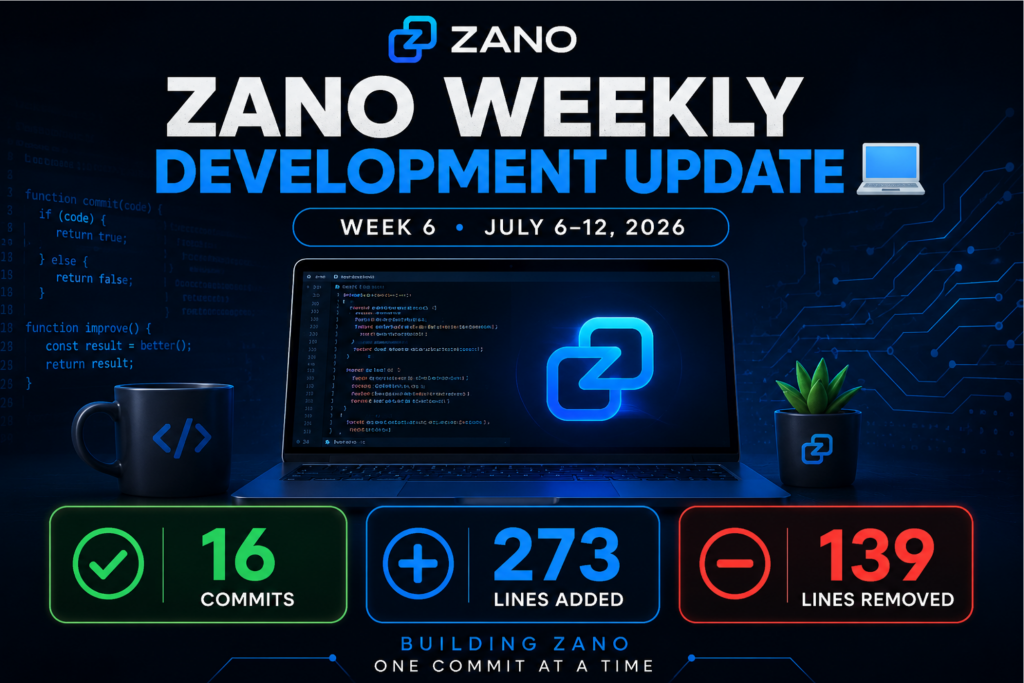
  • โœ… 16 commits
  • โž• 273 lines of code added
  • โž– 139 lines of code removed

These updates reflect continuous work to improve and maintain the Zano blockchain.

2. What Is a Commit?

A commit is a saved change to a project’s source code. Developers make commits when they fix bugs, improve performance, add new features, or clean up existing code.

Adding and removing code is a normal part of software development. In many cases, removing code means replacing older code with a cleaner or more efficient version.

3. Why Regular Development Matters

Consistent development is a positive sign for any blockchain project. It shows that the team is actively maintaining the network, improving performance, and preparing for future updates.

Regular progress also gives the community confidence that the project continues to move forward.

4. Why It Matters

Development happens behind the scenes, but it plays a major role in the long-term success of any cryptocurrency project. Weekly updates like these provide a simple way for the community to track Zano’s ongoing progress and see that development remains active.

To learn more, visit:

Disclaimer: ZanoNews.com is an independent news and information website. This article is for informational purposes only and should not be considered financial, investment, or legal advice.

Zano June Update: HF6 Confirmed ๐Ÿ“ข

The Zano team has released its June Monthly Project Update, highlighting progress across network development, ecosystem expansion, and community growth. Here’s a quick look at the biggest announcements.

Table of Contents

  1. HF6 Activation Confirmed
  2. Gateway Addresses Lead the Upgrade
  3. PrivacyGateway Card Adds ZANO Top-Ups
  4. New ZANO Integrations
  5. Community Platform Changes
  6. Growing Global Community
  7. June at a Glance

1. HF6 Activation Confirmed

Hard Fork 6 (HF6) has officially been finalized and is scheduled to activate at block 3,833,000, expected between August 25โ€“27.

This gives node operators and community members time to prepare for the upcoming network upgrade.

2. Gateway Addresses Lead the Upgrade

The headline feature of HF6 will be Gateway Addresses, while privacy remains enabled by default, staying true to Zano’s privacy-first approach.

3. PrivacyGateway Card Adds ZANO Top-Ups

The PrivacyGateway Card now supports direct ZANO top-ups, making it even easier for users to fund their cards using the native cryptocurrency.

4. New ZANO Integrations

Zano continues expanding its ecosystem with new integrations, including:

  • CardsRelay
  • sshwap
  • fswap

These additions provide users with more ways to use and access ZANO.

5. Community Platform Changes

The Zano team also announced that Discord will be retired in favor of a new alias-authenticated Zano Forum, providing a more secure and integrated community experience.

6. Growing Global Community

Community adoption continues to grow, with the Zano Private Economy Conference in Nigeria attracting more than 700 attendees, demonstrating increasing interest in privacy-focused blockchain technology.

7. June at a Glance

June was another strong month for Zano. With HF6 locked in, new integrations, improved payment features, and a growing global community, the project continues building momentum ahead of its next major network upgrade.

To learn more, visit:

Disclaimer: ZanoNews.com is an independent news and information website. This article is for informational purp

Zano Hard Fork 6 Gets a Date as Privacy Chain Opens to DeFi

Zano’s upcoming Hard Fork 6 (HF6) is gaining wider attention after TheStreet reported on the major network upgrade.

HF6 aims to help Zano connect with DeFi and wider crypto liquidity while keeping privacy at the heart of the network.

Table of Contents

  1. What Is Zano Hard Fork 6?
  2. Why Gateway Addresses Matter
  3. Zano Opens the Door to DeFi
  4. What Happens Next?
  5. Sources

1. What Is Zano Hard Fork 6?

Hard Fork 6 will activate at block 3,833,000, expected between August 25 and 27, 2026.

Users running Zano full-node desktop wallets should update before the fork.

2. Why Gateway Addresses Matter

One of the biggest HF6 changes is Gateway Addresses.

They are designed to make it easier for exchanges, bridges and DeFi platforms to connect with Zano, while regular users can continue using Zano’s private addresses.

Simply put: easier integrations without changing Zano’s privacy-first experience.

3. Zano Opens the Door to DeFi

HF6 also prepares native ZANO for cross-chain access through Bridgeless.

This could allow ZANO to connect with public blockchain liquidity and DeFi services, while users can bridge back to the Zano network when native privacy is needed.

Update: Zano’s Hard Fork 6 is also gaining wider crypto media attention, with Bitcoin.com News highlighting the upgrade’s potential to open ZANO to DeFi liquidity and a broader exchange footprint.

4. What Happens Next?

The idea behind HF6 is simple:

Keep Zano private at its core. Make it easier to connect with the wider crypto world.

With the activation block approaching, Hard Fork 6 could be an important step in Zano’s push toward wider utility.

5. Sources

Disclaimer: ZanoNews.com is an independent news and information website. This article is for informational purposes only and does not constitute financial or investment advice.
Zanoโ€™s Bridgeless Update: Privacy on Zano, Liquidity Across Chains

Privacy and liquidity do not always work well together in crypto.

Privacy-focused blockchains can protect users, but limited access to major DeFi platforms, exchanges and public blockchain liquidity can make their assets harder to use.

Zano’s Bridgeless update is designed to tackle this problem with a simple idea:

Keep privacy where it matters. Let liquidity move where it is useful.

A recent post from House of Chimera on X highlighted how native $ZANO
can remain on Zano’s privacy-focused blockchain while wrapped ZANO, or wZANO, moves across supported public networks.

Table of Contents

  1. What Is the Zano Bridgeless Update?
  2. How Does ZANO Move Across Chains?
  3. What Is wZANO?
  4. Why Liquidity Matters for Zano
  5. What Happens to Privacy?
  6. Why This Could Open More Doors for ZANO
  7. Privacy When You Need It. Liquidity When You Want It.
  8. Sources

1. What Is the Zano Bridgeless Update?

Zano is built around financial privacy.

But the wider crypto world runs across many different blockchains and DeFi ecosystems.

The Bridgeless integration aims to connect these two worlds.

Native $ZANO can be locked on the Zano blockchain through Gateway Addresses. An equal amount of wZANO can then be created on supported public networks such as EVM chains, TON and Solana.

The idea is simple:

$ZANO stays native to its privacy network. wZANO travels.

2. How Does ZANO Move Across Chains?

The process works in a few steps.

Native $ZANO is first locked in a Gateway Address on the Zano blockchain.

The protocol then mints the same amount of wZANO on the supported destination chain.

For example, if ZANO is bridged out, the corresponding wZANO is backed 1:1 by native $ZANO.

When a user bridges back, the wZANO is burned and the native $ZANO is unlocked. Zano says the system uses Threshold Signatures so no single validator holds the complete key needed to control a transfer.

3. What Is wZANO?

wZANO is a wrapped version of ZANO designed to work on other blockchains.

Think of it as a version of ZANO that can enter public blockchain ecosystems.

This could allow wZANO to interact with DeFi services, liquidity pools and other blockchain applications that native $ZANO cannot directly access on the Zano network.

The important difference is:

Native $ZANO is private on Zano.

wZANO is visible when used on transparent public blockchains.

4. Why Liquidity Matters for Zano

Liquidity simply means how easily an asset can be bought, sold or traded.

More liquidity can mean easier trading and access to a wider range of crypto services.

By moving wZANO across supported public networks, ZANO could gain access to deeper liquidity and higher trading activity.

The House of Chimera described the result as private settlement on Zano combined with public-chain liquidity and utility elsewhere.

This could help Zano avoid a common problem:

A private blockchain with an asset that is difficult to access or trade.

5. What Happens to Privacy?

This is important to understand.

Zano’s privacy does not automatically move with wZANO to public blockchains.

When wZANO is used on transparent networks such as EVM chains, TON or Solana, balances and transactions can be publicly visible.

If privacy is needed, users can bridge back to native $ZANO, where Zano’s privacy protections apply again.

In simple terms:

Bridge out for liquidity and wider utility.

Bridge back for Zano’s native privacy.

6. Why This Could Open More Doors for ZANO

Zano says the infrastructure could give ZANO new access to DeFi liquidity pools and potentially make the asset easier to integrate with larger exchanges and services.

As a wrapped asset on public chains, wZANO can potentially interact with lending protocols, liquidity pools and other DeFi applications.

This does not guarantee exchange listings or adoption.

But it removes some of the technical barriers that have limited how native privacy assets interact with the wider crypto ecosystem.

7. Privacy When You Need It. Liquidity When You Want It.

The most interesting part of the Bridgeless update may be its simplicity.

Zano does not need to turn its private blockchain into a public one.

Instead, native $ZANO can remain within Zano’s privacy ecosystem while wZANO connects with public blockchain liquidity.

Privacy on Zano.

Liquidity across chains.

Maybe the future of privacy crypto is not choosing one or the other.

Maybe it is giving users the choice.

8. Sources

  1. House of Chimera โ€” Original X Post
  2. Zano Blog โ€” ZANO Goes Cross-Chain: Native Zano Is Coming to Bridgeless
  3. Bridgeless Zano Integration Documentation
  4. Zano Offficial Website

Disclaimer: ZanoNews.com is an independent news and information website. This article is for informational purposes only and does not constitute financial or investment advice.