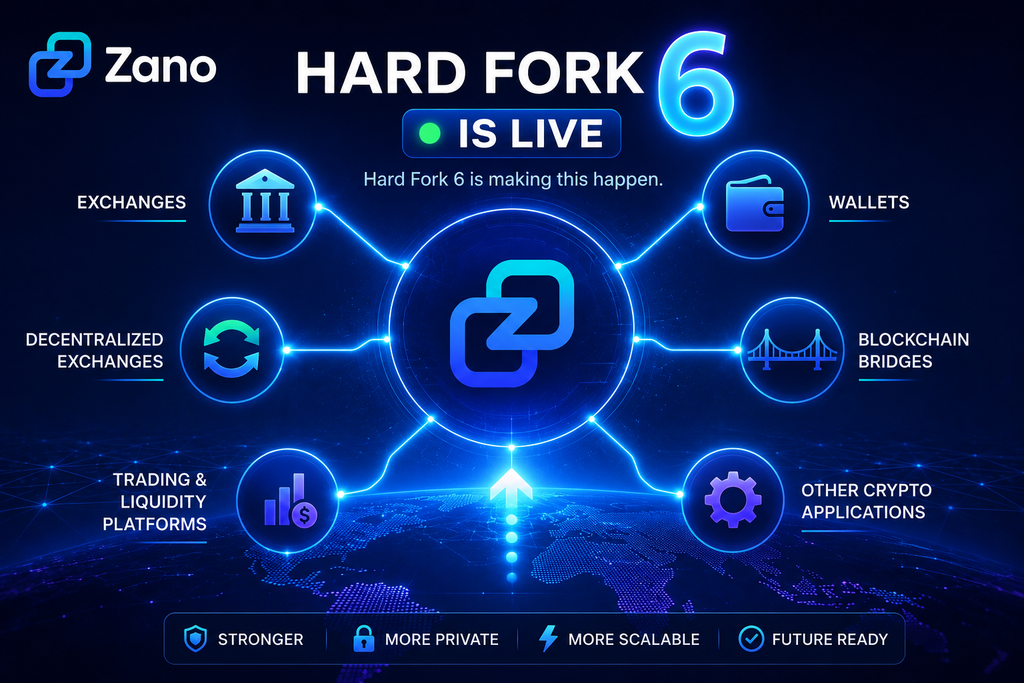
Zano’s Hard Fork 6 (HF6) is now live, activating at block 3,833,000 on August 26, 2026.
The upgrade makes it easier for exchanges, wallets, bridges, DEXs and other crypto services to connect with Zano. For everyday users, this could eventually mean more ways to buy, sell, store and use ZANO, while keeping Zano’s privacy features.
HF6 also supports two-way cross-chain transfers, helping Zano connect with other blockchain networks.
This is where HF6 could become particularly important for everyday users.
If integrating Zano becomes easier, more services may have a simpler path toward supporting it.
That could include:
🏦 Exchanges
👛 Wallets
🔄 Decentralized exchanges
🌉 Blockchain bridges
💱 Trading and liquidity platforms
🛠️ Other crypto applications
The Zano team has previously discussed Gateway Addresses with platforms including THORChain, NEAR Intents and Maya Protocol, with the new infrastructure intended to make integrations easier.
This does not mean every exchange or wallet now supports Zano automatically.
Instead, HF6 removes an important technical barrier and gives these services a simpler way to integrate with the network.
7. Does Hard Fork 6 Change Zano’s Privacy?
No.
Zano’s privacy remains a core part of the network.
HF6 improves how external services can connect with Zano without replacing the privacy features of standard Zano addresses.
In simple terms:
More connectivity + privacy at the core. 🔒
8. What Do Zano Users Need to Know?
For most users, there is no complicated process involved with HF6.
If you use a full-node desktop wallet, make sure you are running the latest version and that it has fully synced with the network.
Disclaimer: ZanoNews.com is an independent news and information website. This article is for informational purposes only and does not constitute financial or investment advice.
Zano’s upcoming Hard Fork 6 (HF6) is designed to make it easier for $ZANO to connect with other blockchains while keeping the network’s core privacy features intact.
One of the most important changes is the ability to bridge native $ZANO to networks such as EVM chains, TON and Solana through Bridgeless.
Hard Fork 6 is a major Zano network upgrade introducing Gateway Addresses, among other improvements. Gateway Addresses are designed to make Zano easier for exchanges, wallets, bridges and other applications to integrate.
HF6 is scheduled to activate at block 3,833,000, expected between August 25 and 27, 2026.
In simple terms, trustless bridging means users do not need to rely on a person or company to hold their funds.
Instead, the process is secured by blockchain infrastructure and cryptographic mechanisms. No single party controls the complete key needed to access the locked funds.
3. How Does Zano Bridging Work?
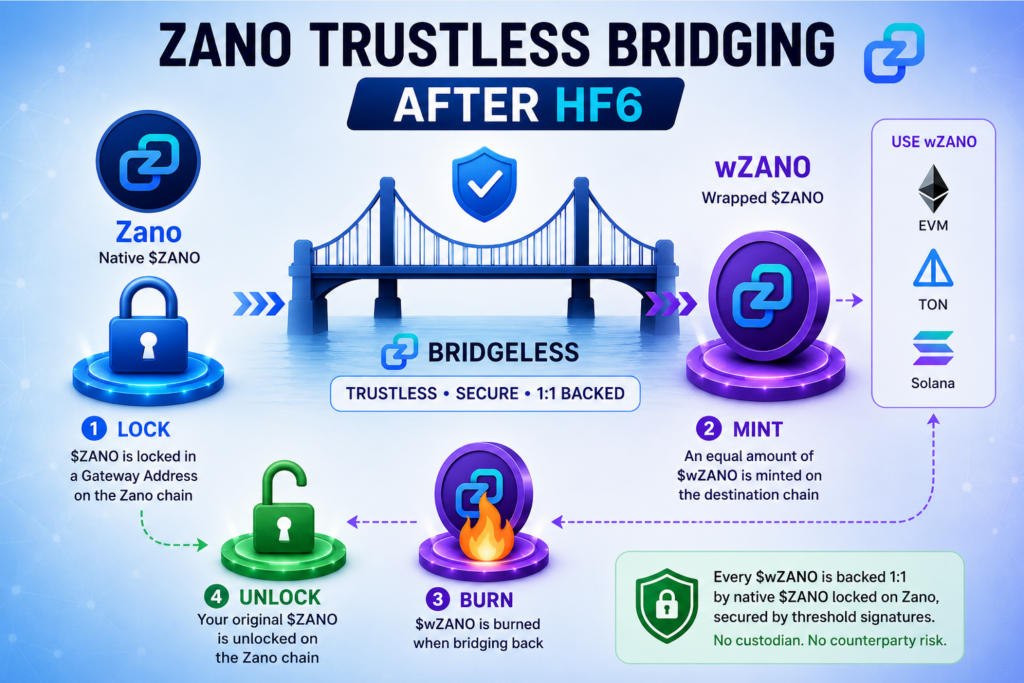
The process is straightforward:
1. Lock $ZANO
Your native $ZANO is locked in a Gateway Address on the Zano blockchain. The funds are held by the protocol rather than by a company or individual.
2. Mint $wZANO
An equivalent amount of $wZANO, a wrapped version of Zano, is minted on the destination blockchain. This can be an EVM network (blockchains that support Ethereum-compatible apps), TON (The Open Network) or Solana, three different blockchain networks where $wZANO can be used.
3. Use $wZANO
You can then use $wZANO within the supported ecosystem, including applications and DeFi platforms.
4. Bridge Back
When you want to return to Zano, your $wZANO is burned. The corresponding native $ZANO is then unlocked from the Gateway Address.
The important part is that $wZANO is backed 1:1 by native $ZANO locked on the Zano side. Threshold signatures are used so that no single party holds the complete private key.
4. Why Is This Important?
Previously, Zano’s privacy-focused design could make integration more complicated for exchanges and other services.
HF6’s Gateway Addresses provide infrastructure specifically designed for services such as bridges, exchanges and DEXs. This could make it easier for more platforms to support Zano.
For users, this could eventually mean:
More ways to use $ZANO
Greater access to DeFi
More liquidity across different networks
Easier integration with wallets and exchanges
5. What Happens to Privacy?
Zano’s standard privacy remains intact on the Zano network.
However, there is an important point to understand: when $ZANO is bridged to a transparent blockchain, activity on that destination network can be publicly visible. Users return to Zano’s privacy-focused environment when they bridge their funds back.
In simple terms, HF6 creates a way for native $ZANO to move between ecosystems without requiring a traditional centralized custodian to sit in the middle.
This could make Zano more accessible to the wider crypto ecosystem while keeping privacy at the center of the Zano network.
Disclaimer:ZanoNews.com is an independent news and information website. This article is for informational purposes only and should not be considered financial, investment, or legal advice.
THORChain is a decentralized cross-chain liquidity protocol. In simple terms, it allows users to swap native cryptocurrencies across different blockchains without relying on a centralized exchange.
3. Why Is a Comeback Being Discussed?
THORChain has been an established name in cross-chain DeFi, but the crypto landscape has changed significantly.
The discussion will look at whether THORChain can attract new users, liquidity and attention while competing with newer projects.
4. Zano’s Role
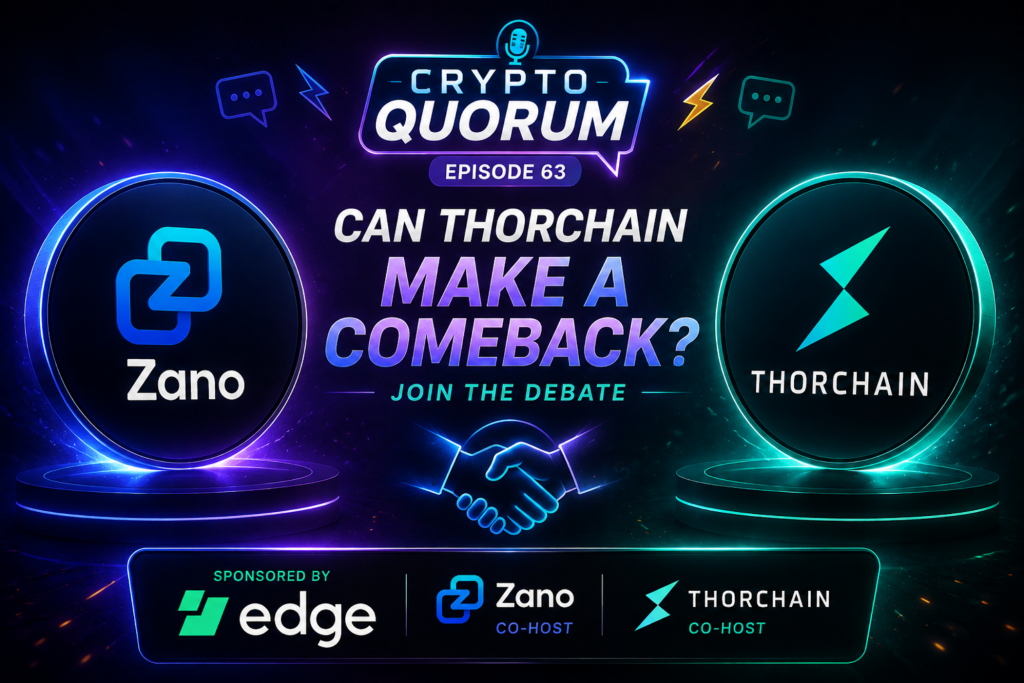
Zano is joining the conversation as a co-host alongside THORChain, bringing another perspective to the discussion.
The episode should be interesting for anyone following privacy, DeFi and cross-chain technology.
5. What to Watch
The key question is simple: Can THORChain make a comeback, or is it too late?
Tune in to Crypto Quorum Episode 63 to hear the debate. ⚡
Disclaimer:ZanoNews.com is an independent news and information website. This article is for informational purposes only and should not be considered financial, investment, or legal advice.
Its main blockchain, or Layer 1, is designed to keep transactions, amounts and other financial information private.
But there is one area where Zano has not traditionally focused: smart contracts.
Smart contracts are programs that run on a blockchain. They power things like decentralized exchanges, lending platforms, token applications and other Web3 services.
So how can Zano add smart contracts without changing the privacy that makes Zano different?
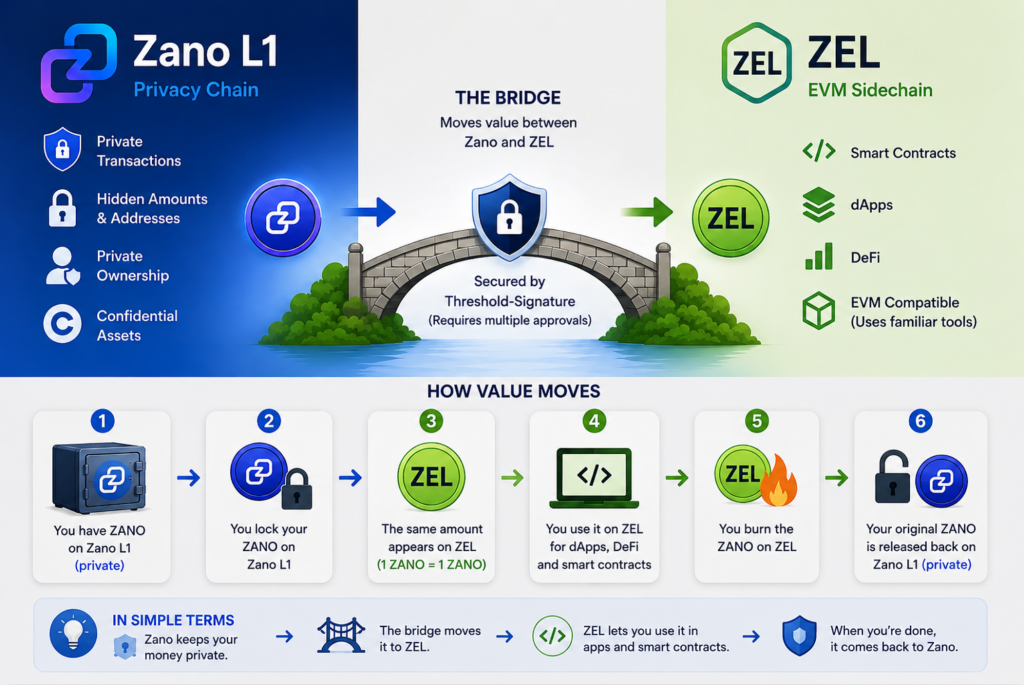
The answer is Zano Execution Layer, or ZEL.
ZEL is designed to be a separate blockchain that works alongside Zano. It can handle smart contracts and other applications while Zano’s main blockchain continues to focus on privacy.
Zano is the private blockchain. ZEL is the smart-contract blockchain connected to it.
Zano’s main blockchain handles things such as:
Private transactions
Private ownership
Confidential Assets
Hidden transaction amounts
Hidden addresses
ZEL is designed to handle:
Smart contracts
Decentralized applications
Trading
Lending
Other EVM-based applications
Zano’s roadmap describes ZEL as an EVM-compatible sidechain. This means developers can use technology and tools similar to those used on Ethereum and other EVM networks.
In simple terms, ZEL gives Zano an additional place where smart contracts can run.
2. Why Does Zano Need ZEL?
This is easier to understand if we look at what Zano is designed to do.
Zano’s main blockchain is built around privacy.
When you make a transaction on Zano, information such as the amount and addresses can be protected.
Smart contracts work differently.
For smart contracts to operate properly, their activity generally needs to be visible and verifiable by the network.
For example, if you use a decentralized exchange, people need to be able to verify what the smart contract is doing.
This creates a challenge:
How can Zano add smart contracts without turning its private blockchain into a public one?
ZEL provides one possible answer.
Instead of putting smart contracts directly onto Zano’s private Layer 1, Zano can have a separate environment for smart contracts.
So:
Zano L1 = privacy
ZEL = smart contracts
This allows the two networks to focus on different jobs.
3. How Do Zano and ZEL Work Together?
Think of Zano and ZEL as two connected roads.
One road is designed for private activity.
The other is designed for public applications.
The connection between them is a bridge.
The basic journey looks like this:
Zano L1
↓
Bridge
↓
ZEL
You can move ZANO from the Zano blockchain to ZEL.
Once there, it can be used with smart contracts and applications on ZEL.
You can then move the value back to Zano.
The important thing is that ZEL does not replace Zano.
It works alongside it.
4. What Happens When ZANO Moves to ZEL?
This is one of the most important parts to understand.
Let’s say you have:
100 ZANO
on the Zano blockchain.
You want to use that ZANO on ZEL.
First, your 100 ZANO is locked on Zano.
Then, 100 ZANO is represented on ZEL.
So you effectively have:
100 ZANO on Zano → locked
100 ZANO on ZEL → available to use
The amount is intended to remain 1:1.
You can then use the ZANO on ZEL to interact with applications and pay transaction fees.
What happens when you want to come back?
The process works in reverse.
Your ZANO on ZEL is burned.
The corresponding ZANO locked on the Zano side is then released.
So the basic process is:
Lock → Move to ZEL → Use → Burn → Return to Zano
5. What Is the Bridge?
The bridge is the part that connects Zano and ZEL.
You can think of it like a secure doorway between two buildings.
Zano is one building.
ZEL is another.
The bridge allows assets to move between them.
The ZEL design uses a threshold-signature bridge.
That sounds complicated, but the basic idea is quite simple.
Instead of one person having a single key that can control the bridge, multiple authorized participants are involved.
A required number of them must work together to approve certain actions.
This reduces the risk of one person being able to control the funds by themselves.
Why is the bridge important?
Because the bridge is where the two networks meet.
Zano and ZEL are separate networks.
Therefore, users need to trust the mechanism that connects them.
This means the bridge is an important part of ZEL’s overall security.
6. Is ZEL Private Like Zano?
No.
This is extremely important.
Zano and ZEL have different purposes.
Zano
Zano’s Layer 1 is designed for privacy.
ZEL
ZEL is designed for public smart-contract activity.
Once ZANO moves to ZEL, activity on ZEL can be publicly visible.
For example, imagine you move:
1,000 ZANO → ZEL
The 1,000 ZANO is represented on ZEL.
If you then use it to:
Trade
Swap tokens
Use a lending application
Interact with a smart contract
Send it to another ZEL address
that activity takes place on the public ZEL network.
So users should not think of ZEL as another privacy layer.
A simple way to remember it is:
Zano protects your privacy. ZEL provides the smart-contract environment.
7. What Can People Do on ZEL?
The biggest reason for creating ZEL is to give developers a place to build applications connected to the Zano ecosystem.
Because ZEL is designed to be EVM-compatible, developers can use familiar smart-contract technology.
This could allow applications such as:
Decentralized exchanges
Users could potentially trade tokens through smart contracts.
Lending
Users could potentially lend assets or borrow against them.
Token applications
Developers could create different types of blockchain-based tokens.
DeFi applications
Developers could build financial applications using smart contracts.
Other Web3 applications
EVM compatibility could make it easier for developers already familiar with Ethereum-style development to work with ZEL.
8. Why Not Put Smart Contracts Directly on Zano?
This is probably the biggest question.
Why create another blockchain instead of simply adding smart contracts to Zano?
The answer comes back to privacy.
Zano’s main blockchain was built with privacy as a priority.
Smart contracts generally need public information about their code, state and execution so that users and network participants can verify what is happening.
Trying to make Zano L1 do both jobs could make its design much more complicated.
Instead, Zano can separate the two:
Zano L1
Private transactions and assets.
ZEL
Public smart-contract execution.
This means Zano does not necessarily have to give up its privacy-focused design just to gain access to smart contracts.
9. What Are the Risks?
ZEL also introduces some things users need to understand.
Because ZEL is a separate network, users are not relying only on Zano.
They also need to consider:
ZEL’s validators
ZEL’s network security
Smart-contract security
The bridge
The people or entities operating the bridge
The bridge is particularly important because it connects the value on Zano with its representation on ZEL.
House of Chimera’s analysis of ZEL describes the threshold-signature bridge as the main trust boundary between the two networks.
That does not automatically mean the system is unsafe.
It simply means users should understand that ZEL and Zano are separate systems with different security and trust assumptions.
10. Why Could ZEL Be Important for Zano?
Zano already has a clear identity:
A blockchain focused on financial privacy.
ZEL could add something that Zano has been missing:
Smart-contract functionality.
This could potentially make the Zano ecosystem more useful to developers and users.
Instead of trying to turn Zano into another Ethereum-like blockchain, the project is taking a different approach.
It can keep the private Layer 1 while providing another network for public applications.
This creates a simple division:
Zano
ZEL
Privacy
Smart contracts
Private transactions
Public transactions
Confidential Assets
EVM applications
Private ownership
DeFi and other applications
Zano L1
Separate execution layer
The idea is not necessarily to make Zano and ZEL identical.
It is to make them work together.
11. ZEL Explained in One Simple Example
Imagine you have €1,000 in a private bank account.
You want to use €500 of it in a public online marketplace.
You move €500 from your private account into the marketplace.
Once there, you can use it to buy things, trade or interact with different services.
The marketplace is public, so activity there can be visible.
When you’re finished, you move your money back into the private account.
The basic idea behind ZEL is similar:
Zano = private place where your value starts
↓
Bridge = moves the value
↓
ZEL = public place where smart contracts can be used
↓
Bridge = brings the value back
↓
Zano = private environment again
Of course, blockchain bridges are technically much more complicated than this example, but this is the basic concept.
12. A New Direction for Zano
ZEL could give Zano a way to expand into smart contracts without changing the main purpose of its Layer 1.
Instead of forcing privacy and public smart contracts into the same blockchain, the architecture separates them.
Zano handles privacy.
ZEL handles smart contracts.
The bridge connects them.
According to Zano’s roadmap, the ZEL public testnet is targeted for Q3 2026, with a mainnet target of Q4 2026. These are roadmap targets and can change as development continues.
If the system works as intended, ZEL could give developers a familiar EVM environment while allowing Zano’s main blockchain to remain focused on what it does best: privacy.
In simple terms, ZEL is Zano’s attempt to add smart contracts without turning Zano itself into a transparent smart-contract blockchain.
Disclaimer:ZanoNews.com is an independent news and information website. This article is for informational purposes only and should not be considered financial, investment, or legal advice.