Most people trade crypto through centralized exchanges. You deposit your coins, make a trade, and the exchange takes care of the rest.
But there is another way.
Zano lets users trade directly with each other without giving their coins to a centralized exchange.
This is possible through Ionic Swaps, a built-in feature of the Zano blockchain.
In simple terms, Ionic Swaps allow two people to exchange crypto assets directly, while keeping control of their funds and protecting their transaction privacy.
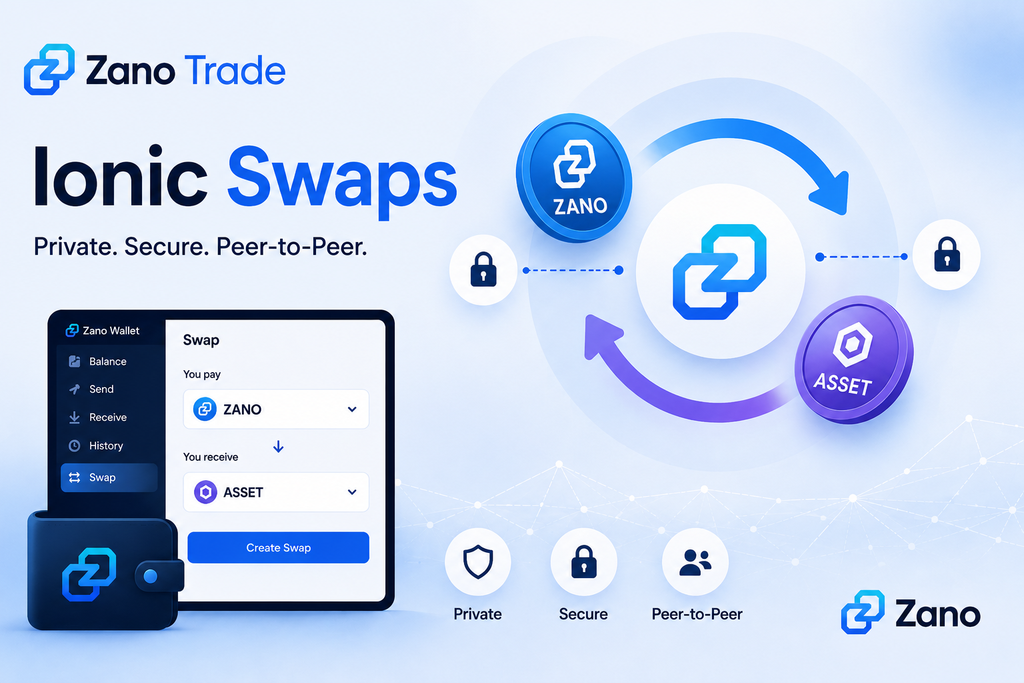
Table of Contents
- What Are Zano Ionic Swaps?
- What Do You Need to Trade?
- How Do Ionic Swaps Work?
- What Is Zano Trade?
- Do You Have to Give Up Your Coins?
- How Does Zano Protect Your Privacy?
- What Can You Trade?
- Ionic Swaps vs Traditional Crypto Exchanges
- Why Are Ionic Swaps Important?
- Why This Matters
1. What Are Zano Ionic Swaps?
Ionic Swaps are a way to trade crypto directly with another person on the Zano blockchain.
Imagine you have ZANO and want another asset.
Instead of sending your ZANO to an exchange, you can create a trade offer saying:
“I will give you this amount of ZANO in exchange for this amount of another asset.”
Another user can accept your offer.
The Zano blockchain then handles the swap.
The important part is that you keep control of your funds throughout the process.
There is no need for a centralized exchange to hold your coins.
2. What Do You Need to Trade?
To use Ionic Swaps, you need a Zano wallet with the asset you want to trade.
Your wallet is where you keep control of your funds and where you can create or accept an Ionic Swap. The official Ionic Swaps guide also includes screenshots showing the different steps, so readers can follow along visually.
In simple terms, if you want to create a swap:
- Open your Zano wallet and select the Swap tab.
- Choose the asset you want to sell and the asset you want to receive.
- Enter the amount and the wallet address or alias of the person you want to trade with.
- Set an expiration time for the swap.
- Create the proposal and share the generated swap code with the other trader.
If you receive a swap proposal, you can open the Swap tab in your wallet, select Confirm Swap, enter the proposal code, check the trade details and accept the proposal. The swap is then submitted to the Zano blockchain.
For users who want an easier way to find trades, Zano Trade provides a platform where you can browse available offers, while the actual exchange is handled through Ionic Swaps on the Zano blockchain.
3. How Do Ionic Swaps Work?
The process is easier than it might sound.
Step 1: Create a trade offer
You choose:
- What you want to sell
- What you want to receive
- How much you want to trade
- The price or exchange rate
Step 2: Someone accepts your offer
Another user finds your offer and decides they want to make the trade.
Step 3: The swap is created
Both sides agree to the transaction and sign it from their own wallets.
Step 4: The blockchain completes the trade
The transaction is processed on the Zano network.
The basic idea is:
Both sides get what they agreed to, or the trade does not happen.
This means users don’t have to simply trust the other person to send their side of the deal.
4. What Is Zano Trade?
Zano Trade makes Ionic Swaps easier to use.
Instead of finding someone yourself and arranging a trade manually, Zano Trade lets you browse available offers from other users.
You can look at the available trades, choose one you are interested in and accept it.
Behind the scenes, the actual exchange is handled by Ionic Swaps on the Zano blockchain.
So you can think of it this way:
Zano Trade = where you find the trade
Ionic Swap = how the trade is completed
Zano Trade is also non-custodial, meaning it does not take control of your crypto.
5. Do You Have to Give Up Your Coins?
No.
This is one of the main differences between Ionic Swaps and traditional centralized exchanges.
With a centralized exchange, you normally deposit your crypto into a wallet controlled by the exchange before trading.
With Ionic Swaps, your assets remain under your control until the swap is completed.
You don’t need to send your coins to a company and wait for the company to process your trade.
Instead, the trade happens directly between the participants through the Zano blockchain.
6. How Does Zano Protect Your Privacy?
Privacy is a major part of Zano.
On many public blockchains, people can look at transactions and see information such as wallet addresses and transaction amounts.
Zano takes a different approach.
Its privacy technology is designed to hide important transaction information, including:
- Wallet addresses
- Transaction amounts
- Asset information
- Transaction history
This also applies when using Zano Trade.
For someone looking at the public blockchain, the details of a completed trade are not simply displayed for everyone to see.
That can be important for people who don’t want their financial activity publicly exposed.
7. What Can You Trade?
Ionic Swaps are not only for trading ZANO.
They can also be used with Confidential Assets created on the Zano blockchain.
For example, users can potentially trade:
ZANO ↔ Confidential Asset
or
Confidential Asset ↔ Confidential Asset
depending on the available trading pairs.
Confidential Assets are tokens that use Zano’s privacy technology.
This gives projects the ability to create their own assets while benefiting from the privacy features built into the Zano network.
8. Ionic Swaps vs Traditional Crypto Exchanges
So how is this different from using a normal crypto exchange?
| Traditional Exchange | Zano Ionic Swaps |
|---|---|
| Exchange holds your funds | You keep control of your funds |
| Centralized platform | Peer-to-peer |
| Trading happens through the exchange | Trading happens on the Zano blockchain |
| Transaction information may be publicly visible depending on the platform | Zano provides privacy by design |
| Requires trusting the exchange | Uses blockchain-based settlement |
This doesn’t necessarily mean centralized exchanges are bad.
They can be convenient and offer many trading features.
But Ionic Swaps provide another option for people who value privacy, self-custody and peer-to-peer trading.
9. Why Are Ionic Swaps Important?
Ionic Swaps bring several useful features together.
🔐 Privacy
Your trading activity benefits from Zano’s privacy-focused blockchain.
👛 Self-custody
You keep control of your crypto instead of depositing it with a centralized exchange.
🤝 Peer-to-peer trading
You can trade directly with another user.
⛓️ On-chain trading
The blockchain handles the transaction rather than a centralized company.
🚫 No traditional middleman
Zano Trade helps users find trading offers, while the actual swap is handled on-chain.
⚡ Fast settlement
Zano’s documentation says Ionic Swaps require one confirmation and typically complete in around one minute.
Together, these features create a different way to think about crypto trading.
10. Why This Matters
Crypto trading doesn’t always have to mean sending your coins to a centralized exchange.
Zano Ionic Swaps provide another option.
You can trade directly with another person, keep control of your funds and benefit from Zano’s privacy technology.
And with Zano Trade, finding and accepting these trades becomes easier for everyday users.
You don’t need to understand all the technical details behind Ionic Swaps to understand the main idea:
Trade directly. Keep control. Keep your transactions private.
That’s what makes Ionic Swaps an interesting part of the Zano ecosystem.
Learn More
Disclaimer: ZanoNews.com is an independent news and information website. This article is for informational purposes only and does not constitute financial or investment advice.