
Development on Zano continued during the third week of August, with the project team reporting another week of activity across its codebase.
From August 3 to August 9, 2026, the Zano team recorded:
- ✅ 20 commits
- ➕ 880 lines of code added
- ➖ 206 lines of code removed
But what do these numbers actually mean? Let’s break them down in simple terms.
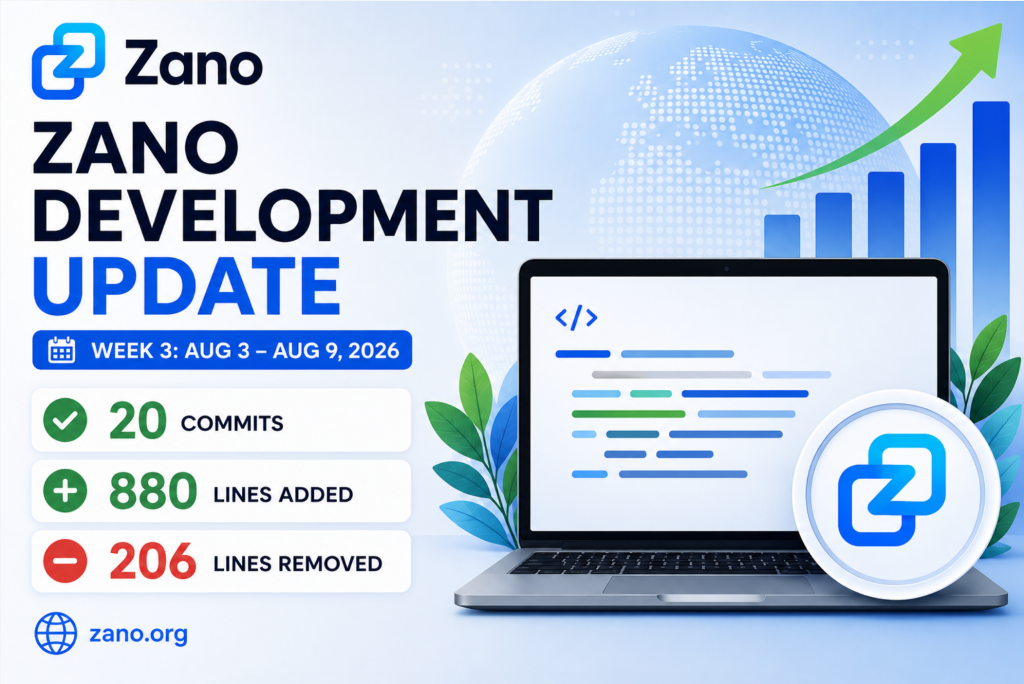
Table of Contents
- What Happened During Week 3?
- What Is a Commit?
- What Do 880 Lines Added Mean?
- Why Were 206 Lines Removed?
- What Do These Numbers Tell Us?
- Why Development Activity Matters for Zano
- The Bigger Picture
- The Road Ahead
- Sources
1. What Happened During Week 3?
According to the latest development update shared by We Are Zano, the team recorded 20 commits between August 3 and August 9, 2026.
During the same period, developers:
Added: 880 lines of code
Removed: 206 lines of code
That gives a simple picture of continued development work happening behind the scenes.
Zano is a privacy-focused blockchain where privacy is built into the protocol by default. Its ecosystem includes private transactions, Confidential Assets, staking, trading and other applications.
2. What Is a Commit?
A commit is simply a recorded set of changes made to a software project.
Think of it like editing a document. You make several changes, save those changes as a group, and record what was changed. That recorded update is a commit.
So when Zano reports 20 commits, it means developers recorded 20 separate sets of changes to the project’s code during that week.
It doesn’t mean there were only 20 individual changes. A single commit can contain many different changes.
3. What Do 880 Lines Added Mean?
The team reported 880 lines added.
This means developers added 880 lines of code to the relevant project repositories during the week.
It’s important to remember that:
More lines of code don’t necessarily mean better software.
One line of code can be extremely important, while hundreds of lines can sometimes be removed or replaced with a more efficient solution.
The number is better understood as a measure of development activity, rather than a direct measurement of progress or software quality.
4. Why Were 206 Lines Removed?
The update also shows that developers removed 206 lines of code.
Removing code is completely normal in software development.
Developers may remove code when they:
- Replace an older solution
- Fix bugs
- Simplify the software
- Improve efficiency
- Remove code that is no longer needed
- Refactor existing components
In other words, removing code isn’t necessarily a bad thing.
Sometimes, taking code away can make software cleaner, easier to maintain and more efficient.
5. What Do These Numbers Tell Us?
The simplest takeaway is that Zano development remains active.
During one week, developers recorded 20 commits while making both additions and removals to the codebase.
The numbers don’t tell us exactly what every commit accomplished, however.
For that reason, it would be misleading to say that 880 lines added automatically means Zano became 880 lines “better.”
Instead, these figures give the community a quick snapshot of developer activity.
The individual code changes provide more detail, but the overall message is simple:
The project continues to be actively developed.
6. Why Development Activity Matters for Zano
Software projects need continuous development to remain useful, secure and adaptable.
This is especially important for a blockchain because the technology has to support several areas at the same time, including:
- Network security
- Privacy
- Wallet functionality
- Developer tools
- Confidential Assets
- Trading
- Ecosystem applications
Zano’s developer resources include APIs, blockchain data tools, Confidential Asset tools and resources for developers building applications on the network.
Zano also continues to work on major network improvements. For example, Hard Fork 6 is scheduled to activate at block 3,833,000, expected between August 25 and August 27, 2026, according to Zano’s official announcement.
This puts weekly development activity into a bigger context: blockchain development is an ongoing process rather than something that happens only when a major update is released.
7. The Bigger Picture
It is easy to focus on major announcements in crypto:
New partnerships.
New listings.
New products.
Major upgrades.
But much of the work required to make those developments possible happens quietly in the codebase.
Weekly development statistics provide a small window into that work.
For Zano, this includes maintaining and improving a privacy-focused blockchain that supports not only $ZANO but also Confidential Assets and applications built around the network.
So while 20 commits, 880 lines added and 206 lines removed may not sound exciting to everyone, they represent another week of work behind the scenes.
8. The Road Ahead
The latest numbers provide a simple snapshot of where development activity stood during August 3–9, 2026.
The more important question is what these ongoing development efforts contribute to over time.
For developers, the individual code changes matter.
For crypto users, what ultimately matters is what those changes deliver:
A more capable network, better tools, stronger privacy and a growing ecosystem.
As Zano continues developing its technology and preparing for major network changes such as Hard Fork 6, weekly development activity will remain one of the quieter but important parts of the project’s progress.
9. Sources
Disclaimer: ZanoNews.com is an independent news and information website. This article is for informational purposes only and should not be considered financial, investment, or legal advice.