Zano Shares More Details on How Smart Contracts Will Work Alongside Its Privacy Chain

Zano has shared a clearer look at how its upcoming Zano Execution Layer (ZEL) will work alongside its privacy-focused blockchain.

In a recent post, Zano explained that ZEL will be a standard EVM environment running alongside Zano’s privacy-by-default blockchain.
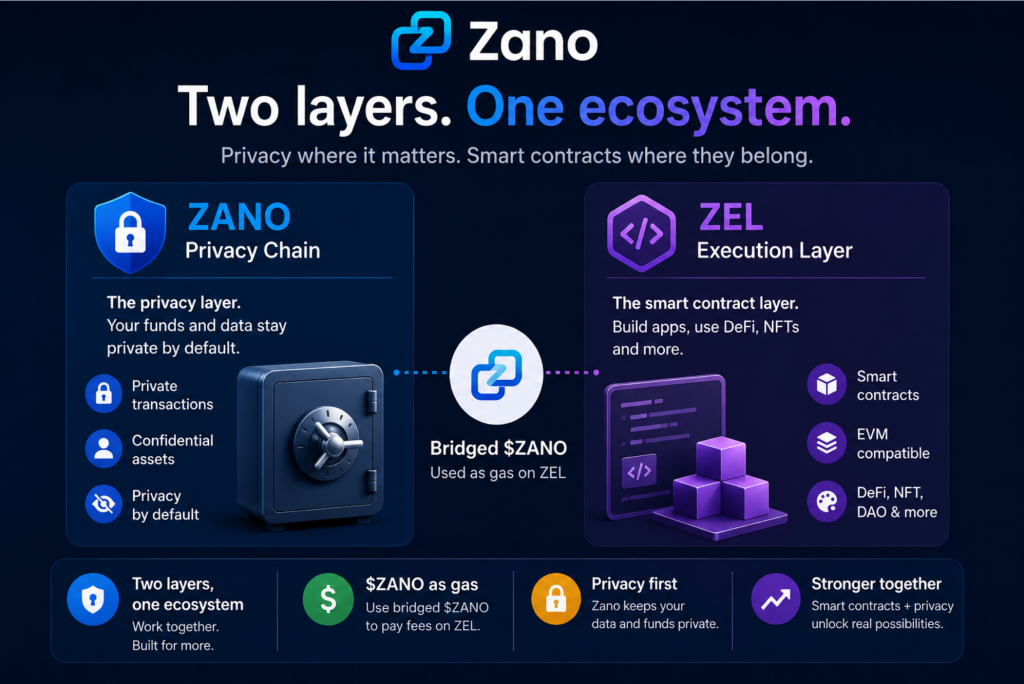
Table of Contents

  1. How Zano and ZEL Will Work Together
  2. Where $ZANO Fits In
  3. Privacy and Smart Contracts Have Different Roles
  4. Learn More About ZEL

1. How Zano and ZEL Will Work Together

The idea is simple: Zano’s main blockchain remains focused on privacy, while ZEL provides an environment for smart contracts.

Smart contracts are programs that run on a blockchain. They can power applications such as decentralized exchanges, lending platforms and other Web3 services.

Instead of changing Zano’s privacy-focused Layer 1 to support these applications, ZEL will operate alongside it.

This gives the two layers different jobs:

  • Zano: Private transactions and assets
  • ZEL: Public and verifiable smart contracts

2. Where $ZANO Fits In

Bridged $ZANO will be used to pay for transactions and smart-contract activity on ZEL. These fees are known as “gas fees” and are similar to paying a small fee to use a service.

This means $ZANO will connect Zano’s privacy-focused blockchain with the new smart-contract environment on ZEL.

3. Privacy and Smart Contracts Have Different Roles

One of the key points from Zano’s post is that privacy and smart-contract transparency do not necessarily have to exist on the same layer.

Zano can keep its main blockchain focused on protecting private assets and transactions, while ZEL allows users and developers to interact with public, verifiable smart contracts.

In simple terms:

  • Private assets on Zano.
  • Verifiable smart contracts on ZEL.

The goal is to let each layer do what it was designed to do without compromising the other.

4. Learn More About ZEL

For readers who want a deeper explanation of how ZEL works, including the bridge between Zano and ZEL, what happens when $ZANO moves between the networks, and what developers could build on ZEL, read our full guide:

👉 Zano Execution Layer (ZEL) Explained: Smart Contracts Without Changing Zano’s Privacy

Zano’s roadmap currently lists the ZEL mainnet release as a Q4 2026 target, with the goal of bringing programmable smart contracts to the ecosystem while Zano L1 remains the privacy chain.

Sources

Disclaimer: ZanoNews.com is an independent news and information website. This article is for informational purposes only and should not be considered financial, investment, or legal advice.
How Transparent Blockchains Can Expose Your Salary and Transactions

Many people assume cryptocurrency is private.

In reality, that’s not always true.

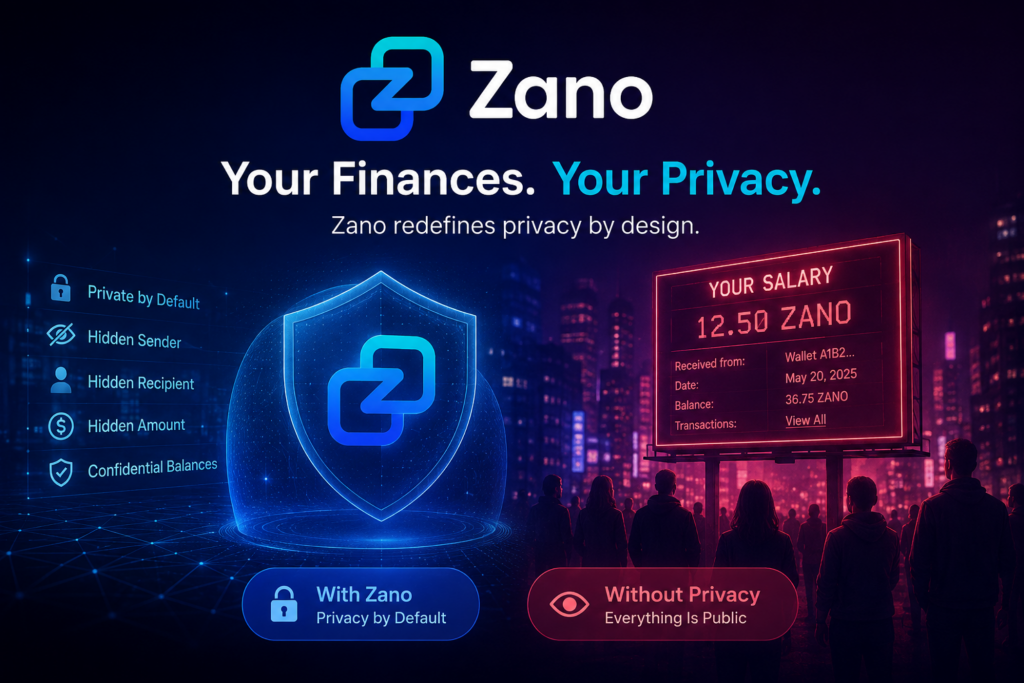
Imagine if your salary was posted on a public billboard every time you got paid. Your neighbours, employer, friends, and even strangers could see how much you earn, how much money you have, and every payment you make.

Most people would never accept that in everyday life.

Yet this is exactly how many transparent blockchains work.

Table of Contents

  1. What Is a Transparent Blockchain?
  2. Why Does Financial Privacy Matter?
  3. How Transparent Blockchains Can Expose Your Finances
  4. Why Zano Was Built Differently
  5. Privacy Is More Than Secrecy
  6. Key Takeaways
  7. Sources

1. What Is a Transparent Blockchain?

A blockchain is a digital ledger that records transactions.

On many popular blockchains, every transaction is publicly recorded forever. While your real name may not appear, your wallet address, transaction history, balances, and transfers can often be viewed by anyone using a blockchain explorer.

If someone links your wallet address to your identity—perhaps because you shared it online, received a payment publicly, or interacted with a regulated exchange—they may be able to see much more than you intended.

This level of transparency is one of the defining features of many public blockchains.

2. Why Does Financial Privacy Matter?

Think about your everyday finances.

Your bank doesn’t publish your account balance.

Your employer doesn’t announce your salary to the public.

Your payment history isn’t available for anyone to browse.

That’s because financial privacy is something most people expect.

Privacy doesn’t mean you have something to hide. It means you have control over who can see your personal financial information.

Without that privacy, people may become targets for scams, phishing attacks, theft, or unwanted attention simply because their financial activity is publicly visible.

3. How Transparent Blockchains Can Expose Your Finances

Let’s go back to the salary example.

Imagine your employer pays you in cryptocurrency using a transparent blockchain.

Anyone who knows your wallet address could potentially see:

  • Your salary amount
  • Every payment you receive
  • Every payment you send
  • Your wallet balance
  • Your complete transaction history

Over time, someone could build a detailed picture of your financial life.

For businesses, this can also be a concern. Competitors may be able to track payments, suppliers, or business activity through public blockchain records.

While blockchain transparency helps with verification, it also means financial information can become far more public than many people expect.

4. Why Zano Was Built Differently

Zano takes a different approach.

Instead of making every transaction publicly visible, Zano was designed with financial privacy as a core feature.

By default, Zano protects important transaction details, including:

  • The sender
  • The recipient
  • The transaction amount
  • Wallet balances from public view

This allows users to send and receive digital assets without exposing their financial activity to the entire world.

Privacy on Zano isn’t an add-on or an optional setting. It is built directly into the blockchain protocol.

The goal is simple: digital money should provide a level of financial privacy similar to what people already expect when using their bank account or making everyday payments.

5. Privacy Is More Than Secrecy

Some people mistakenly believe privacy is only useful for people doing something wrong.

In reality, privacy protects everyone.

It helps individuals keep their salaries confidential.

It helps businesses protect sensitive commercial information.

It helps families keep their finances private.

Just as we lock the front door of our homes, use passwords for our online accounts, and expect our banking information to remain confidential, many people believe digital money should also protect personal financial information.

Privacy is about security, personal choice, and protecting sensitive information—not hiding illegal activity.

6. Key Takeaways

  • Many transparent blockchains make transaction history and wallet balances publicly visible.
  • If someone links your wallet address to your identity, they may be able to view your financial activity.
  • Financial privacy helps protect personal and business information from unwanted exposure.
  • Zano was built with privacy by default, keeping transaction details such as the sender, recipient, and amount confidential.
  • As blockchain adoption grows, protecting financial privacy is becoming an increasingly important consideration for users and businesses alike.

Sources

  1. Zano Official Website
  2. Zano Documentation
  3. Official Zano X post

Disclaimer: ZanoNews.com is an independent news and information website. This article is for informational purposes only and should not be considered financial, investment, or legal advice.