
How Does the Confidential Layer Bridge Work?

Crypto assets like Bitcoin and Ethereum are useful, but their transactions are normally visible on public blockchains. Confidential Layer offers a way to bring these assets into Zano and give them the privacy features of the Zano blockchain.
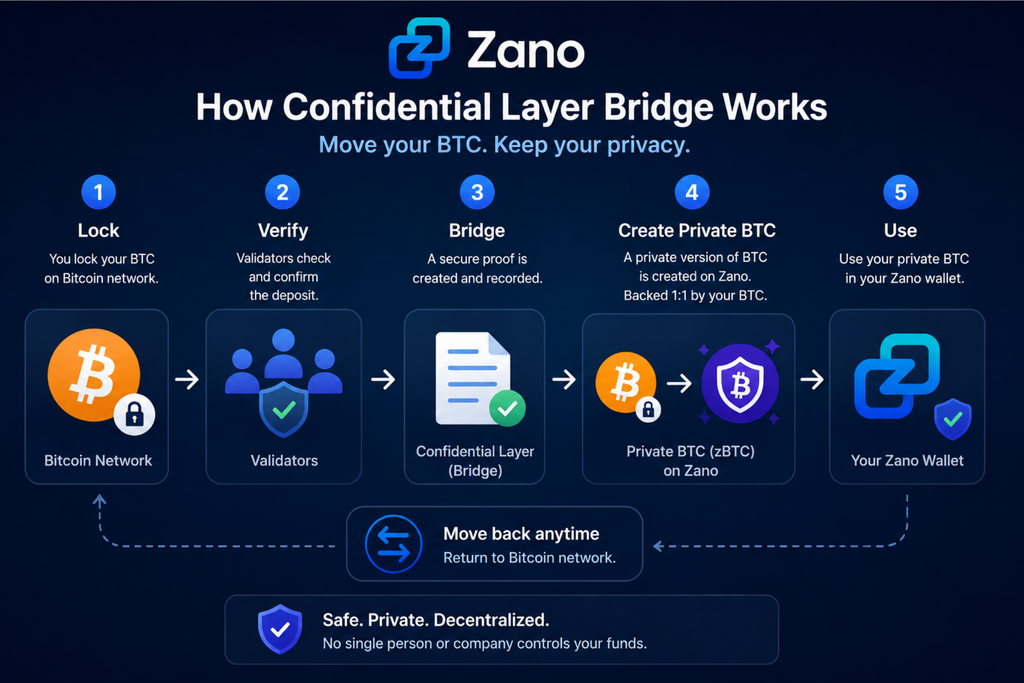
But how does it actually work? πŸ‘‡

Table of Contents

  1. What Is Confidential Layer?
  2. How Does the Bridge Work?
  3. How Are the Funds Kept Safe?
  4. What Do You Receive on Zano?
  5. Why Does This Matter?

1. What Is Confidential Layer?

Confidential Layer is a decentralized, non-custodial bridge that connects public blockchains such as Bitcoin and Ethereum with privacy-focused blockchains like Zano.

In simple terms, it lets you take an asset such as BTC or ETH from its original blockchain and create a private version of that asset on Zano.

For example:

BTC β†’ Confidential Layer β†’ BTCx on Zano

The original asset remains locked on its native blockchain, while the Zano version is backed 1:1 by that locked asset.

2. How Does the Bridge Work?

Let’s use Bitcoin (BTC) as a simple example.

First, the user locks BTC on the Bitcoin network. The bridge’s validators detect the deposit and create a cryptographic proof, known as a witness, confirming that the deposit happened.

That information is then recorded on the Bridgeless blockchain, which powers Confidential Layer.

Once the deposit is verified, the system can authorize the creation of the private version of Bitcoin on Zano.

The process can be simplified to:

1. Lock BTC β†’ 2. Verify the deposit β†’ 3. Create the private version β†’ 4. Send it to your Zano wallet

The result is BTCx, a private version of Bitcoin that can be used within the Zano ecosystem.

3. How Are the Funds Kept Safe?

Confidential Layer does not rely on one company or person holding everyone’s funds.

Instead, it uses a network of validators and threshold signatures. In simple terms, the signing power is divided between multiple participants.

A minimum number of validators must work together to approve a withdrawal. No single validator has the complete private key needed to control the locked funds. Zano states that the bridge requires 66% of validators to sign transactions.

This distributed approach means there is no single central authority holding the assets.

4. What Do You Receive on Zano?

Once the deposit has been verified, the bridge creates a wrapped version of the original asset on Zano.

For example:

Ethereum β†’ ETHx
Bitcoin β†’ BTCx

These assets are backed 1:1 by the original assets locked on their native blockchains. On Zano, they can benefit from Zano’s privacy features, including hidden transaction amounts and addresses.

You can then use the private version on Zano and, when needed, move it back and receive the original asset.

5. Why Does This Matter?

Normally, using Bitcoin or Ethereum means accepting that your transaction history can be publicly visible.

Confidential Layer offers another option: keep exposure to the original asset while using it in a more private environment.

You don’t have to exchange your Bitcoin for ZANO just to get privacy. You can bridge the Bitcoin itself and receive BTCx on Zano.

That creates a simple combination:

Your asset + Zano’s privacy + the ability to move back when needed.

Confidential Layer is therefore designed to connect the open crypto world with Zano’s private ecosystem, giving users more choice over how they use their digital assets.

Sources:

Disclaimer: ZanoNews.com is an independent news and information website. This article is for informational purposes only and does not constitute financial or investment advice.
Inside the Zano-Verse Episode 3: What Zarcanum Means for Zano πŸ”

Originally recorded on February 8, 2024, Episode 3 of Inside the Zano-Verse focused on Zarcanum and the major privacy improvements it was designed to bring to Zano.

Some details discussed in the video were plans at the time and have since changed. So instead of asking you to watch the full video, we’ve broken down the main ideas in simple terms and added some current context.

πŸŽ₯ The full hour-long Episode 3 is here if you’d like to check it out: πŸ‘‡

Table of Contents

  1. What Is Zarcanum?
  2. Private Staking With Hidden Amounts
  3. Create Private Assets on Zano
  4. Why More Activity Can Help Privacy
  5. What Does This Mean for Developers?
  6. How Zano Has Evolved Since the Video

1. What Is Zarcanum?

Zarcanum is a major privacy technology used by Zano.

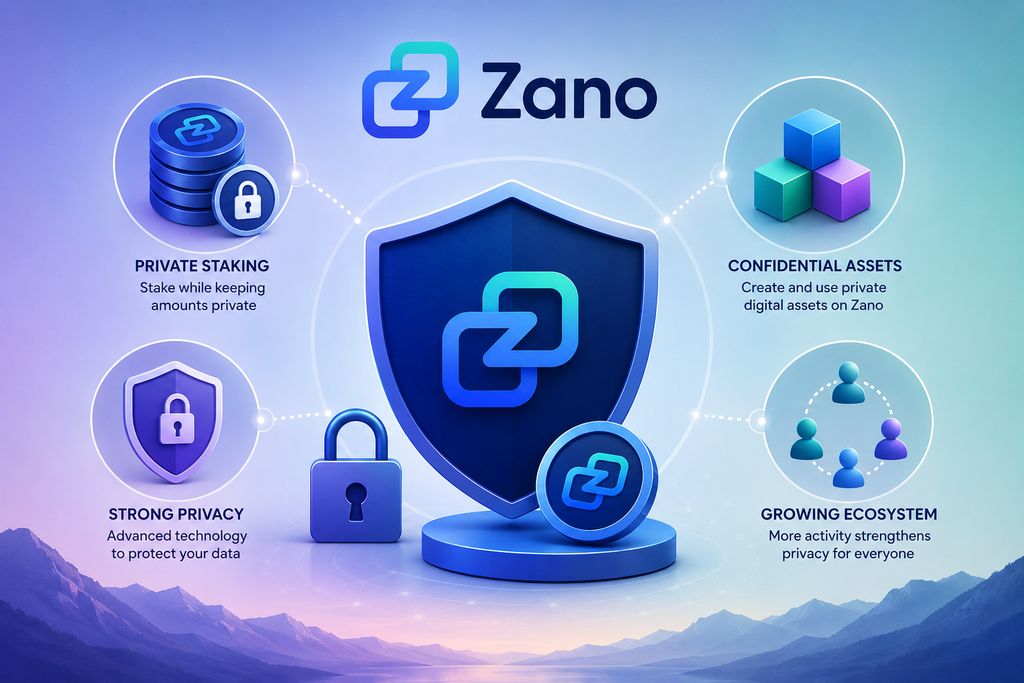
It introduced a new approach to Proof of Stake, allowing people to help secure the network while keeping their staking amounts hidden. The episode described this as one of the biggest privacy upgrades planned for Zano at the time.

In simple terms:

Zarcanum helps Zano keep more financial information private. πŸ”’

πŸ‘‰ We’ve explained this part in more detail in How Zano Keeps Your Staking Amount Private πŸ”’.

2. Private Staking With Hidden Amounts

Staking means putting your crypto to work to help support and secure a blockchain while earning staking rewards.

The challenge is that a blockchain normally needs to know how much someone has staked.

Zarcanum was designed to solve this while keeping the amount hidden.

The network can still use the stake, but people looking at the blockchain don’t simply see the amount being staked.

The team also discussed improvements to transaction selection to strengthen Zano’s privacy.

3. Create Private Assets on Zano

Another major part of Zarcanum is Confidential Assets.

Confidential Assets are digital assets on Zano where important transaction details, such as amounts and addresses, can remain private.

This could include things such as:

  • Stablecoins
  • Tokens
  • Other digital assets

The idea was to expand Zano from a network focused mainly on ZANO into a privacy-focused platform for multiple assets.

πŸ‘‰ You can also read our guide on Zano Confidential Assets.

4. Why More Activity Can Help Privacy

Privacy can become stronger when there are more users and transactions taking place.

Think of it like trying to find one person in a crowd.

A small crowd makes it easier to identify someone. A much larger crowd makes it harder.

The same basic idea applies to privacy technology: more activity can create a larger pool of transactions and information to hide among.

5. What Does This Mean for Developers?

Zarcanum wasn’t designed only for people who want to hold or send ZANO.

It also gives developers the ability to build privacy-focused applications and assets on Zano.

The episode discussed the potential for projects such as private stablecoins, decentralised exchanges and other privacy-focused applications.

These were ideas discussed during the episode, rather than promises of specific future products.

The bigger idea is simple:

Developers can use Zano’s privacy technology instead of building an entire privacy blockchain from scratch.

6. How Zano Has Evolved Since the Video

A lot has changed since this 2024 episode.

For example, Zano now has several wallet options, including its mobile wallet, full desktop wallet, Lite Wallet beta, Edge Wallet, Cake Wallet and other third-party options.

The Lite Wallet is designed to connect to a remote node instead of requiring users to download the entire blockchain, making Zano easier to access for everyday users.

Zano has also continued expanding its ecosystem with Confidential Assets, wallet integrations and other privacy-focused applications.

So while the video is now more than two years old, its main discussion around private staking, Confidential Assets and building a privacy-focused ecosystem remains useful for understanding why Zarcanum is important.

The Simple Takeaway

You don’t need to watch the entire video to understand the main idea.

Zarcanum was designed to make Zano more private while also giving developers more ways to build on the network.

Private staking.
Private assets.
More possibilities for privacy-focused applications.

That’s the bigger picture behind Zarcanum. πŸ”

Sources

Disclaimer: ZanoNews.com is an independent news and information website. This article is for informational purposes only and does not constitute financial or investment advice.