Shops Don’t Accept ZANO? You Can Still Spend It πŸ’³

You might think you can only spend $ZANO or $fUSD at shops that directly accept them. But that is not necessarily the case.

Payment services like AEON Pay and Zebec can let you use your Zano assets while the shop continues receiving payment through its usual system.
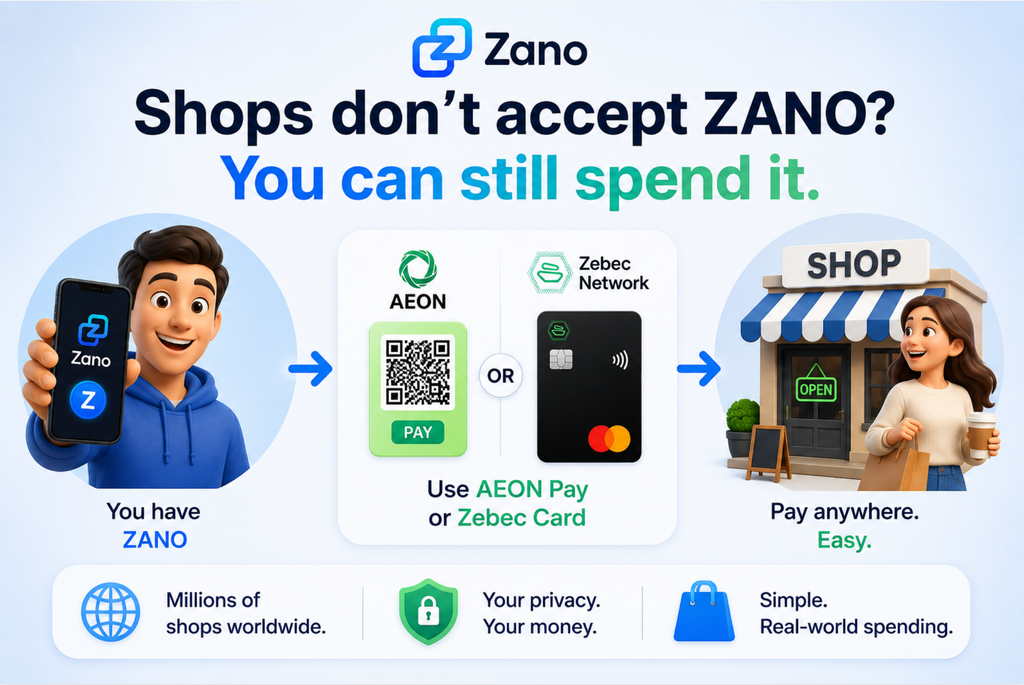
Table of Contents

  1. Do Shops Need to Accept ZANO?
  2. How Does It Work?
  3. Pay With ZANO Using AEON Pay
  4. Spend With ZANO Using Zebec
  5. Why Does This Matter?
  6. What This Means for Everyday Users
  7. Learn More

1. Do Shops Need to Accept ZANO?

Not necessarily.

A shop does not need to have a Zano wallet or directly accept $ZANO or $fUSD for you to potentially spend them.

Instead, a payment service can handle the crypto side while the merchant receives payment through its existing system.

In simple terms:

Your ZANO or fUSD β†’ Payment service β†’ Shop

The shop can continue using the payment method it already supports.

2. How Does It Work?

Think of these services as a bridge between your crypto and everyday payments.

You use your ZANO or fUSD, while the payment service handles the conversion or payment processing in the background.

This means you don’t necessarily need to ask a shop:

β€œDo you accept ZANO?”

You may simply be able to pay through a supported payment service.

Two options highlighted by Zano are AEON Pay and Zebec.

3. Pay With ZANO Using AEON Pay

AEON Pay works as a mini app inside Telegram.

You can top it up with ZANO or fUSD, then scan a QR code at a supported checkout. The merchant receives payment in their local currency.

According to Zano, AEON Pay is accepted at 50M+ merchants worldwide, mainly across emerging markets.

We have already explained how it works in more detail:

πŸ‘‰ How to Spend ZANO with AEON Pay πŸ’³

4. Spend With ZANO Using Zebec

Zebec offers another way to spend ZANO and fUSD.

You can top up a supported Zebec card through the Zebec Super App using ZANO or fUSD, then use the card wherever Mastercard is accepted.

The shop does not need to accept ZANO directly. It simply processes your payment like any other Mastercard transaction.

We covered the Zebec card and how it works in more detail here:

πŸ‘‰ ZANO and Zebec Cards: How to Spend Private Crypto in the Real World

You can also read about the original Zano and Zebec integration:

πŸ‘‰ The Zebec Network x Zano Integration Is Now Live

5. Why Does This Matter?

Getting every shop to directly accept a cryptocurrency would be difficult.

Payment services can make things much simpler.

A recent Zano community poll highlighted the challenge, with 44% of respondents saying that nowhere they shop currently accepts ZANO or fUSD. But as the examples above show, direct merchant acceptance is not always necessary.

Instead of asking merchants to change how they accept payments, services like AEON Pay and Zebec can work with existing payment systems.

This could make ZANO and fUSD more practical for everyday spending.

6. What This Means for Everyday Users

Imagine you have $ZANO or $fUSD and want to buy something from a shop that has never heard of Zano.

You may still have a way to pay.

With services such as AEON Pay or Zebec, the merchant does not necessarily need to accept ZANO or fUSD directly.

You use your Zano assets. The payment service handles the rest. πŸ’³

Of course, availability depends on the service, country, merchant and applicable payment restrictions.

7. Learn More

Zano is continuing to explore ways to make its private assets more useful beyond simply holding or transferring them on the blockchain.

The bigger idea is easy to understand:

A shop doesn’t always need to accept ZANO for you to spend ZANO. 🌍

Sources

Disclaimer: ZanoNews.com is an independent news and information website. This article is for informational purposes only and does not constitute financial or investment advice.
Zano Updates Its Introduction Guide With the Latest Developments πŸ“˜

New to Zano or trying to explain it to someone else?

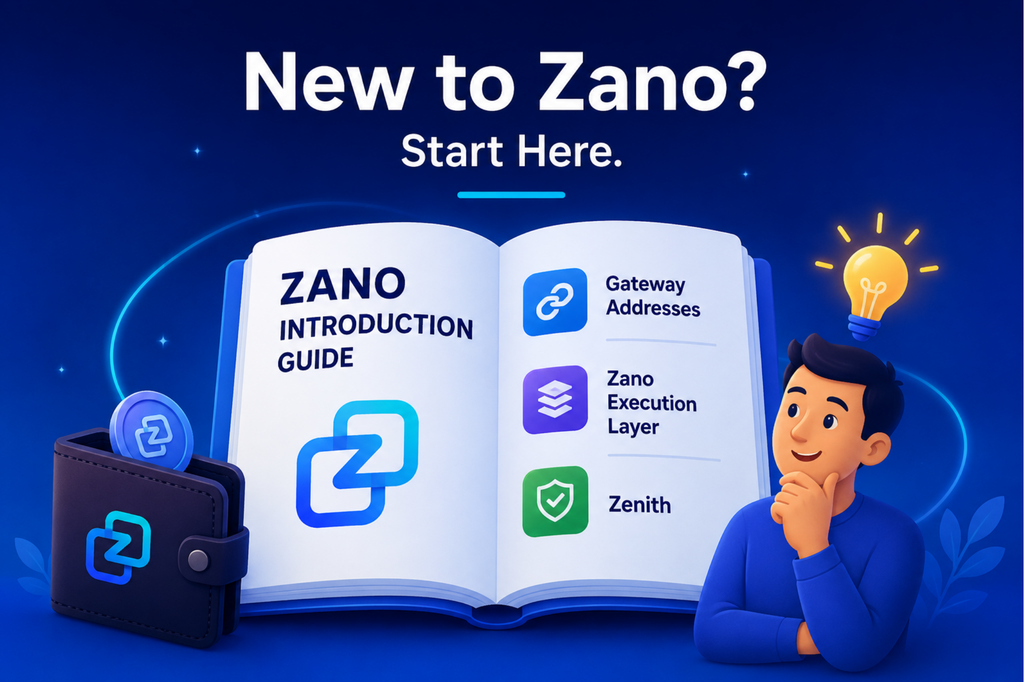
Zano has updated its official Introduction Guide to include some of its latest developments, including Gateway Addresses, the Zano Execution Layer and Zenith. It gives newcomers a simple place to learn about Zano, its privacy technology and where the project is heading.

Table of Contents

  1. What Is the Zano Introduction Guide?
  2. What Has Been Updated?
  3. Gateway Addresses
  4. The Zano Execution Layer
  5. Zenith
  6. Who Is the Guide For?
  7. Where Can You Read It?
  8. What This Means for New Users

1. What Is the Zano Introduction Guide?

The Zano Introduction Guide is a beginner friendly resource designed to explain the Zano ecosystem in one place.

It helps readers understand the basics of Zano, including its privacy features, wallets, Confidential Assets, staking, mining and other parts of the ecosystem.

The latest version has now been updated to reflect some of Zano’s newest developments.

2. What Has Been Updated?

The updated guide includes information about three important areas of Zano’s development:

Gateway Addresses
A new address system designed to make it easier for exchanges, bridges and other services to connect with Zano.

Zano Execution Layer
A planned environment for smart contracts and decentralized applications that works alongside Zano’s privacy focused main blockchain.

Zenith
A planned upgrade that would move Zano from its current hybrid Proof of Work and Proof of Stake system toward pure Proof of Stake.

Each of these developments could play an important role in Zano’s future.

3. Gateway Addresses

Gateway Addresses are designed to make Zano easier for exchanges, wallets, bridges and other crypto services to integrate.

For everyday users, the idea is simple: make it easier for more services to support Zano without removing its privacy.

We have already explained Gateway Addresses in more detail here:

πŸ‘‰ How Gateway Addresses Could Bring Zano to More Exchanges

You can also read our earlier overview:

πŸ‘‰ Gateway Addresses Are Coming: The Game-Changer for Zano Adoption

4. The Zano Execution Layer

The Zano Execution Layer, or ZEL, is designed to give Zano a separate environment for smart contracts and decentralized applications.

Think of it simply as an additional layer that can handle applications such as trading, lending and other Web3 services, while Zano’s main blockchain continues to focus on privacy.

We have already covered ZEL in detail:

πŸ‘‰ Zano Execution Layer (ZEL) Explained: Smart Contracts Without Changing Zano’s Privacy

5. Zenith

Zenith is Zano’s longer term plan to move from its current hybrid Proof of Work and Proof of Stake system to pure Proof of Stake.

In simple terms, Proof of Stake allows users to help secure the network by staking their coins instead of relying on mining.

Zenith is still under development, so it is a future upgrade rather than something users need to change today.

For a deeper explanation, read:

πŸ‘‰ Zenith: Zano’s Move to Pure Proof of Stake Explained

We also covered the bigger picture behind Zenith here:

πŸ‘‰ The Biggest Change in Zano’s History Is Coming 🧭

6. Who Is the Guide For?

You do not need to be a blockchain expert to use the guide.

It is useful if you:

  • Are completely new to Zano
  • Want to understand Zano’s privacy features
  • Want to learn about the Zano ecosystem
  • Want to explain Zano to a friend or colleague
  • Want a simple overview of where Zano is heading

Instead of searching through different articles and technical documents, the guide brings the main information together in one place.

7. Where Can You Read It?

You can read the updated Zano Introduction Guide here:

πŸ‘‰ Zano Introduction Guidebook

You can also visit the Zano introduction website for more information about the project and its ecosystem:

πŸ‘‰ Zano Introduction Website

8. What This Means for New Users

Zano continues to develop beyond its original focus on private cryptocurrency transactions.

Gateway Addresses are designed to make integrations easier, the Execution Layer could bring more applications and smart contracts to the ecosystem, and Zenith represents a future move toward pure Proof of Stake.

For someone discovering Zano today, the updated guide provides a useful starting point to understand where Zano is now and where it could be heading next.

If you have been curious about Zano but did not know where to start, this is a good place to begin. πŸ‘‡

Sources

Disclaimer: ZanoNews.com is an independent news and information website. This article is for informational purposes only and does not constitute financial or investment advice.
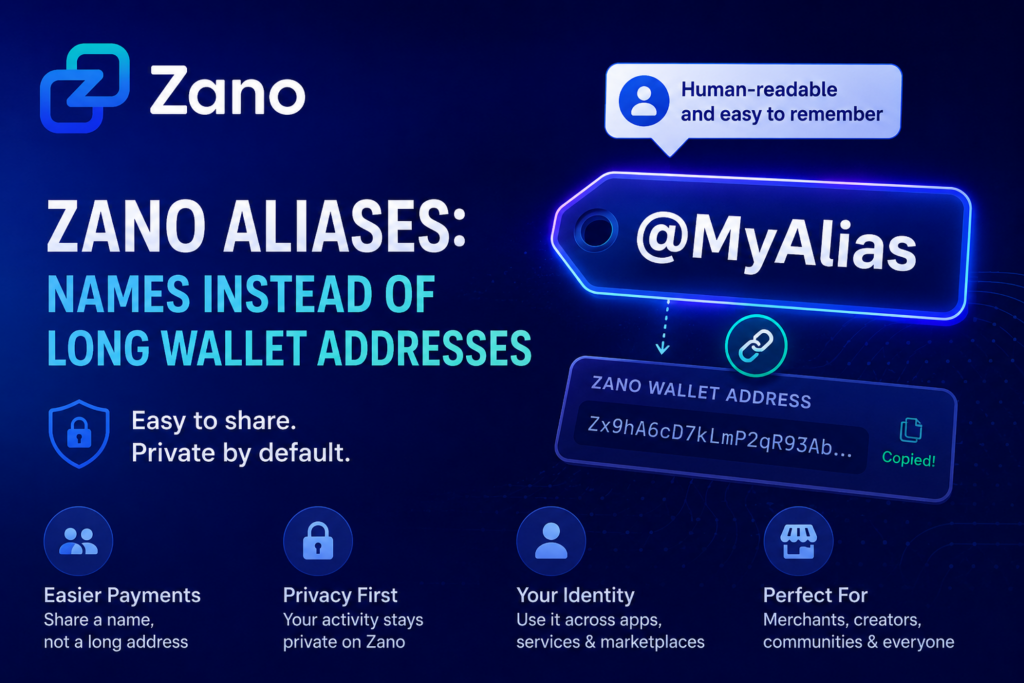
What Are Zano Aliases? A Simple Way to Replace Long Wallet Addresses

Cryptocurrency wallet addresses are often long, complicated, and difficult to remember. Zano Aliases solve this by replacing them with simple, human-readable names while keeping your privacy intact.

In Episode 6 of the Zano Explainer Series, the Zano team explains how Zano Aliases work and why they make private payments easier. Watch the video below! πŸ‘‡

Table of Contents

  1. What Is a Zano Alias?
  2. Why Wallet Addresses Can Be Confusing
  3. How Zano Aliases Work
  4. Do Aliases Affect Privacy?
  5. How to Register a Zano Alias
  6. Who Can Use Zano Aliases?
  7. More Than Just Payments
  8. Why Zano Aliases Matter

1. What Is a Zano Alias?

A Zano Alias is a unique, human-readable name that replaces your long Zano wallet address.

Instead of sharing a complex wallet address filled with random letters and numbers, you can simply share a name like:

@MyAlias

Think of it as your username on the blockchain. It’s easier to remember, simpler to share, and far more convenient when sending or receiving payments.

2. Why Wallet Addresses Can Be Confusing

Traditional cryptocurrency wallet addresses are designed for security, but they aren’t very user-friendly.

A typical wallet address can contain dozens of random characters, making it difficult to type or verify. Even a small mistake can cause unnecessary stress when sending funds.

Zano Aliases remove that complexity by replacing long addresses with simple names that are much easier for people to use.

3. How Zano Aliases Work

When you register an alias, it becomes a public link to your Zano wallet address.

Instead of asking someone to send funds to a long wallet address, they only need your alias.

Behind the scenes, the payment is still delivered securely to your wallet using Zano’s privacy technology. The only difference is that the experience becomes much more user-friendly.

4. Do Aliases Affect Privacy?

No.

Although your alias is publicly linked to your Zano wallet address, your wallet activity remains private.

This means you still benefit from Zano’s advanced privacy features while enjoying a much easier way to receive payments.

In simple terms:

  • Your alias is public.
  • Your wallet address is linked to that alias.
  • Your transactions and wallet activity remain private.

You get improved usability without giving up privacy.

5. How to Register a Zano Alias

Creating a Zano Alias is straightforward.

Simply:

  1. Open your Zano Wallet.
  2. Select Register Alias.
  3. Choose a unique name.
  4. Complete the registration.

Once registered, the alias becomes yours, much like owning a website domain or a social media username.

New to Zano? Check out our step-by-step guide on how to create your first Zano wallet before registering your alias:

πŸ‘‰ How to Create Your First Zano Wallet

6. Who Can Use Zano Aliases?

Aliases are useful for anyone who wants an easier way to receive private payments.

Some examples include:

  • Merchants accepting cryptocurrency from customers.
  • Content creators receiving private tips.
  • Communities and DAOs simplifying internal payments.
  • Everyday users who prefer sharing a memorable name instead of a long wallet address.

7. More Than Just Payments

Zano Aliases have uses beyond sending and receiving cryptocurrency.

They can also act as a decentralized digital identity across applications built on the Zano platform.

For example, aliases can:

  • Serve as a universal identifier for Zano-based services.
  • Connect to reputation systems.
  • Identify users on marketplaces like ZanoTrade.
  • Help create an anonymous digital identity while preserving privacy.

As the Zano ecosystem continues to grow, aliases could become an important building block for many future applications.

8. Why Zano Aliases Matter

Cryptocurrency doesn’t have to be complicated.

By replacing long wallet addresses with easy-to-remember names, Zano Aliases make private digital payments more accessible without sacrificing privacy.

Whether you’re accepting payments, supporting creators, running a business, or simply sending funds to friends, aliases help remove one of the biggest usability challenges in crypto.

It’s a simple feature that makes using private digital money feel much more natural for everyone.

Sources

Disclaimer:Β ZanoNews.comΒ is an independent news and information website. This article is for informational purposes only and should not be considered financial, investment, or legal advice.

What Is Zano? A Beginner’s Guide

If you’re new to cryptocurrency, you’ve probably heard about Bitcoin and Ethereum. But what is Zano, and why are more people paying attention to it?

Zano is a privacy-focused blockchain designed to make digital payments secure, confidential, and easy to use. It combines modern privacy technology with features for businesses, developers, and everyday users.

Whether you’re completely new to crypto or simply curious about Zano, this guide explains everything in simple language.

Table of Contents

  1. What Is Zano?
  2. Why Was Zano Created?
  3. Key Features of Zano
  4. What Can You Do With Zano?
  5. Is Zano Good for Beginners?
  6. Where Should You Start?
  7. Frequently Asked Questions
  8. Final Thoughts

1. What Is Zano?

Zano is a Layer 1 blockchain launched in 2019 that focuses on privacy, security, and usability.

Unlike many cryptocurrencies where transactions can be viewed publicly, Zano keeps transaction details private by default. This means the sender, receiver, and transaction amount remain confidential while still being securely verified on the blockchain.

Its goal is to provide digital money that protects financial privacy without sacrificing security.

2. Why Was Zano Created?

Many blockchains allow anyone to view wallet balances and transaction history.

While transparency has advantages, it also means anyone can potentially track your financial activity.

Zano was built to give users greater financial privacy while remaining decentralized and secure.

3. Key Features of Zano

3.1 Privacy by Default

Every Zano transaction is private, helping protect your financial information from public view.

3.2 Low Transaction Fees

Sending Zano costs only a small network fee, making it suitable for everyday payments.

3.3 Fast Transactions

Transactions are confirmed quickly, allowing users to send and receive funds without long waiting times.

3.4 Hybrid Consensus

Zano uses a hybrid Proof-of-Work and Proof-of-Stake (PoW + PoS) consensus model to help secure the network while allowing eligible holders to earn staking rewards.

3.5 Confidential Assets

One of Zano’s standout features is Confidential Assets, which allow developers and businesses to create private digital assets while keeping transaction information confidential.

3.6 Cross-Chain Transfers

Recent network upgrades allow native ZANO to move between supported blockchain ecosystems while maintaining Zano’s privacy-focused infrastructure.

4. What Can You Do With Zano?

Zano can be used in many different ways:

  • Send private payments
  • Receive payments securely
  • Stake ZANO to earn rewards
  • Create Confidential Assets
  • Buy and sell on ZanoBay
  • Explore decentralized applications built on Zano

5. Is Zano Good for Beginners?

Yes.

Zano is designed to be beginner-friendly while offering advanced privacy features for experienced users.

If you’re just starting, learning how to install the wallet and securely back up your recovery seed is the best place to begin.

6. Where Should You Start?

If you’re new to Zano, these guides are recommended:

  1. Install the Zano Wallet
  2. Create Your First Wallet
  3. Back Up Your Recovery Seed
  4. Learn How Staking Works
  5. Understand Zano Privacy
  6. Explore Confidential Assets

7. Frequently Asked Questions

7.1 Is Zano anonymous?

Zano is privacy-focused, meaning transaction details are confidential by default while the blockchain remains secure and verifiable.

7.2 Can I stake Zano?

Yes. Eligible holders can stake ZANO to help secure the network and earn rewards.

7.3 Is Zano open source?

Yes. Zano is an open-source blockchain project, allowing anyone to inspect the code and contribute to development.

8. Final Thoughts

Zano is more than just another cryptocurrency. It is a privacy-first blockchain designed for secure payments, confidential digital assets, and long-term usability.

Whether you’re looking to make private transactions, earn staking rewards, or simply learn about privacy-focused blockchain technology, Zano provides a solid starting point.

If you’re completely new to Zano, continue with the Getting Started guides below to learn how to install your wallet, create your first address, and begin exploring the ecosystem.

Learn more:

Disclaimer: ZanoNews.com is an independent news and information website. This article is for informational purposes only and should not be considered financial, investment, or legal advice.

PegasusSwap Highlights Zano in New 2026 Review

Table of Contents

  1. PegasusSwap Publishes a Zano Review
  2. Why This Matters
  3. What the Review Covers
  4. About PegasusSwap
  5. Why More Platforms Are Covering Zano
  6. Sources

1. PegasusSwap Publishes a Zano Review

PegasusSwap, a cryptocurrency swap platform that allows users to exchange digital assets and publishes educational blockchain content, has released a new article introducing Zano to readers interested in privacy-focused cryptocurrencies.

The review describes Zano as a privacy-first blockchain created by one of the original developers behind the CryptoNote protocol. It is written for both newcomers and experienced crypto users, explaining the project in simple language while highlighting its long-term vision and technology.

The announcement was also shared on X, where PegasusSwap encouraged anyone exploring the next generation of privacy-focused cryptocurrencies to check out the guide.

2. Why This Matters

As more crypto projects compete for attention, independent articles help introduce new users to different blockchain ecosystems.

When established platforms publish educational content about Zano, it can:

  • Increase awareness of the project.
  • Help newcomers understand what makes Zano different.
  • Encourage readers to research privacy-focused technology.
  • Bring more attention to the growing Zano ecosystem.

Educational content is often one of the first places people learn about a cryptocurrency before deciding whether to explore it further.

3. What the Review Covers

According to PegasusSwap, the article explains several important aspects of Zano, including:

  • Zano’s privacy-focused design.
  • The history behind the CryptoNote developer who helped create the project.
  • Key blockchain features.
  • The technology behind the network.
  • The project’s future potential.

The review is designed as an introduction rather than a highly technical document, making it accessible for readers who are new to privacy coins.

4. About PegasusSwap

PegasusSwap is a cryptocurrency swap platform that allows users to exchange supported digital assets through its website.

Its platform focuses on providing a straightforward swapping experience while also publishing educational articles covering blockchain projects, cryptocurrencies, and industry topics. The addition of a dedicated Zano review shows the platform’s interest in highlighting privacy-focused technologies.

5. Why More Platforms Are Covering Zano

Over the past year, Zano has continued expanding its ecosystem with new integrations, wallet improvements, infrastructure upgrades, and preparations for Hard Fork 6. These developments have attracted increasing attention from exchanges, swap services, developers, and crypto media.

As more companies publish educational content about Zano, it becomes easier for people who have never heard of the project to discover its technology and learn how it differs from other privacy-focused cryptocurrencies.

While educational articles do not guarantee adoption, they can help increase visibility and encourage more people to explore the ecosystem.

6. Sources

Disclaimer:Β ZanoNews.comΒ is an independent news and information website. This article is for informational purposes only and should not be considered financial, investment, or legal advice.

What Is BTCx? A Beginner’s Guide to Private Bitcoin on Zano

Bitcoin is the largest cryptocurrency in the world, but it comes with one challenge that many people don’t think about: every transaction is recorded on a public blockchain.

That’s where BTCx comes in.

BTCx allows users to maintain exposure to Bitcoin while using the privacy-focused Zano network. But what exactly does that mean, and why are more people starting to talk about it?

Table of Contents

  1. What Is BTCx?
  2. Why Was BTCx Created?
  3. How Does BTCx Work?
  4. Why Not Just Use Bitcoin?
  5. What Makes BTCx Different?
  6. Frequently Asked Questions
  7. Final Thoughts

What Is BTCx?

BTCx is Bitcoin that has been bridged to the Zano network.

Think of it as a version of Bitcoin that can be used within the Zano ecosystem while benefiting from Zano’s built-in privacy features.

The goal isn’t to replace Bitcoin.

The goal is to give Bitcoin holders another way to use their BTC while keeping their financial activity more private.

Why Was BTCx Created?

Bitcoin is transparent by design. Anyone can view transactions on the blockchain, which helps with security and verification. However, not everyone wants their wallet activity to be easily traceable.

BTCx was created for users who want to keep exposure to Bitcoin while benefiting from the privacy tools available on the Zano network.

How Does BTCx Work?

The process is fairly simple.

A user sends Bitcoin through a bridge connected to the Zano ecosystem. The Bitcoin is then represented on Zano as BTCx.

Once on the network, BTCx can be sent, received, and stored just like other assets within the Zano ecosystem.

If needed, users can later convert BTCx back into Bitcoin.

Why Not Just Use Bitcoin?

For many people, regular Bitcoin is perfectly fine. But some users prefer greater financial privacy.

Every Bitcoin transaction leaves a public record that can be viewed and analyzed.

BTCx offers an alternative for users who want to keep their Bitcoin exposure without having every transaction permanently visible on a public blockchain.

What Makes BTCx Different?

There are already several versions of Bitcoin available on different blockchains. What makes BTCx stand out is its focus on privacy.

Instead of concentrating on lending, yield farming, or DeFi applications, BTCx focuses on helping users move and store Bitcoin value within a privacy-focused ecosystem.

For privacy-conscious users, that’s a significant difference.

Frequently Asked Questions

Does BTCx have the same value as Bitcoin?

BTCx is designed to represent Bitcoin on the Zano network, allowing users to maintain exposure to Bitcoin’s market value.

Can BTCx be converted back to Bitcoin?

Yes. Users can bridge BTCx back into Bitcoin through the supported bridge infrastructure.

Is BTCx a separate cryptocurrency?

BTCx is not intended to replace Bitcoin. It is a bridged version of Bitcoin that operates within the Zano ecosystem.

Who might use BTCx?

Anyone interested in combining Bitcoin exposure with greater transaction privacy may find BTCx useful.

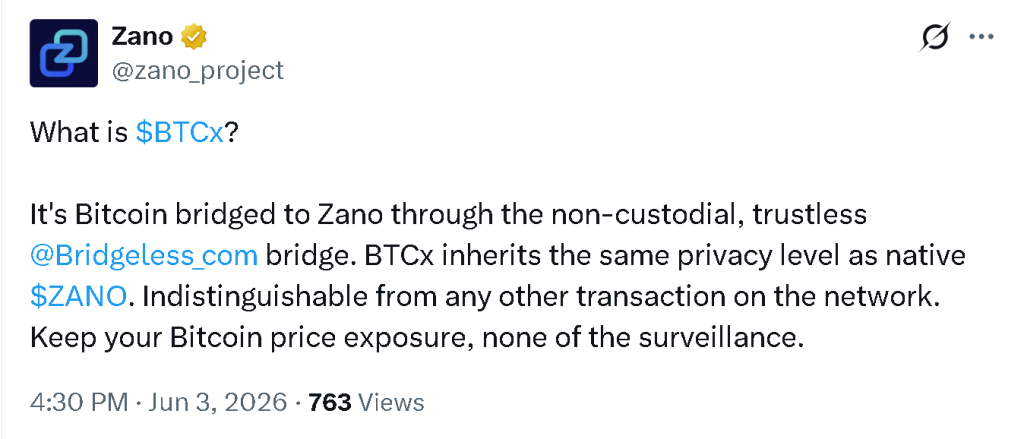
Zano’s Explanation of BTCx

Recently, the Zano team described BTCx as:

“Bitcoin bridged to Zano through a non-custodial, trustless bridge. BTCx inherits the same privacy level as native ZANO.”

This highlights the project’s goal of combining Bitcoin exposure with the privacy features available on the Zano network.

Final Thoughts

Privacy has become one of the most discussed topics in crypto.

While Bitcoin remains the dominant digital asset, some users are looking for ways to protect their transaction activity without giving up exposure to BTC.

BTCx is one approach to solving that problem.

Whether you’re a long-time Bitcoin holder or simply curious about privacy-focused technologies, BTCx is a project worth keeping an eye on as the Zano ecosystem continues to grow.

Source: Official Zano X post published on June 3, 2026.

Disclaimer:Β ZanoNews.comΒ is an independent news and information website. This article is for informational purposes only and does not constitute financial or investment advice.